ChatGPT Personal Finance: When AI Takes Over Your Wallet
OpenAI recently introduced the ChatGPT Personal Finance feature, allowing users to connect their bank accounts, cards, and portfolios directly into the chat. This move could pose a serious challenge not only to traditional financial institutions but also to neobanks. If clients become accustomed to using an AI assistant for their everyday finances, banks may lose their most valuable asset in the long run: direct customer relations.
On May 15, OpenAI entered a territory that traditional banks and neobanks have considered their own hunting ground for the past decade: personal finance. The new feature – ChatGPT Personal Finance – currently available only in the USA, allows ChatGPT Pro users to connect their bank accounts, credit cards, and investment portfolios directly to the chatbot. What seems at first glance to be merely a convenience update could actually put everyday banking on completely new foundations.
The Dashboard that Thinks Before We Do
The onboarding experience is intentionally smooth. We click on the "Finances" tab appearing in the ChatGPT sidebar, or simply type: @Finances, connect my accounts. This tiny detail reveals a lot about OpenAI's design philosophy. The feature was not banished to a separate app, but made an integral part of the familiar chat. There is no separate download, no new account, no long onboarding.
The connection takes place through a financial infrastructure layer called Plaid, which provides access to more than 12,000 banks and brokerages – including Chase, Fidelity, Schwab, Robinhood, and Capital One. After a few minutes of synchronization, a clear visual dashboard is presented: spending categories, active subscriptions, portfolio performance, upcoming payments – all on a single screen.

But the real innovation is not in the visualization; Mint, YNAB, or Monarch Money have been offering such dashboards for years. The big breakthrough does not lie here, but in the next step.
From Static Charts to a Financial Advisor
Traditional personal finance applications are static. They show how much was spent on coffee, for instance, and display this on a chart. In contrast, ChatGPT also tackles complex, forward-looking questions.
"Am I spending more lately than usual?" "If I cancel unused subscriptions and order less food, when will I have saved the money for a new MacBook?" These are questions that neither the aforementioned applications nor our bank's mobile app can answer at present. But ChatGPT – based on the GPT-5.5 Thinking model – can; it not only sees the data but also models it in context.
The "financial memories" introduced with the feature further deepen this capability. Contextual information not included on the bank statement can also be stored in the system: an informal family loan, a specific savings goal, or the unique terms of a mortgage. The model combines these memories with real data provided by Plaid, taking them into account in every single dialogue.

The technology is, of course, far from infallible, which is quite a critical problem in finance. In OpenAI's own expert-run tests, the most advanced GPT-5.5 Pro model achieved 82.5% accuracy, while the default Thinking model achieved 79%. In practice, this means that the AI makes a mistake in roughly one out of every five cases. Due to hallucinations, leaving a credit assessment or tax optimization to it would currently pose a huge risk, so it is still too early to talk about replacing certified professionals.
Pure Data from Chaos: How Plaid's Backend System Works
The technological backbone of the product is less spectacular, but all the more important. Raw bank transaction data is notoriously chaotic: a coffee shop purchase often appears as a jumbled string of letters and numbers on the bank statement. If OpenAI were to feed this raw data directly into a large language model, the AI would easily miscategorize expenses or draw incorrect conclusions about financial patterns.
Plaid's own Transaction Foundation Model resolves this issue. This specialized preprocessing layer is trained on a massive volume of anonymous transaction data flowing through Plaid's network. The model identifies the merchant's identity and the payment context. Based on the company's measurements, this backend system categorizes incoming items 48% more accurately than previous solutions. Thus, GPT-5.5 receives a clean, enriched financial picture, which drastically reduces the probability of AI hallucinations.
The Acquisition of Hiro – Talent Hunting or Silencing the Competition?
OpenAI did not merely rent infrastructure; it also signed specialists. On April 14, it acquired Hiro Finance, an AI-based personal finance startup that had helped manage over a billion dollars in client assets since its launch. Six days later, OpenAI shut down Hiro's consumer app and told users to save their data.
Industry analysts at RIABiz described the move as a "catch-and-kill" strategy: OpenAI wanted the team, while simultaneously removing the acquired competitor from the market. Hiro's engineers excelled in account reconciliation, expense categorization, cash flow forecasting, and anomaly detection – exactly the backend processes that make ChatGPT's financial dashboard truly reliable.
Who Should Be Afraid of It – and Is It Justified?
Market reactions came from three distinct groups.
For traditional banks and neobanks, the main threat is not that OpenAI will steal their clients overnight. The real danger is the loss of the intermediary role: if users manage their finances through ChatGPT, the function of banks could narrow down to a mere technical channel. They lose the direct interface where mortgages, personal loans, and premium cards are sold. Revolut, Monzo, and Chime could find themselves in a particularly difficult situation, as their market value is largely determined by daily in-app activity.
The threat is amplified by the Super App direction toward which ChatGPT is heading. With the planned integrations of Intuit (TurboTax, Credit Karma) and PayPal, the AI will not only analyze finances but could also become an active transactional channel. Users may soon apply for credit cards or handle tax matters directly from the chat window, rendering the opening of banking applications completely obsolete.
However, major digital players are not sitting idly by. Neobanks are actively developing their own solutions to retain user engagement. A prime example is Revolut's recently introduced AI assistant, AIR, which aims to become the application's primary interface, replacing traditional menu systems with conversational control. By moving towards Agentic AI – or "Self-Driving Money" – these institutions hope to keep daily financial interactions within their own ecosystem, rather than surrendering them to a third-party chat interface.

Dedicated personal finance applications currently have a deeper line of defense. In the case of YNAB, this is provided by zero-based budgeting. Here, a place must be found in advance for every income. This kind of conscious planning requires serious effort from the individual and brings about a behavioral change that a passive AI assistant, merely answering questions, cannot replace.
For asset managers and financial advisors, legal and financial liability marks the watershed. Experts agree that ChatGPT is an excellent tool for putting basic monthly expenses in order, but it is simply inadequate for more serious wealth planning or complex investment decisions. The most critical point is the lack of accountability. If the AI makes a mistake and money is lost as a result, there is currently no one to shift the blame to – unlike with a human advisor, whose professional errors carry serious legal consequences.
Privacy and Targeted Ads: The Ethical Minefield
OpenAI seemingly provides strict technical guarantees: the system can only read data, deletes everything 30 days after the connection is terminated, and we can clear the memory at any time. The real problem, however, is rooted deeper. Since OpenAI introduced ads based on conversation content, connecting our entire financial life to the platform poses a serious risk. If an AI model displays advertisements based on chats, then a sudden financial downturn or a looming debt spiral instantly becomes a valuable advertising target for the algorithm.
Zoe Hitzig, a former researcher at OpenAI, warned of such ethical risks upon her departure. She described chatbot logs as "an unprecedented archive of human honesty" and cautioned that turning users' deepest vulnerabilities into mere commercial commodities carries immense danger. With ChatGPT's expansion into personal finance and the arrival of contextual ads, this warning now hits closer to home than ever.
Entering the European Market: Regulation is the Real Obstacle
The new feature is currently available only in the USA. When it arrives in Europe depends more on lawyers than on developers.
EU regulation – with the combined force of DORA, PSD3, and the AI Act – presents an incredible administrative and legal challenge. This is compounded by Article 22 of the GDPR, which flatly prohibits purely automated decision-making in cases that have a significant impact on individuals. If ChatGPT were to start offering loans, it would immediately cross this line.
Thus, the UK is expected to be the testing ground for the continent. OpenAI's advertising pilot has already launched among the British, where, alongside an advanced financial background, the legal environment also resembles the EU model. The experiences here will be decisive in determining when and how the feature can conquer the European market.
The IPO Narrative and the Trillion-Dollar Valuation
The introduction of the feature is closely related to OpenAI's long-term strategic goals. The company is preparing for a historically scaled initial public offering (IPO) valued at approximately $1 trillion. This astronomical sum is not self-serving: this capital is needed to finance the Project Stargate supercomputer program, estimated at $500 billion over a span of several years. This would provide the brutal physical and hardware infrastructure essential for operating future, even more intelligent models.
However, for capital markets and major investors to actually believe that the company is truly worth this much, OpenAI must level up. It must prove that ChatGPT is no longer just a text-generating, useful chat interface, but the new operating system for global financial and consumer transactions. It needs to show that it can become a fundamental platform through which our daily affairs and financial movements will be managed in the future.
Integrating personal finance fits perfectly into this strategy, as the financial sector is one of the tech world's most valuable markets. This is the area where the business value of users is highest in the long run (what the industry calls customer lifetime value). If users get used to managing their wealth, credit cards, and expenses on a single interface, they will find it extremely difficult to switch afterward, remaining chained to the system for years. Furthermore, the revenue generation, or monetization opportunities, are the most significant here. Much more substantial profit can be generated from premium packages, contextual ads, and indirect financial services than from a traditional software subscription, for instance.
Paradigm Shift or Just Smart Positioning?
In the short term, this move is undoubtedly about positioning. Its goal is to convince investors before the IPO, justify the $200 per month Pro subscription, and instantly demonstrate power in the most valuable consumer market. The integration of Plaid and the lightning-fast acquisition of Hiro also indicate that OpenAI did not want to wait years with in-house development, but opted for immediate, aggressive market entry.
In the long term, however, the new model could indeed bring about a paradigm shift. Tracking personal finances was dominated for a long time by static, retrospective charts. Generative AI, however, reverses this logic. The machine now draws the conclusions; we only need to ask. This transition from passive data analysis to active dialogue seems irreversible for now. Although the outcome is still open, traditional and digital banks could easily face a situation where AI drains daily interactions away from them – and they gradually fade into the background.
Illustrations: OpenAI
About the authors
Balázs has been working in content for more than 20 years, having the role as an editor at one of the first and largest news sites, later helping to establish the content marketing business for media publishers and agencies. Today, Balázs serves as content producer at Ergomania Ltd.
Related case studies
Prefixbox
Prefixbox is a Hungarian e-commerce scaleup. We helped them design an AI agent that gives more accurate product recommendations to shoppers with generative AI.

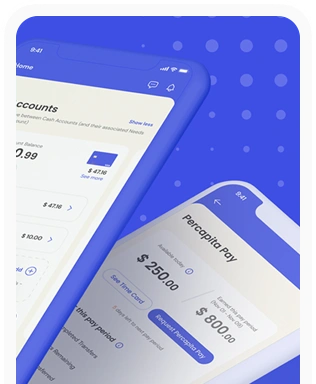
Percapita
We designed a full-fledged application for simplifying everyday finances.
Atmen Fintech
Mobile App
Designing a Minimum Viable Product for a Diaspora Neobank Startup

Sterling Archer
By applying the DDD framework, we created multiple digital tools for a US based Data Company.

Ergomania and NGOs in the Netherlands
UX design for Fintechs, banks and financial startups is the everyday work of Digital Product Design company, Ergomania based out of Budapest, Hungary.

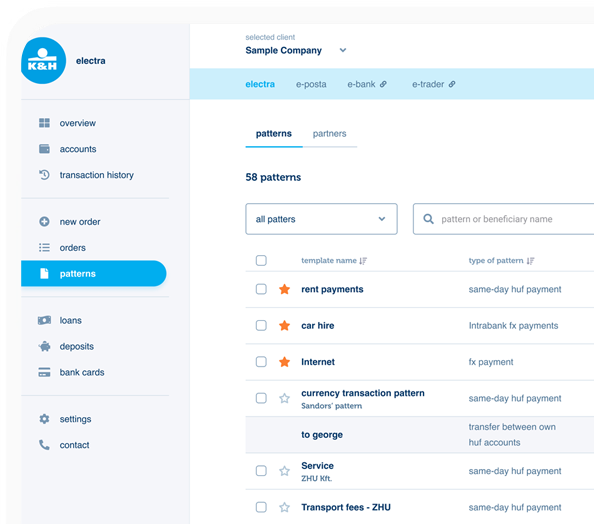
K&H Bank's Corporate Netbank
The K&H Electra Netbank App consolidates all financial needs into a single, user-friendly application. With its intuitive design, businesses can effortlessly manage their company's cash flow, transactions, and investments from one centralized hub.
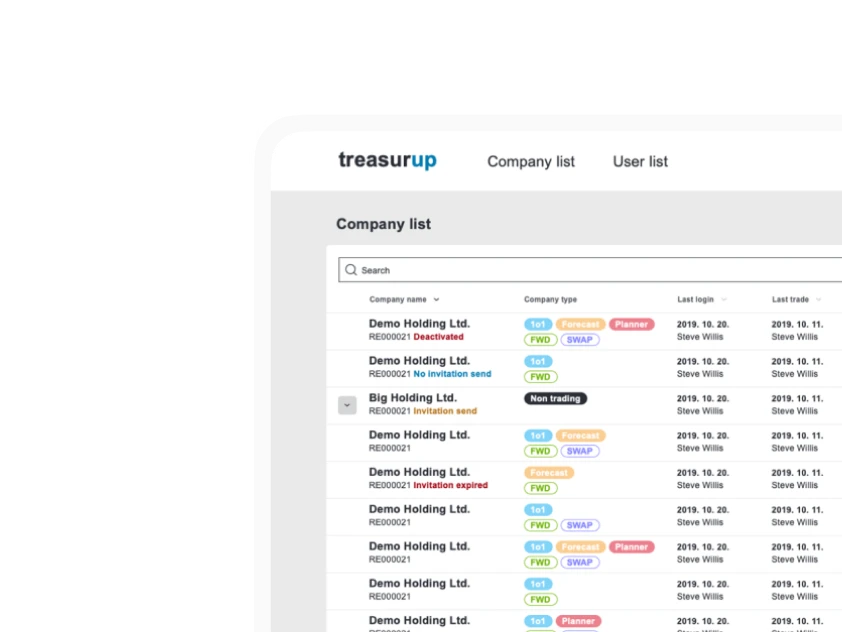
TreasurUp
We established written and visual consistencies and guidelines for TreasurUp’s financial platform.
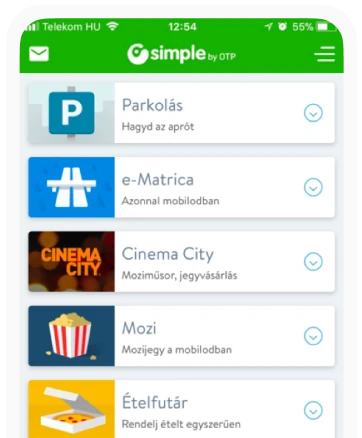
Simple by OTP
Simple by OTP Bank is Hungary's No.1 mobile payment app for cashless payments with 1M+ downloads, and 1 million+ transactions.

White Label Banking App
We provide full-blown next-generation mobile banking solutions for sales-oriented banks.
Want to read more
about UX, fintech and banking?
Subscribe to our biweekly newsletter and get the latest of our news and thoughts!