Looking to the future, and elevating digital customer engagement - the Czech way
Apart from a very brief face to face meeting at a Budapest Fintech conference, my previous contact with Ivan Dovica was virtually, in 2021. Back then his company Dateio was gaining a foothold in the Czech market and reaching a mere sliver of the ten million domestic population. The first client outside of Czechia had just been signed up - Bunq in the Netherlands - and a new product offering, called Tapix, was being rolled out.
Now… Well, things have developed. Ivan reports around 120 million end users worldwide, with some 50-plus international banks and financial organizations onboard. What was a fledgling product, Tapix, is now recognisable as ‘Tapix by Dateio’, and while the Dateio Platform remains at the company core, Ivan is now concentrating his own energies on Tapix.
Enriched transaction data
OK, so a quick review of what Dateio and Tapix actually do, and why these products have ‘exploded’ in recent years. Ivan mentions 8 UK clients, and takeoff in South America and across Europe. Dubai, the United Arab Emirates and Jordan are also in the mix, with the most ‘exotic’ territory yet being Tajikistan. Tapix is, ‘The industry-leading API that enables banks and Fintechs to build solutions driven by enriched transaction data.’ Or in 4 simple steps:
1 New Transaction - Your client makes a payment or transaction
2 Store data - Raw data are stored within your infrastructure
3 Call Tapix API - Data are turned into meaningful information
4 Leverage smart data - Use data for your analytics, UX, ESG or business cases.
Or, putting it even more simply, ‘We are here to bridge the gap between payments and people's lives’.

This sounds very much like the original Dateio offering, extended with some more ‘bells and whistles’. “Dateio used to be an innovative thing.” Ivan explains. “Now it's becoming more of a must-have. And we added new things, like new kinds of extensions towards UX. For example we can now much more accurately identify subscriptions.” He explains how retail business models such as Spotify and Netflix-like services have changed radically, from consumers making one-off payments to now having subscription commitments.
In the past Dateio could show what an end-user’s spend was on subscriptions, but not break this down at a more granular level. Now Tapix enables a bank to tell its customer exactly what they are subscribing to, and of course how much. Ivan describes it as a small but important add-on and points out that many people can lose track of what they are subscribing to, or even if the subscription is worth continuing.
 Ivan Dovica
Learning through data
“Banks say they want to be digitally and data-driven companies,” Ivan expands on the subject. “So understanding their clients’ behavior is part of that: Who you are, how you behave. The better they can communicate with you, the more offers can be tailored to your needs.” And that’s where the huge potential lies, and why Tapix by Dateio is being adopted so enthusiastically by banks. Learning about clients through data is the future for them to become more accurate, efficient… and profitable.
So with more than fifty customers worldwide for Tapix, this presumably means that the offering is customised for every market? Ivan says this is not the case and as long as the banks are digital (and what bank isn’t?) then that’s where his company is. He does agree that some countries adopt different payment methods and mentions the increasing use of QR codes, especially in Asia. He laughs at his assertion that in some places people are so used to QR that they can read the codes by eye. He observes that where you might expect a big logo and small QR code on a product, it’s often the other way round. He also notes that cards are the dominant form of payment in Europe and that cash is naturally disappearing. But whatever the method of payment, the Tapix offering is the same because it’s not about the method but all about payment data. “We are not a company that enriches and cleans just card payments,” Ivan says. “But any type of payment. That’s the central information about the customer which can be applied to two types of use cases: The user experience, and strategically."
Looking from the customer perspective
Strategy is certainly the area of interest for Tomáš Blažek of Raiffeisenbank Česká republika. “I'm a strategy consultant with a connection between strategy and R&D, and between R&D and business.” He is setting out his wares during 2025 when a whole new five year strategy cycle is planned, to be enacted in the following half decade. Tomáš describes the importance of seeing outside innovation and matching that with internal business capacities, so it seems a good time to speak with the man responsible for creating the bank’s 2030 Banking Trends Report. He points out that there are many trend reports available through consultancies, but they can sometimes be a little out of touch with reality. In contrast the Raiffeisen approach is to look at future developments from the customer’s perspective, and while Tomáš and his team of four colleagues are focussed on the Czech Republic, their antennae are also very much tuned to global issues. They have been especially interested in emerging Asian trends.
 Tomáš Blažek
Platformization
One big trend is towards Open Banking. But, we already have that, right? Tomáš agrees that it’s been around for nearly ten years but, “What is a bit different around Open Banking is that banks are going towards platformization, like Revolut, NuBank, and DBS Bank in Singapore, where you look at the various customer journeys that your clients have, and try to fit your product portfolios to these journeys. You provide products and services beyond core banking. So for example, for a client who would like a mortgage, you just don't sell the mortgage, you sell other services that might come with the mortgage - probably you’ll need a moving company to get you into your house, and perhaps renovators or other tradespeople.” Embedded Finance is another identified trend with banks being present at the exact point of need for a client. You’re in an e-shop and looking at something quite pricey - how about a Raiffeisen button to get an instant loan embedded in the e-shop?
Personalization and granularity
There are also increasing trends towards new client-centric approaches, for example for kids, women, or the elderly. This granular approach to personalization is going to be a big thing in the coming five years, Tomáš and team predict.
In fact hyper-personalization will see entirely new segments emerging, and the more precise targeting of those segments. This tailored approach will be enabled by using data that has actually been around for years, but which only now can be seriously leveraged. Many bank customers are still being targeted with the wrong propositions, and Tomáš illustrates this with the story of a friend who had just opened a bank account with the specific goal of gaining a mortgage. Mission accomplished, but then within days the bank was sending him prompts to ask if he’d like to apply for a mortgage!
There’s still a way to go with personalization, and AI is a crucial part of this where the use case is most prominent. Having said that, Tomáš points out that AI – in particular, machine learning algorithms – isn't such a new thing in banking and has been in use for risk assessment for years now.
Innovative payments
As to the future of money, he says, “The Czech Republic is a really innovative country in terms of payments. Around 40% of all payments are instant payments. How we deposit money, and transfer money, will increasingly be with instant payment systems where people see the money in their account within seconds.” Czechia is currently ahead on this, set against Western Europe where the instant payment ratio is not so high. The Raiffeisenbank strategy team also has the remit to look at digital assets, cryptocurrencies, stablecoins, and central bank digital currencies. “When you work in strategy you have to have an overview around different segments: around retail, around corporate, around investments. In a way it's a pity I can't go into the detail, but I really need to take the broad overview.”
What’s good, and what works
When the 2030 Banking Trends Report lands on the desks of Board Members and top managers, what are some of the trends that might be notable? Tomáš stresses that the team can only offer recommendations and because Management is responsible for making ideas concrete, sometimes what seem like promising ideas end up in the trash can. That’s just the way it goes. So are there examples of anything especially interesting that’s good, and works? He smiles and differentiates between what’s good and what works, pointing out that these are separate things.
What’s good in the area of payments is the innovation coming out of Asia, where regulation tends to be more relaxed than in Europe. Biometric payment by palm or eye scanning is an attractive way of authentication, but is unlikely to make its way west anytime soon. Tomáš also mentions DBS Singapore again and the bank’s Agile transformation to better target customer’s real needs, rather than basing offers around existing products.
Then there are digital assets which the Report says will have an impact in the next five years. “The new MiCA regulation will move the crypto segment from a bit of a ‘shady’ business into a well-regulated business, similar to banking, Fintech, and financial services.” Clients will invest in crypto and stablecoins, and companies will increasingly use stablecoins for payments, instead of standard payments which can take days.
A deep dive into Czech Fintech
Like many Fintechers, Aleš Krempa is keen on physical activity and in his case that means a passion for scuba diving. He’s a qualified instructor and is clearly a brave man in that he certified his wife as a diver. Pre-covid he ran his own Amers Diving Academy in Prague, and still enjoys nothing better than holidaying underwater. What’s notable about Aleš however is that in his almost twenty-five years of scuba adventures, he has brought others along who might never have imagined swimming with the fishes. He’s a founding member of Deep Silent, which provides adaptive scuba diving for people with disabilities and special needs. This philanthropic instinct seems to be a thread which runs through many of his activities, including his current position as a board member of the Czech Fintech Association.

Going pro bono
His route there was through a two-year stint as Partner and COO of Coinmate, the Czech Republic’s first crypto exchange and present in the market for over a decade. Coinmate joined the Fintech Association, but Aleš notes, “We were kind of passive.” Networking and the community were the payback but he felt that this wasn’t enough for him personally. In December ‘24 he left Coinmate and admits to having ‘a cliché moment’ of thinking, “And now what? Instead of just taking from society and community, I'm old enough to give something back.” And so Aleš Krempa began a pro-bono year with a deep dive into all things regulatory on the Fintech scene in Czechia.
 Aleš Krempa
Stability is key
This immediately meant meetings with the Ministry of Finance, the Czech National Bank, and Members of Parliament. With an upcoming national election in October ‘25 it was important to get to the bottom of the assumptions and promises made by politicians to help shape policies towards Fintech. The Association was not so much pressuring for particular policies, but rather advocating for clarity and stability, whichever party was voted into power. What would be new initiatives, and what would potentially be stopped, were the questions being asked. Friends wanted to know why Aleš was devoting so much of his time to the political scene, but his explanation was simple: Stability is key to growth and success, and even if some laws might change, the overall framework for Fintech regulation had to remain essentially the same.
Looking back over a five year period, Aleš mentions that attitudes have definitely changed, especially in the relationship between crypto businesses and the Czech National Bank. Its main focus was on banking, insurance, investment, payments and pension companies, with crypto entities being regarded very much as the outliers. It was difficult for them, and even their Association, to have much meaningful dialog with the regulator. That has altered over time. “The situation has changed a lot and now they also talk to us. It's not as if the bank always does what we ask them to do, but that's life. But at least there is a discussion with the Czech National Bank and the Ministry of Finance, and I'm really grateful for that - I think it’s crucial.”
A broad spread of membership
The makeup of the Fintech Association - which has a company membership and not an individual membership scheme - is broad. There are around 90 Fintech members, ranging from one or two person disrupter startups, through some law firms, to large payment institutions. Some of the more progressive banks are also members.
So is the Fintech Association a pressure group, a networking organization, or a club? It’s all of that and more Aleš says. From having fun to ‘noble’ priorities, the Association spans a lot of points.
One is Growth and Expansion, and there is a lot of interest among members in looking towards Southeast Asia and Asia in general. It seems slightly surprising that expansion into neighboring countries, especially Poland, isn't more attractive. It’s four times bigger than the Czech Republic, but Aleš notes that there’s a tendency for Polish potential partners to be ‘rather dogmatic’ and to want to see key roles filled by Poles. The Slovakian market is also a little problematic, with a lot of history slowing down progress. Then there’s the DACH region of Germany, Austria and Switzerland which could provide fertile Fintech ground, but language barriers can limit growth there.
In contrast Southeast Asia looks good and some Czech Association members have already made inroads and participated in events in Hong Kong, Singapore, and Malaysia. Association members have also accompanied Czech Ministry of Trade & Industry officials, along with delegations from CzechInvest, the business and investment development agency. So in terms of growth and expansion, eyes are set on the Southeast Asian horizon.
 A Czech Fintech Association event
User experience and strategic solutions
For Ivan Dovica user experience is at the core of what Dateio and Tapix by Dateio does. What began purely with card transactions has extended to bank transfers, QR payments, and open banking, all unlocking enriched transaction data. The user experience solutions provide clear transaction histories and an overview of subscriptions, along with the ability to manage personal finances. There are then dropdown offerings including the useful indication of nearby ATMs, CO2 insights, and card-linked offers.
Strategic solutions available to a bank include behavioral insights provided by the data, which in turn provides the opportunity for hyper-personalisation so that customers always get tailored offers. Fraud prevention comes high on the list of benefits too - the more you know your customer the easier it is to flag unusual or suspicious activity. Predictive analytics are also part of the suite of strategic solutions, along with strategic decision-making, risk scoring, and the clear benefits of client segmentation.

When banks go it alone
Ivan smiles when recounting that sometimes banks do go it alone, or at least try to. “It’s not good for us, but then it is good for us if they come back two years later and invite us in. Then they appreciate our product a lot more.”
So as with payment methods in different markets, can Tapix by Dateio essentially remain the same with each new client bank? The company is resistant to change for change’s-sake. It has its API, and essentially that’s that. If a customer does come up with a proposal which can improve the product then Ivan and his team will listen to the suggestion and evaluate it, but then if it is adopted, it will be for everyone. He does comment that in terms of the payment model there was initially some pushback from banks against Dateio’s pay-as-you-go consumption. Traditionally banks budgeted for the year ahead but that mindset is changing as people get used to the flexibility of cloud services, for example.
Then they wake up and get sober
And what about AI use in the business? Ivan gives a nod to the advantages of AI but for internal processes that free up staff from repetitive jobs, citing three AI tools launched recently to improve efficiency. Across Fintech in general he acknowledges that a lot is being changed by AI, but despite the excitement, “People expect huge things, then they wake up and get sober!”
In banking the value of having a qualified financial advisor is clear, but is it possible to talk with a banking chatbot at present that can truly give advice? That’s a rhetorical question because the answer is No. The reason, according to Ivan, is that banks are not yet data-ready, “Because everything starts with data.” He gives an example, “A chatbot can tell me how much I spent in Starbucks last month, but there needs to be a clear notion of what is Starbucks and what is not-Starbucks.” If you feed the bot with messy data you’ll get messy answers, and that’s not something anyone seeks from a financial advisor. Chatbots currently work well for operational activities such as ordering a new card, and Ivan is certainly interested in, and working on extending chatbot functionality. He points out that all the pieces are already there and the market isn’t waiting for any missing part - it’s just that someone has to come along and get it right.
More ideas than employees
Back to Aleš Krempa who says that SME Financing is a key goal for the Czech Fintech Association because to date SMEs have found it almost impossible to get support from the banks, or if loans are offered they are at prohibitively high rates of interest. Working with the Ministry of Finance the Association is making progress on a guarantee from state-owned banks to provide SMEs with better access to financing. The Prague Stock Exchange is also in the mix to assist Fintech startups get better market access.
A rather surprising issue that the Association is also addressing is the matter of Qualified Immigration to make it easier for suitably qualified personnel to join companies. Surprising because the expectation is that there is sufficient tech and financial talent already present in the country. However complex immigration and labor laws mean that it’s difficult to gain long-term occupancy permits for key hires. Working with the appropriate state bodies promises to make processes smoother… or at least more understandable. To this end Aleš and colleagues have produced a useful two-pager for both employers and potential employees.
And as to the question of not having enough native talent, Aleš counters that Fintech will always need more. Right now, “There are more ideas than employees.”
SMEs - an underserved sector
Tomáš Blažek also notes that SMEs are an interesting sector to look at because many are still underbanked and their needs have been overlooked by banks in the past, often hitting difficulties in getting credit and financing. One fast growing Fintech that has caught attention is Flowpay, providing SME-specific loans. wFlow has also attracted his attention, with a similar offering to Digitoo, and is part of the Corporate Venture Capital arm of Česká spořitelna, the Czech Republic’s biggest bank.
Tomáš is a fan of CVC by banks (of which only two are engaged at present) but notes that the Fintech market is still quite small, with about 150 Fintechs currently active in Czechia. He also sees the potential of not just Fintechs but technology startups that can help with banks’ internal efficiencies.
Other Fintechs of note
Although small, Czech Fintech is doing well and the ecosystem is growing, with a recent estimate that the sector has around 7,000 people working in it. “We are technologically strong in the Czech Republic, and really good at developing technologies. But then the problem is scaling up. Many Fintech founders tell you that if they started their Fintech again, they would do it elsewhere. For example, London, Paris, or the USA, because the Czech market is too small and it's better to start big from scratch.”
Despite this Tomáš cites some Czech Fintechs which are doing really well, mentioning Tapix by Dateio, and co-CEO Ivan Dovica by name.
Wultra is another Czech Fintech making waves by, ‘Helping banks and Fintechs secure their digital channels with seamless, post-quantum authentication built for today’s users and compliance needs, and ready for tomorrow’s threats.’ Yep, this is a company paving the way for the new era of quantum computing where much of our previously solid security may be compromised.
Away from that scary scenario, Malcom Finance specializes in payment terms for carriers and says that, ‘Malcom Finance is poised to transform the world of finance for SMEs in logistics, globally.’
Engagement is the next big thing
On average Czechs go to their mobile banking app for some service every day, with only TikTok and Instagram used more frequently. However a banking app is usually only accessed for seconds, to check balances or send payments. Engagement will be the next big thing Tomáš says - getting users to stay with their banking app. This means in part improved UX-UI. It’s generally ‘good enough’ for sending money but must be improved for personal finance management and advice, possibly to serve as a communications hub in the future. So while checking my balance I might get tickertape news of the world? Well, maybe. It’s about channeling personalized information, and if a newsfeed is what a customer is looking for, why not supply it on their banking app?
Raiffeisen does already have CO2 emissions tracking on its mobile app, allowing customers to see the environmental implications of their purchases. However a balance has to be struck in this rather controversial area and there’s an opt-out available. The goal is to fit the offer to the user, with increasing accuracy.
UX is definitely important according to Tomáš, because a static experience doesn’t build engagement. Give customers a dynamic interface and they will engage more deeply. He weighs up the search bar found with Revolut: It’s a small feature that’s useful, but on the other hand goes against engagement because it enables getting to a specific query quicker!
In the digital world… with wooden sticks
AI is something of a buzzword in Ivan Dovica’s sector (where is it not?) and he notes that everyone wants to help banks with AI offerings. So when will a reliable, useful AI Financial Advisor turn up? He takes a guess at the next two years. I get the sense that Tapix by Dateio is currently set to keep expanding, but not rock the world with anything startlingly new. Ivan adds to this sense of an inherently ‘safe’ approach when he speaks of another trend that he sees at some of the Fintech meetups and conferences he attends, essentially as a salesperson. “I've been part of this Fintech ecosystem for more than ten years and I still don't ‘get’ cross-border payments. Why on earth should there be hundreds of people competing and telling you we can be faster and cheaper for sending your money from Japan to Kenya? I mean, we have a digital world! It's 2025 but it’s like we’re still doing agriculture with wooden sticks!” He’s a fan of digital currency and stable coins that can reduce the hassles of cross border payments.
Small, niche improvements
One area of huge scope that Ivan sees is SME banking, currently within the basket of Tapix user experience solutions. He says that because every SME is different, ‘one size fits all’ solutions are not good enough. Currently, every SME solution solves some problems but other issues stay unresolved and so overall value-add is limited.
This means there is potential for companies that have a wide product offering with a lot of flexibility where every SME can choose ‘their own ten features’ that they need, providing small, niche improvements. For example, he cites how accountants for SMEs still do manual reconciliation of payments, rather than using suitable AI tools, “I see huge potential there because, of course, if you save money, effort and hassle for companies, they are ready to pay for that.”
The future of voice assistants
Another technology that is often discussed but perhaps still has to gain real traction is voice technology. Tomáš Blažek of Raiffeisenbank Česká republika notes from his research that as yet a neobank such as Revolut has yet to adopt voice. So is voice a non-starter for banking apps? Tomáš talks about Hey George, the Gen AI voice assistant launched by Česká spořitelna. “With Hey George you can ask for a Goulash recipe if you want.” - That’s the biggest Czech bank launching a GenAI assistant, which is really good in many ways because it can answer not only banking but also non-banking questions.
The KPMG consultancy in the Czech Republic conducts a Customer Experience report every year, and says that the overall Customer Experience index, across all industries, has declined from previous years. One reason is digital assistance, because firms are cutting down on personnel but digital assistants are not yet able to really help with essential tasks. Tomáš does comment that KBC’s voice-based digital banking assistant Kate can fulfil around 80% of all tasks.
Czech banking into the future
And to final comments on the Czech banking scene? “Clients are eager to have everything instantly. The main things they do in a mobile app is send money, and look at their checking account, and it has to be very smooth. Czechs are really savings-oriented. We have a huge amount of deposits, and there's a trend, and also opportunity for banks to transfer those savings into investments. Czechs are not as used to investing as people in Denmark, Germany, or the Netherlands. They also have a strong third pillar in that when you save for your retirement in Western Europe, you typically do it via Exchange Traded Funds, and stocks. In the Czech Republic, people do it either through buying a property or through a savings account, or even on your checking account, which is horrible!”
In 2026 the first fruits of future-gazing research which Tomáš Blažek is part of will start to manifest, and roll forward to 2030. What’s likely is that this ex-pro ice hockey player, along with his strategy and R&D colleagues, is likely to see some of their predictions and suggestions come to pass. Which ones, time will tell.
The pan European view
The Czech Fintech Association is a member of the European Digital Finance Association, an international cooperation between Fintechs, or as Aleš Krempa puts it, “An association of associations. We are within this body and want to be visible on a European level, because you also touch the issue of regulations, most of which are governed from the EU level.”
As with the Czech Association’s links to their own political and banking regulators, much of the posture of the European organization is about being prepared for change, and dealing with sometimes difficult issues, not least those raised within the ‘V4’ group of Poland, Hungary, Slovakia, and the Czech Republic. The purpose of the Visegrad Group is to foster mutually supportive policies across military, economic, cultural, and energy sectors. Although he’s not sure it’s working as intended, at the level of Fintech, Aleš remains supportive of smaller countries coordinating and developing a stronger voice in European matters. He adds that a personal priority would be to see Czechia and two others in the V4 Group find their way into the euro currency, which he sees as an essential. In fact Slovakia adopted the euro back in 2009, “Nobody knows how and why it happened, but it happened and lucky for them!”
He’s optimistic about the future of Fintech in the Czech Republic and is sure that there’s a big part to be played by the Fintech Association in this, “There are lots of smart people with clever ideas. We need to help them and make sure that things will happen. This is one of the main asks of the Association. We need to develop the environment and the community, and help young entrepreneurs overcome obstacles.”
And when not dealing with such weighty matters, for sure there’s definitely communicating and networking to be done within the Association, where every month a ‘Mixer Event’ brings Fintechers and other innovators together to meet, and address a key topic, often presented by a Ministry of Finance or National Bank leader, along with panel discussions. “And of course we have some nice Moravian wine too!” Aleš adds.
 ‘…and some nice Moravian wine too.’
Looking back to look forward
Meanwhile, one thing Ivan Dovica notices is that a lot of things have changed in four years as he reviews how his company has developed. Thirty colleagues in Prague have grown to 130. Ivan’s co-founder Ondrej Knot has moved over to running the cashback program which is now established across the CE Region - in Austria, Slovakia, Romania, Hungary, Croatia, and Czechia, and expansion to America is a ‘maybe’ in a more distant future.
Ivan says, “I always see development as an incremental thing. You can see and plan for expansion - hire more people, be active in more regions. But when it comes to product propositions, we have many discussions with clients and they help us to identify better, new potential things. So it's all getting wider and bigger.”
One key ingredient Ivan also looks for in Tapix and Dateio is simple however, “It has to continue to be fun.”
The work of Ivan Dovica, Aleš Krempa and Tomáš Blažek - looking into the future and elevating digital customer engagement - the Czech way.
About the authors
Harlan Cockburn is a writer and director based in Budapest, Hungary.
Related case studies
Prefixbox
Prefixbox is a Hungarian e-commerce scaleup. We helped them design an AI agent that gives more accurate product recommendations to shoppers with generative AI.

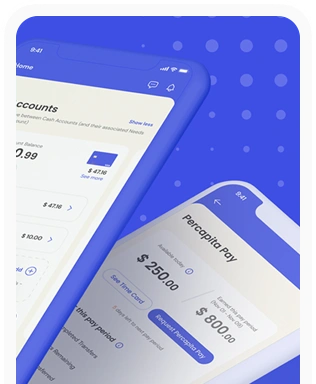
Percapita
We designed a full-fledged application for simplifying everyday finances.
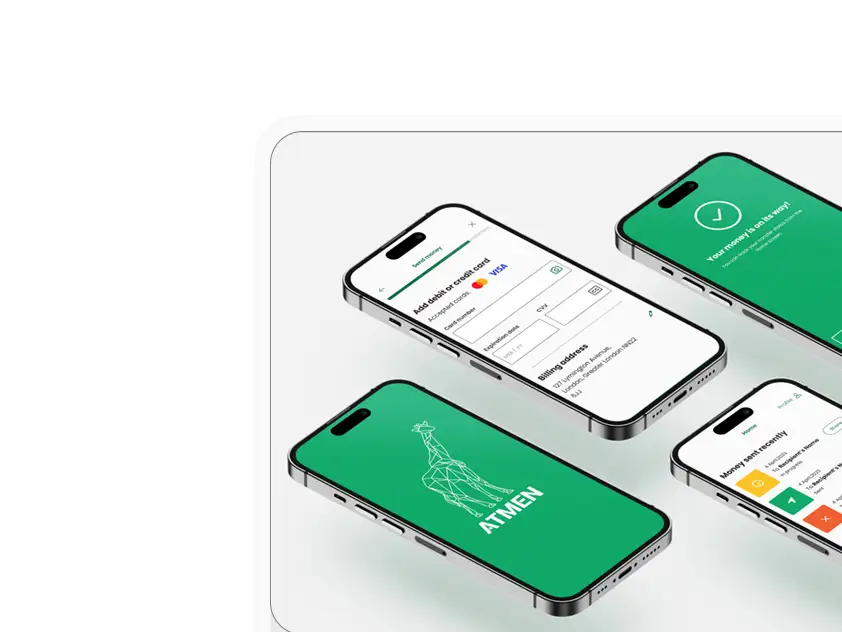
Atmen Fintech
Mobile App
Designing a Minimum Viable Product for a Diaspora Neobank Startup
Sterling Archer
By applying the DDD framework, we created multiple digital tools for a US based Data Company.

Ergomania and NGOs in the Netherlands
UX design for Fintechs, banks and financial startups is the everyday work of Digital Product Design company, Ergomania based out of Budapest, Hungary.

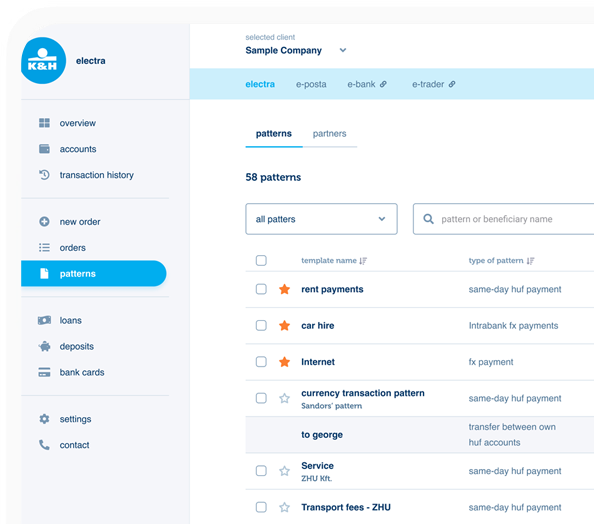
K&H Bank's Corporate Netbank
The K&H Electra Netbank App consolidates all financial needs into a single, user-friendly application. With its intuitive design, businesses can effortlessly manage their company's cash flow, transactions, and investments from one centralized hub.
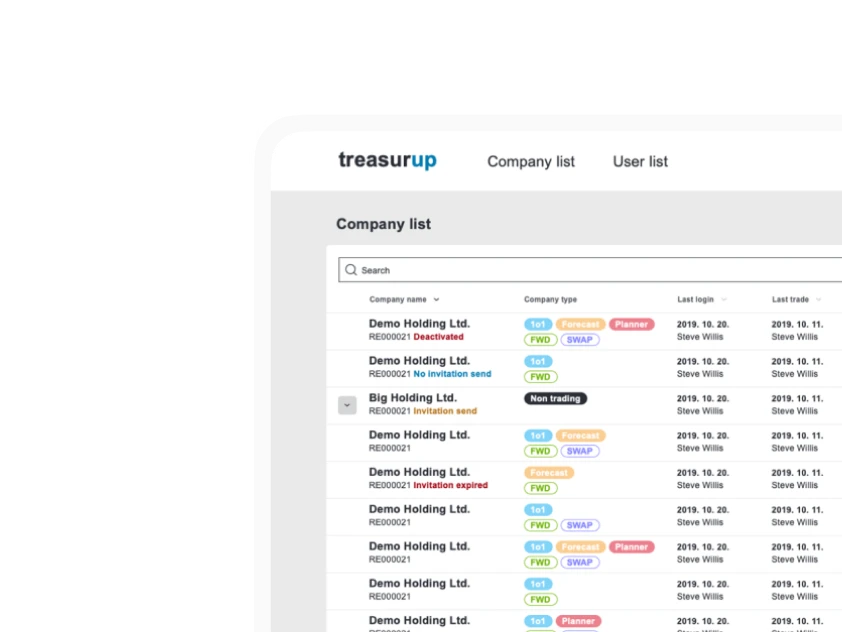
TreasurUp
We established written and visual consistencies and guidelines for TreasurUp’s financial platform.
Simple by OTP
Simple by OTP Bank is Hungary's No.1 mobile payment app for cashless payments with 1M+ downloads, and 1 million+ transactions.

White Label Banking App
We provide full-blown next-generation mobile banking solutions for sales-oriented banks.
Want to read more
about UX, fintech and banking?
Subscribe to our biweekly newsletter and get the latest of our news and thoughts!