Digital Accessibility: Legal Constraint or Untapped Business Opportunity?
When user experience (UX) meets legal compliance, it often feels like two separate worlds colliding. At the latest Ergomania Business Breakfast, we sought the answer to how legal obligations can be forged into a competitive advantage, and why accessibility is not merely a checklist item, but the cornerstone of future-proof digital products.
In recent years, digital accessibility has shifted from the “nice to have” category to being “mandatory,” yet the majority of organizations remain uncertain about how to navigate this transition. Dr. Gergely Gábor Szabó, attorney and expert at Bán, S. Szabó, Rausch & Partners, and Ádám Drágus, Ergomania Design Strategist, explored the topic. The discussion highlighted that while legal pressure is real, the true driving forces behind accessibility are business rationality and empathy.

The Accessibility Paradox
The 2024 Munich Push UX conference was entirely dedicated to accessibility, with the industry’s elite debating the deepest layers of inclusive design. Ironically, one of the keynote speakers couldn’t get his wheelchair onto the stage.
This incident is a perfect metaphor for the current state of the digital space: the intention is there, the knowledge is available, we talk about it, yet implementation somehow stalls. As established during the discussion, however, accessibility is not binary – it is not about a product being either accessible or not. It is a spectrum that affects individuals to varying degrees and requires our continuous work.
Why Has the Question Become Urgent Now?
Understanding the legal framework surrounding accessibility is essential, as new regulations imposing obligations on market players came into force in the European Union – and thus in Hungary – from the summer of 2025. The European Accessibility Act (EAA) is clear in its intent: to ensure products and services can be used widely by everyone, regardless of disability.
This law was not born in a vacuum. Consumer protection focus has been strengthening in the EU for years, and with the acceleration of the digital transition, it became untenable for any social group to be excluded from online administration or shopping. Although the new regulation primarily applies to newly launched services with strict deadlines, there is a grace period for existing systems that may last until 2030. However, let no one be misled: this “grace period” is not a time for inaction.
The scope of the regulation covers the banking sector, e-commerce (webshops), transport services (ticketing systems), as well as communications and audiovisual equipment. While micro-enterprises may receive certain exemptions, the majority of the market must prepare. As Szabó pointed out, authorities (such as the National Media and Infocommunications Authority (NMHH) or consumer protection) are expected to follow a principle of graduality initially – warning first, fining later – but reputational risk may appear much sooner.
The Human Side: Not Statistics, But Reality
We tend to treat the term “users with disabilities” as an abstract, remote target group that we only have time for after serving everyone else. Szabó demonstrated the weight of the problem through a personal example. One of his neighbor's twin daughters lives with a disability due to birth complications. She is an intelligent, open-minded young person who wants to live her life and surprise her parents with a trip, but she constantly hits walls in the digital space.
Her story highlights that digital accessibility is actually about supporting independent living. When a poorly designed checkout process or a badly coded interface prevents a purchase, it is not merely a technical error, it excludes a human being from society.
Furthermore, disability is not always a permanent state. The concept of “situational disability” may be familiar. When we try to use a mobile app in blinding sunshine, or try to watch a video on a noisy bus without subtitles, or try to validate a ticket while holding a child in one hand and shopping bags in the other, we too are hindered. If we design our systems for the most vulnerable groups, we are in fact improving the experience for every user.

The Power of Business Arguments: The $13 Trillion Market
Beyond moral and legal arguments, the hardest argument is business rationality. Many decision-makers still view accessibility as a cost center. In reality, the purchasing power of users with accessibility needs and their immediate environment in the global market is staggering. According to some research, this segment represents over $8 trillion in disposable income, or $13 trillion when including family members and friends.
Statistics mentioned during the discussion show that 69% of users leave a website immediately if they find it difficult to handle. For an e-commerce player, this churn is a direct revenue loss. In today’s fierce market competition, where the fight for every click and lead is cutthroat, it is a luxury to give up 10%–15% of potential buyers.
Just consider: If 3,000 of a webshop’s 20,000 monthly visitors do not complete a purchase because the interface is not accessible, that adds up to a massive annual loss. A well-optimized interface accessible to everyone not only increases conversion but also improves discoverability – both in traditional Search Engine Optimization (SEO) and the emerging era of AI-driven search. Just like Google’s algorithms, modern Large Language Models (LLMs) rely on well-structured, semantic sites to understand and recommend content.
Law and Design: Enemies or Allies?
One of the central themes of the morning was resolving the tension between the legal and product development (UX/UI) fields. According to stereotypes, the lawyer is “Dr. No” who kills creativity, and the designer is “creative chaos” who ignores rules. In reality, these two fields must cooperate closely.
The problem often arises because representatives from the two fields do not talk to each other at the beginning of the process. The legal department may encounter a product only when it is already finished, at which point expensive and painful alterations are needed due to compliance pressure. This silo-like operation must be replaced by a “compliance by design” or “accessibility by design” approach.
In practice, this means that the legal expert and the cybersecurity officer must be present at the kickoff meetings in the very first phase of planning. If we clarify the frameworks and risks at the start, designers’ creativity will be guided rather than hindered. The goal is not for the lawyer to be the smartest person in the room, but for legal compliance to support business goals and user experience.
How to Start? Practical Steps
Accessibility is not a one-time project that can be done and then forgotten. Using Drágus’s analogy, it is like maintaining a pool. Cleaning it once is not enough; it must be constantly maintained because new functions, content, and technologies add new impurities (obstacles) into the system.
The correct approach may consist of the following steps:
- Auditing: First, we must be aware of the current state. A comprehensive audit reveals technical and design deficiencies based on WCAG (Web Content Accessibility Guidelines) directives.
- Roadmap: Based on audit results, a schedule must be established. We don’t need to solve everything at once; errors must be weighted, and we must start repairs by focusing on quick wins. This roadmap can also provide protection from a legal standpoint, as it proves the organization’s commitment.
- Documentation and feedback: Regulations require the publication of an Accessibility Statement, as well as the operation of a Complaint Handling and Feedback Mechanism. The latter is particularly important: we must give users the opportunity to signal if they encounter an obstacle. If the error-reporting interface itself is not accessible, that’s embarrassing.

Socializing Developers and Internal Resistance
Questions from the audience highlighted that resistance within the organization is often a serious barrier to progress. It is especially difficult to enforce new perspectives in large organizations, where hundreds of developers and dozens of product owners work.
The IT leadership at the Education Authority takes the issue seriously. By listing errors and naming those responsible, they “socialize” developers. This kind of internal transparency and accountability is indispensable. Without the support of the legal department and management, UX professionals often fight windmills. Education, therefore, is also for decision-makers: they must understand that accessibility is a fundamental metric of product quality.
What’s Next?
The experts agreed that in five years, the question of accessibility will follow a similar path to GDPR. Initially, we felt it was a nuisance and an administrative burden, but today it is integrated into everyday operations. Data protection has become the basis of trust.
We can expect the same in the field of digital accessibility. Companies that act now can gain a significant competitive advantage. Not only to avoid fines but because they create better, more usable products. As technology evolves and the awareness of affected users grows, pressure will intensify. In the age of social media, no company can afford the reputational loss that, for example, a viral video exposing a discriminatory interface could cause.
So let’s not wait until the authorities knock on the door. We can view accessibility as an opportunity to help us re-evaluate our processes, improve UX, and broaden our client base.
Do you want to know where your product stands?
The Ergomania expert team – in cooperation with our legal partners – is ready to map the accessibility level of your digital interfaces within a comprehensive audit and prepare the necessary roadmap. Remember, good design belongs to everyone.
About the authors
Balázs has been working in content for more than 20 years, having the role as an editor at one of the first and largest news sites, later helping to establish the content marketing business for media publishers and agencies. Today, Balázs serves as content producer at Ergomania Ltd.
Related case studies
Prefixbox
Prefixbox is a Hungarian e-commerce scaleup. We helped them design an AI agent that gives more accurate product recommendations to shoppers with generative AI.

Percapita
We designed a full-fledged application for simplifying everyday finances.
Atmen Fintech
Mobile App
Designing a Minimum Viable Product for a Diaspora Neobank Startup
Sterling Archer
By applying the DDD framework, we created multiple digital tools for a US based Data Company.

Ergomania and NGOs in the Netherlands
UX design for Fintechs, banks and financial startups is the everyday work of Digital Product Design company, Ergomania based out of Budapest, Hungary.

K&H Bank's Corporate Netbank
The K&H Electra Netbank App consolidates all financial needs into a single, user-friendly application. With its intuitive design, businesses can effortlessly manage their company's cash flow, transactions, and investments from one centralized hub.
TreasurUp
We established written and visual consistencies and guidelines for TreasurUp’s financial platform.
Simple by OTP
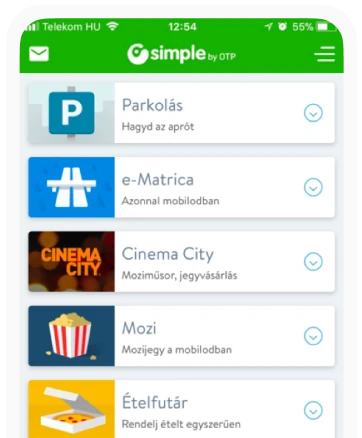
Simple by OTP Bank is Hungary's No.1 mobile payment app for cashless payments with 1M+ downloads, and 1 million+ transactions.

White Label Banking App
We provide full-blown next-generation mobile banking solutions for sales-oriented banks.

Want to read more
about UX, fintech and banking?
Subscribe to our biweekly newsletter and get the latest of our news and thoughts!