A Golden Age for Vietnam Fintech
Nghia Nguyen says he’s fortunate that his native country of Vietnam is rapidly developing, with plenty of work opportunities. With inward foreign investment and a government intent on encouraging development with new regulation incoming, it’s what Nghia says could be ‘a golden age’ for Vietnam, compared to the USA or much of Europe.
Having studied finance and banking in Singapore, Nghia had hoped to stay in the city-state to pursue his career, but rule changes there meant he had to return to Vietnam, where he started in import-export banking. At the time – back around 2010 – the banking industry was moving quite slowly and was ‘kind of outdated’, while Fintech was as yet a rare concept. Nghia decided to up his educational level and went to study for an MBA in Taiwan, before returning again to Vietnam and starting work with a blockchain company. “My Fintech journey had started,” he says. “And I had found my new passion.”
 Nghia Nguyen
Time and Money
As yet Vietnam didn’t really have any regulatory framework to accommodate Fintech companies, but 2015 saw the founding of Timo, the country’s first digital bank. The name is an acronym of ‘Time and Money’ and Timo’s launch by VPBank signaled a significant change in the previously slow moving Vietnamese banking scene. Nghia recalls how Timo was an almost instant success, especially among younger people who were attracted by the easy-to-use app and the absence of complex and high fees. Timo was also innovative in being the first mobile banking application, with other banks having to rapidly change and adopt new technologies and ways of working. VPBank withdrew from the Timo collaboration in 2021 in order to develop its own digital banking offerings VPBank Neo, and Cake by VPBank. Since then Timo has collaborated with BVBank.
During this time the government had to catch up and create new regulatory frameworks for digital access, including new rules on crypto. Vietnam is one of the world leaders in cryptocurrency ownership with over twenty million people, a fifth of the population, being investors in crypto. The irony is that as yet there is no Vietnam-based exchange and most buyers use KuCoin or Binance. That is set to change with a recent flurry of government financial decrees. Not least is the 2025 creation of a regulatory sandbox for innovative Fintech solutions in the banking sector, such as credit scoring, Open API data sharing, and P2P lending. It’s taken five years to get there, Nghia says, but now the way is open for new and innovative Fintech products and services.
Everyday solutions
Since the effective ‘Year Zero’ of Vietnam’s Fintech growth, when there were under 40 Fintech companies, the market has expanded to around 260, including wealthtech, digital payments, and alternative lending. With the government showing ever greater encouragement towards digital payments, and a reported 88% of all consumers going cashless, change is rapid. Nghia reports that Govtech solutions are also increasing, with an AI ‘Virtual Assistant for Citizens’ platform to allow faster and more efficient processing of many everyday functions, including health insurance and ID card issuing. e-Know Your Customer solutions by providers such as VNPT (Vietnam Posts and Telecommunications Group) are also being quickly adopted by the banks and government departments, using facial recognition and other biometrics. The State Bank regulates customer onboarding and information protection, with e-KYC now essential for compliance.
Transforming banking in Vietnam
But let’s take a step back in time to 2015, when Vietnam’s banking sector started undergoing restructuring and modernization. Traditional banks were rebranded or transformed into new-generation digital banks as part of government moves to strengthen the Vietnamese banking sector and improve macro-economic stability.
Uyen Tien was responsible for the end-to-end design of one such digital credit platform, ‘enabling full-stack lending, credit card, and insurtech integration across a newly launched digital bank ecosystem.’ In the wake of the restructuring of the Vietnamese banking scene and the establishment of new disruptive digital services, this bank’s investors decided to create an official digital technical offshore vendor as a joint venture.
Uyen was on the ground floor of the new setup, developing the vision and the mission, and defining customer segmentation. She and her colleagues created the requirements for the core banking system and technical architecture for lending, and so much more. And while the team were in effect creating a whole new bank, it was actually being built on the foundations of an existing legacy bank. Uyen’s experience in product development, digital transformation, consumer lending, and risk management all played a part in bringing operational success, and informing this interview.
 Uyen Tien
Pioneering work
There is something very pioneering about re-tooling and re-engineering a legacy bank into a fit-for-purpose digital bank. It’s a case of working in a changing landscape, with relatively limited governance and frameworks available from the State Bank of Vietnam. The regulatory framework is still evolving, with sandboxes and reforms under way. This lack of comprehensive guidelines is now changing but did tend to make things difficult for the emerging digital banks to create confidence in promoting new products, defining the customer journey, and ensuring that customer data is protected. On the other hand, having relatively light regulation provided Fintechs with more opportunity to cooperate with the banks and offer new solutions.
Vietnam’s regulatory system is undergoing significant transformation, including a five-year reform program to reduce business regulations by 20%. This is part of the ongoing national digital transformation strategy. The changes aim to simplify processes, attract investment, and support the growth of the digital economy.
Underlying all of this is the transformation from a prevalent mindset of ‘old-school’ banking, both within the regulatory system and the banks themselves. In the past, decision making could take a long time, but now Uyen looks towards a relaxation of boundaries, where Fintech and banks can enter each other’s territories and allocate the right capabilities of each party into mutual benefits.
Looking forward to booming markets
Fintech is still relatively new in Vietnam and has become a recognized sector only within the last five years. It started mainly in alternative credit scoring helping lenders to identify the right customer for lending but has rapidly grown into the banking sector.
Outside of banking there are multiple Fintechs engaged with Govtech projects in setting up the Citizen Data platform, a SuperApp which consolidates digital services, identification, driving licences, insurance cards and many other facilities through the National Data Center and National Blockchain platform. Govtech initiatives such as citizen data platforms and national digital transformation programs are expected to boost digital banking adoption, and Uyen predicts that when this happens markets will then be booming.
The National Digital Transformation Program was launched in 2020 to digitize government records, build national databases, and create seamless digital governance by 2030.
Significant investment in infrastructure, including 5G, data centers and undersea cables is boosting connectivity and the digital economy. The Ministry of Information and Communications is also active in nurturing and increasing digital enterprises.
Improving decision making
The pressure is on for consumer finance companies to improve their decision-making processes, using big data and machine learning to define credit scores. Consumer finance in Vietnam has been growing rapidly over the last ten years, with FE Credit and SMBC being the biggest players. FE Credit focuses on financial inclusion, digital innovation and providing tailored financial solutions to meet the needs of the Vietnamese market, particularly for workers and micro-business owners – that is, households. Home Credit is also in the market for electronic device loans, cash and motorcycle loans. Changes in customer data protection have made business more difficult for these consumer lenders as credit scoring is no longer available through third party vendors. This tends to slow down the loan approval, while consumers demand ever-faster responses.
There is also greatly increased awareness of fraud through phishing and other scams, due to government campaigns to protect citizens, all of which suggest many opportunities for Fintechs to help.
The banking experience
Personalization is an increasing trend in many parts of the world, and Uyen comments that her development of risk-based pricing for lending was a pioneering initiative. AI and data-driven models are increasingly important not only for credit decisioning and product innovation but also for better customer services. Customers also respond to being rewarded for their loyalty and should certainly receive a fast, simple, friendly and seamless experience. UX-UI is a critical success factor in this as customers expect fast, simple, personalized journeys.
Simplicity and ease of use
Until recently Nghia Nguyen worked for a Singapore-founded company active in Indonesia, India, the Philippines and Vietnam. His role was to lead partnerships for a new credit card product, which relied on advanced Big Data and AI/Machine Learning models to handle credit scoring and risk management for underbanked and unbanked consumers. A typical underbanked or unbanked consumer may want to buy a new smartphone and at their point of contact with the retailer can apply for 100% online credit card issuance, then use the newly issued virtual card to apply for 100% free instalment payments. The entire process takes less than 30 minutes, thanks to the new technology of eKYC and alternative credit scoring, making the registration process far faster than traditional methods which previously took 3-7 days. Nghia adds that the siting of the company operational headquarters in Vietnam, while being legally founded in Singapore, is a popular model for Fintechs, as he says that Singapore is more ‘friendly’ towards startups and Fintechs.
As a side issue he comments that Vietnamese UX-UI tends towards simplicity and ease of use. He compares it to the very distinctive look of Japanese interfaces which are, “Kind of anime, very complex with a lot of content. Now many Vietnamese Fintechs and banks have their own UX-UI teams in house.” This implies a strong tech talent pool in the country, and he agrees that Vietnam is rightly regarded as a great IT outsourcing hub. However, in the higher reaches, the country is somewhat lacking the requisite talent. Is it a failing of the education system that has yet to catch up with demand? Nghia makes the caveat that he is no expert in the education system but says that rather than a lack of technical training, it’s perhaps the lack of robust English that holds back many would-be higher-level workers.
Ones to watch
Success has certainly come to some Fintech enterprises however, and Nghia is impressed by VNPay (a subsidiary of VNLife), the unicorn valued at $1 billion in 2021 and responsible for many payment processing solutions. These include the very popular use of QR codes that enable payment at Point of Sale terminals using a mobile banking app or e-wallet, and which is the fastest-growing cashless payment method in the country. As VNPay says of its ecosystem, it ‘caters to everyday needs, from shopping, transportation to entertainment, including taxi booking, flight, train and intercity bus tickets, hotel reservations, movie tickets, golf booking, football tickets, online shopping with VnShop … and more, offering a seamless experience for users.’
MoMo is another ‘one to watch’ from Nghia. It started as an e-Wallet and is now a SuperApp enabling a one-stop solution for financial services, including bill payments, mobile top-ups, peer-to-peer transfers, insurance, micro-loans, investment opportunities and stock trading.
He also draws attention to the ride-hailing app, Be. Incidentally Be offers not just taxi bookings, but also motorbike ride services … for the courageous traveller!
The Tima Group catches Nghia’s attention as the first provider of nationwide Peer-to-Peer technology in Vietnam, and he says it performs a valuable service in lending to poorer individuals.
A very good time for Fintech in Vietnam
So, a Fintech-encouraging government, an ever-maturing Fintech and banking scene, and a population of over 100 million generally eager to embrace new tech offerings, with around 70% of that population of working age. No wonder Nghia describes it as ‘a golden age’. “We are a young country, and it’s a very, very good time for the economy and Fintech, and for some new things to come in.”
One thing Nghia would like to see is an independent Fintech Association. Currently it’s a subset of the Vietnam Banks Association where it’s classed as ‘the Fintech Club’. “Sometimes there will be potential conflict between a bank and a Fintech, and in that situation, I think the Fintech will have less voice than the bank and be less independent.” So it seems a separate organization is overdue.
Meanwhile Nghia has plenty to keep him busy – travelling with his two daughters, his love of online gaming, and reading. And if the Fintech scene in Vietnam ever gets too pacey, he’s also a practitioner of meditation.
The way ahead
So what conclusions does Uyen Tien draw about the Vietnam banking scene? She responds that while there’s a lot of room for investment in digital banking in Vietnam, it’s also about the strategy and roadmap, from which short-term plans should only account for 30% of backlogs, the rest being saved for the establishment of a customer data platform, AI and the banking architecture. Data-driven banks will continue to be the way forward, and it’s the quality of the team creating the customer data platform that will produce results. Banks therefore need to develop their customer data platforms to identify and analyze who their customer is and what their customer needs. They can then create the product, the journey and the service offered. In other words, we’re back to increased personalization.
High-level themes
Another observation from Uyen is that there is currently something of a wait while the State Bank rolls out digital banking regulations. The upcoming Fintech sandbox was started back in 2019 and will be live soon. In addition, completion of the Citizen Data portal will connect everything about a citizen: their tax, social insurance, income, and credit ratings, all in one app. This in turn will encourage and enable lending, green lending and responsible lending.
In the area of green banking the International Finance Corporation’s Alliance for Green Commercial Banks brings together twenty institutions managing more than $5.6 US trillion in assets. The Vietnamese banks HDBank, OCB, MSB and VPBank are now members and the initiative will provide a boost to green banking practices. The Alliance covers renewable energy, energy efficiency, sustainable transport, climate adaptation and the circular economy. With the government’s commitment to net zero emissions by 2050 there is huge scope for Fintech startups to bring new solutions to market. The Vietnam Green Growth Strategy aims to, ‘Accelerate the process of economic restructuring in order to use natural resources efficiently, reduce greenhouse gas emissions through research and application of modern technologies, develop infrastructure to improve the entire efficiency of the economy, cope with climate change, contribute to poverty reduction, and drive economic growth in a sustainable manner.’
Hot topics
Embedded finance in Vietnam is another rapidly growing sector, expected to reach $2.73 US billion by 2029 and driven by the consolidation of digitalization and consumer demand. E-commerce platforms such as Shopee Pay offer one-click purchases and rewards, while lending and embedded insurance are offered through telcos such as Viettel. There are still challenges for the general population with financial inclusion and literacy, but the adoption of embedded finance is increasing accessibility and convenience. For example, insurance services are easily accessible through the mobile app MyViettel app.
AI is a hot topic worldwide, and Vietnam is setting itself up to be an AI hub in Asia and a major player by 2030. There are strong talent growth schemes to bring on the next generation of AI expertise, including a government program to train 7,000 AI experts and support 500 AI startups by 2030, framed within the supportive Digital Technology Industry Law. Effective from January 2026 this introduces tax incentives, defines digital assets and AI regulation, and sets the goal to see 150,000 digital tech firms in the market by 2035. The government anticipates that AI could be contributing over $79 US billion to the Vietnamese economy by then.
Noticeable strides
These are some of the high-level themes prevalent in Vietnam both now and for the near future. Not surprisingly they reflect industry-wide global trends. A 2024 EY Report includes the observation that, ‘Vietnam has made noticeable strides in financial inclusion, with the government playing a pivotal role. Based on the National financial inclusion strategy to 2025, and vision to 2030, public and private sectors have collaborated to extend financial banking services, particularly to underserved rural areas and the unbanked and underbanked population, resulting in an increase in payments account ownership from 31% during 2015-2017 to 87% by the end of 2023. According to the Global Financial Inclusion Index 2024 Vietnam has been ranked No. 14, lagging only Singapore and Thailand in the ASEAN region.’
Despite rapid development, there is a significant proportion of Vietnam’s population that remains unbanked or underbanked. Fintech solutions are helping bridge this gap by making financial services more accessible, as digital wallets, digital banking, mobile banking apps and online lending platforms enable individuals to access banking services and bring people into the formal financial system. Uyen Tien regards Vietnam as poised for strong growth and learning from global leaders while developing its own models. “With very clear governance, big data, and the use of services from multiple Fintechs all joined together, we will have many win-win benefits.”
About the authors
Harlan Cockburn is a writer and director based in Budapest, Hungary.
Related case studies
Prefixbox
Prefixbox is a Hungarian e-commerce scaleup. We helped them design an AI agent that gives more accurate product recommendations to shoppers with generative AI.

Percapita
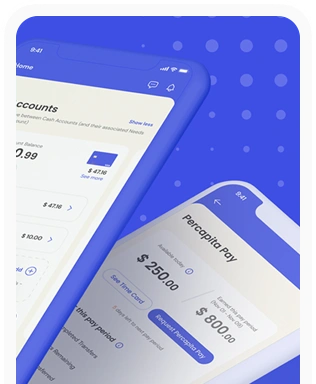
We designed a full-fledged application for simplifying everyday finances.
Atmen Fintech
Mobile App
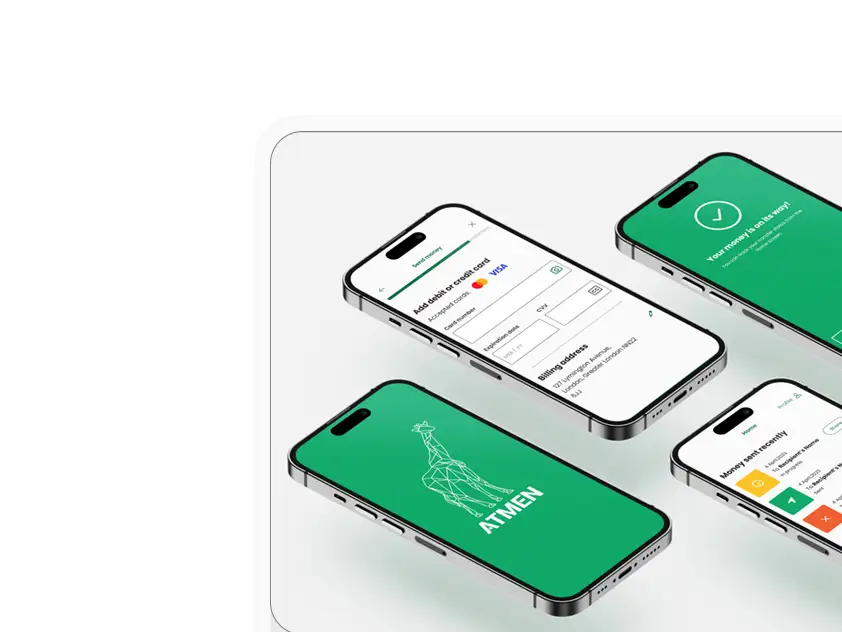
Designing a Minimum Viable Product for a Diaspora Neobank Startup
Sterling Archer
By applying the DDD framework, we created multiple digital tools for a US based Data Company.

Ergomania and NGOs in the Netherlands
UX design for Fintechs, banks and financial startups is the everyday work of Digital Product Design company, Ergomania based out of Budapest, Hungary.

K&H Bank's Corporate Netbank
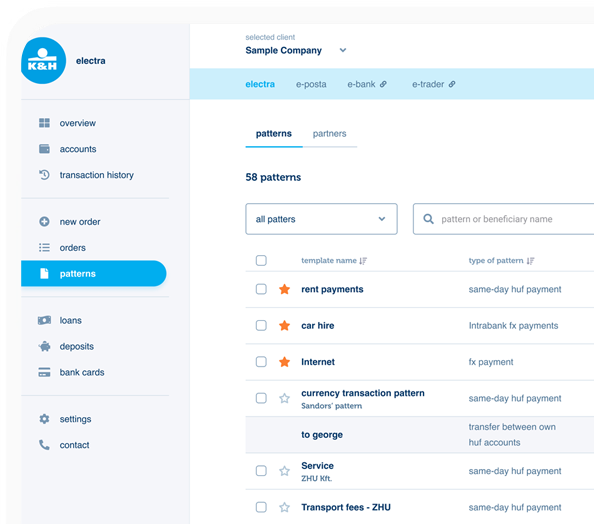
The K&H Electra Netbank App consolidates all financial needs into a single, user-friendly application. With its intuitive design, businesses can effortlessly manage their company's cash flow, transactions, and investments from one centralized hub.
TreasurUp
We established written and visual consistencies and guidelines for TreasurUp’s financial platform.

Simple by OTP
Simple by OTP Bank is Hungary's No.1 mobile payment app for cashless payments with 1M+ downloads, and 1 million+ transactions.


White Label Banking App
We provide full-blown next-generation mobile banking solutions for sales-oriented banks.
Want to read more
about UX, fintech and banking?
Subscribe to our biweekly newsletter and get the latest of our news and thoughts!