The Latvian way
With a global footprint of companies co-founded with his partner Davis Barons, it’s worth asking Matiss Ansviesulis how on earth he keeps tabs on businesses ranging from Mexico, through Spain, and onwards to the latest developments in Malaysia. Or in other words, what is his actual ‘day job’?
“We’re very good at starting new companies and developing new ideas, and growing,” he says. “But our challenge as entrepreneurs is to remain focused and not just keep adding new exciting ideas, right?”
OK, which means what exactly in practice? (And this question to an entrepreneur and co-founder who includes Esketit, NewSchool, Spanda Capital, Mojocapital, and Money for Finance among his businesses).
Matiss responds that his day job is the creation of new companies, which then means looking for the best leaders because, “I cannot put myself in a position where I'm running any individual business. So by default we need good leaders and CEOs.”
With companies spread around the world, the second line of action for Matiss is strategy, in terms of resource use and prioritization. “Where do we put the capital… and where do we not put the capital?”
Then there’s all the regular stuff of controlling business, reporting, and dealing with performance issues, along with legal matters such as registering companies - often in places with very specific local regulations. Yep, that all adds up to quite the complex plateful.
 Matiss Ansviesulis
Latvian competencies
It’s interesting that the two Latvian co-founders don’t have a consumer-facing business in their native country, mainly because they see it as too small a market. Matiss agrees that Latvia is extremely good for some types of financial services in banking and non-banking, but at present the country is only home to his head office teams that run businesses in other countries, such as Jordan, and the new territory of Malaysia. Over the last fifteen years Latvia has developed great competencies in online Fintech, and particularly in lending. Latvian-founded companies are now present in around seventy countries across the world and the experience and knowledge that has been gained makes Latvians able to ‘punch above their weight’ (to use a boxing analogy).
Does this mean you have to be Latvian to head up one of Matiss’ businesses? He responds that it’s more a matter of looking for and finding C-level execs that have managed consumer lending operations around the world, and been able to build from zero to a thousand people in a few years. He says that many of these leaders happen to be Latvian, and adds that in some emerging markets the competency to run his business models is simply not present. Jordan or Peru, for example, have big e-commerce businesses and banks, but specifically the data-driven consumer lending product providers are non-existent, so the knowledge and product understanding is not there either.
The flavor of… Fintech?
From a native-born Latvian to someone who has settled in the country. “I knew where Latvia was and I could point at it on the map, but didn't know much else about it.” Polish-born Sofian Berrahal is speaking about his home of over a decade, where he is CEO of Latvian companies Nexpay, and Nexdesk, offering ‘Next generation financial infrastructure for the digital business world.’
Back in the day, having studied economics at the University of Krakow, and graduated from business school in Normandy, Sofian was ready for some change and adventure. So why Latvia? Well, the adventure was romance-related (and we’ll catch up on that later), but at first the Business Administration graduate took whatever work he could find in his new domicile. “I started selling food additives, such as flavoring, stabilizers, and colorings. I’d drive from Riga to Poland to different factories, and talk with lab people about testing and chemical ingredients.” It was a case of learning on the job, but Sofian put his strong belief in building relationships to good use.
Within six months an entirely new role appeared in one of those twists of fate which often come to Fintech travellers. This was with Dukascopy SA, a Swiss bank with an office in Riga. Sofian joined, “Without hesitation,” working there for some eight years and rising from sales and risk management positions to VP and Head of Sales.
 Sofian Berrahal
Being aware of cultural differences
During this time the opportunity came to take care of Dukascopy’s business in Hong Kong and Japan, where he learned a lot about running a Forex brokerage, and also observed various cultural differences. He mentions that while European businesses might offer cashback, in Tokyo the sign-up bonus was more likely to be a box of sushi, “We did that a lot and were shipping hundreds of sushi boxes!” Sofian also noticed that his team of fifteen refused to leave their desks until he had finished his own working day. His solution was to depart the office at six each evening to take a walk around the area, and by the time he returned, everyone would be gone. It’s a nice example of people-management that worked unconfrontationally within the local culture, and demonstrates his assertion that he is ‘a people-person.’
As we’re discussing people and culture, it’s worth finding out more of what he has learned over the years in different countries. He describes people in the Baltic states as being ‘insanely creative’ and says they are brave and willing to try things that have never been attempted before. Switzerland is at the opposite end of the scale, where some banks are hundreds of years old and determined to stick with traditional ways of operating. “Opening a bank account there is still not usually fully online, but I guess there must be some demand for that approach from clients.”
The business ethic in Hong Kong and China is very demanding and, “You work, work, work. You have lunch at your desk while writing emails, and you are there from morning to very late in the evening.” He laughs at the difference in the Swiss attitude, where lunch is viewed as an almost sacred break in the working day.
As to Sofian’s native country, he says that Poles have a strong impetus to get the job done through hard work and determination. Managing these very different international approaches is a skill he has learned to deploy over the years.
Technical processing
Deputy Head of Sales at DECTA, Gabriel Štefaňák, starts with the ‘bar room’ answer to what he and the company he has worked for over the last ten years actually do. By which I mean his explanation is Banking Solutions in the Digital Age… for Dummies. “What we do is definitely not a simple business. We provide payments technology, which is my answer to someone I don't want to go deeper with. But if I'm at a Fintech meetup and there are people who are from the field, I tell them that besides payment technology, we provide technical processing for issuers and acquirers. Meaning, if someone wants to issue a payment card like MasterCard or Visa, we provide the underlying technology.”
Hey, that doesn’t sound too complex. That is until Gabriel drills down into his subject of technical processing - a business with financially regulated entities, with the same term also being used on the acquiring side. So in other words, every transaction between a retailer, a customer and a bank relies on seamless and timely processing through a provider such as DECTA. “We provide payments technology, but that's such a broad term, so then I narrow it down to this: We service financially regulated entities and help them issue cards and accept payments online. I would say this is the simplest explanation, but of course, it can be broken down into many more layers.”
 Gabriel Štefaňák
Starting from the ground up
DECTA was founded in Latvia early in 2016 by industry financial veterans, one of whom Gabriel now works closely with - Sales Director Nikita Melnikov. The key idea was to create a ‘Challenger Processor’ which met all the standards of other leading European processors. At the time the industry in the Baltic states, and Latvia in particular was only legacy-based, which was also noticeable in Slovakia, Czechia and Hungary. Nikita and colleagues came from a banking background, and the new enterprise was established as an independent global payments company, with the support of an established Latvian payments vendor. This bank was burdened by legacy systems but was intent on card-issuing and acquiring services to merchants. The idea was floated to create DECTA and start again from the ground up with a modern technical processor, built on modern systems with modern APIs, and a very flexible infrastructure. There would also be a flexible sales approach, and strong customer support. Gabriel’s own involvement with DECTA in Latvia came because of his regional connections and his knowledge of the language.
Proudly Latvian
Headquartered in Riga, there are now also DECTA offices in Dublin, London, and Limassol, Cyprus. Gabriel’s own team in Latvia comprises six people, with the intention of expanding to ten during 2026. The Latvian company employs around 200 developers, account managers, project managers and support, and is “Proudly Latvian.” That’s an interesting comment seeing as Gabriel is Slovakian, (although his two daughters are Latvian born). The pride comes from a country which suffered under communist rule and which for a long time remained yoked to Russian business practices, but has come through that history. Once upon a time, to come from the Baltic states was widely seen as a limitation, but there is now widespread respect for Fintechs from countries such as Estonia and Latvia. Gabriel says that the level of e-governance in his adoptive country is some ten years ahead of the rest of Europe. He also celebrates the high levels of digitalization, and some of the fastest internet speeds across the continent. Today being a Latvian company carries the cachet of respect.
So, DECTA became the first challenger processor in the region, providing issuer and acquirer processing for its first partner. After that, came an increasing pool of collaborations with banking partners and rapid growth of the new company.
On the back of this early expansion came the move into white label solutions, allowing DECTA customers to empower their brands with customizable payment gateways where the whole process - from the user point of view - is transparent. “Many of the components can be white-labeled to provide a turnkey solution,” Gabriel mentions. “We very often say at conferences that we can cover the full payment cycle, starting from simple white label technology all the way to the robust technology of technical processing. That’s very complex, and is not something that can be white-labeled, but we do provide some fractions of that as a white label, turnkey solution.”
The lessons of cause and effect
OK, so let’s rewind a little to trace the story of how once upon a time multiple entrepreneur Matiss Ansviesulis seemed to live in airports as he circumnavigated the world for around eight years, setting up businesses. It’s not something he does now because his CEOs do the travelling, or moving to a country to set up operations there. From around 2010 to 2020 however he was building up the first business, CreamFinance, to the level of 800 people in eight countries, with a revenue at the time of sale of 150 million euro. Not a bad career trajectory for a young man from a small village on the outskirts of Riga.
Matiss recounts how he was always focussed on performance and getting good school grades. This led him to persistently take the exams to get into the best high school in Latvia, which is very math and quantitative math-focussed. (He adds, “And I’m not great at math”!) In school he embraced the message of cause and effect, where consistent and focussed hard work creates confidence and the achievement of goals.
Onwards to the UK where Matiss finished his Bachelor’s degree at Lancaster University, and decided to become a banker, taking a job at JP Morgan. Not a great move. Within a year he’d figured out that taking orders from others really wasn’t his thing, but he and Davis were already musing about starting something that was, “Techy, cool, not traditional, and that could be done online.” It was a time of economic depression following the global financial crisis, as the partners searched for an offering that would make sense. They saw that the Swedish banking sector had more or less stopped lending in the Baltic states, leading to a severe credit crunch there… and an opportunity for the partners. “So that’s the macro view of why non-banking Fintechs emerged. From then on we were off, building our first business."

Researching opportunities
CreamFinance was up and running, later to be rebranded as AvaFin, and then sold to the biggest retail bank in South Africa, Capitec. Onwards and upwards as Matiss and Davis began to look at opportunities anywhere and everywhere. “Part of the job for us is to do the research and look at different opportunities. We gather information and think about potential projects in the pipeline for the next few years.” To this end Matiss says they have mainly focussed on the underbanked middle-to-low working class consumer segment, where what makes sense is not a $20,000 or $50,000 local currency equivalent loan, but something that is more accessible. “The problem for most people around the world is not interest rates, it's access to the loan, and to a Fintech service. So we've been focusing on these easy to apply for, easy to get loan products in a way that's seamless, using mobile apps.”
Such products provide fast access to data gathered through a lot of small loans made quickly in the early years of operation. That helps build the scorecard and credit risk management to understand which data sources work, and which don't. How to build on operations is also crucial, including how to collect the money, of course.
Only once the foundations are firm can more complex products such as secured loans, credit cards, or payment services start being rolled out. There’s often big local competition from established banks and other finance companies, so a step-by-step approach is usually the way forward.
Active meditation
Interestingly, this cautious philosophy is somewhat at odds with Matiss’ own adrenaline-fuelled interests away from the office, including being, “Very deep into Hard Enduro.” If you’re not familiar with this motor-biking sport, it involves ‘focusing on endurance through timed forest stages featuring extreme obstacles like rocks and logs, often in challenging terrain.’ Matiss professes that it’s his form of meditation, along with kite surfing and triathlons. “It's a classic thing for entrepreneurs: action and high energy. For me it’s a way to channel my energy and really clear my mind.”
He also has the pleasurable side-hustle of his BlackBox podcast, which roams across European business stories with fellow Latvian entrepreneur Niks Jansons, where ‘They take everything seriously. Sometimes.’ Of BlackBox, Matiss says, “It's one of the few things that I just do with no aim. I just enjoy it.”
Building from scratch or acquisition?
But back to the global business scene and what Matiss looks for in markets. Is it always startups that he’s into creating? He says that in the past there were a few existing companies acquired, but they weren’t really ‘proper’ businesses and were primarily asset acquisitions. He cites Spain for example, where an existing company gave faster market entry, rather than taking years to start from scratch. A similar situation pertained in Mexico, where the acquired Lending as a Service company had an existing license to provide consumer loans.
In recent times a new strategy has been formulated, “Through our investment platform Esketit, where we bring in retail investors from across Europe, offer them loans to our companies, and they make about 10-12% a year. This new strategy means acquiring consumer lending businesses in different markets. So yes, we've built companies from scratch, but now we have the capital, the know-how, controls and infrastructure in place to also acquire businesses.”
An example is the acquisition in November 2025 of a Malaysian company with an existing license, enabling the continuing focus on consumer loans, with asset backed consumer loans, unsecured consumer, and app-based lending through various different products.
Customization
The approach per territory is almost always customized, in a process which Matiss describes as often ‘trial and error’ to figure out the best market fit for a number of potential existing products. It depends on factors such as market infrastructure, the readiness of the consumer to be interested… and the ability to make money. “So for example, a standard process of how we enter markets is that instead of doing year-long research and a lot of preparation, we do some macro analyses of specific countries. We get to understand the competition, the GDP, the bank account penetration, and general things like that. Then we establish a company, find a local manager, get the operation going and start giving out loans online as soon as possible. Only then do we really get to understand what works, what doesn't, and what makes sense: How big are the average tickets? What is the pricing, what are the nuances of the regulation? Fast steps, instead of lengthy planning, is our approach.”
The SaaS model
There’s an intriguing phrase from the DECTA website of ‘Bespoke-as-standard’ services. Surely that’s a contradiction of terms? Gabriel Štefaňák explains that for DECTA the business case isn’t about simply signing up clients, because the payoff comes with growth and volume. It’s the Software as a Service model where DECTA is only selling the license, and earnings come from commission on the client’s volume. The corollary is that DECTA’s success is dependent on the success of their clients. So Gabriel’s response to what ‘Bespoke’ signifies is that it means consulting on how to build and scale a business. “It’s easy to issue cards but it’s hard to make them profitable,” he observes, referring especially to DECTA’s deep experience in the area of issuer processing in Slovakia and the Czech Republic. So before ink is applied to any contract, there will be consultation with a prospective client to ensure that they have the right people in place, plus a functional business model and a clear road map.
This transparency has meant that sometimes prospective clients find their way to DECTA, both through the company’s reputation, and through connection with partners. As DECTA does business with global giants Visa and Mastercard that’s a natural conduit to anyone wishing to issue a new card. If they’re a processor, then they’ll be knocking at Nikita and Gabriel’s door. Nevertheless the team are more often than not out ‘hunting’ for new leads. As deputy head of sales Gabriel is now a little more managerial in his role, ensuring that KPIs are reached.
A side hustle
Now you might think that all this should be enough to keep Gabriel Štefaňák really quite busy, and you’d be right. Except he also initiated another project which has been quietly running in the background for over ten years. This is BizOptimo, dealing in Company formation, account opening, and business consultation services. Gabriel’s partner is Swiss, and originally the company offered ‘fiduciary services’ which was a popular term in Switzerland where many of the company’s clients come from. ‘Helping Freelancers optimize profits’ is the watchword, and as many clients are French speaking, Gabriel’s Swiss partner handles all day to day enquiries. The most important aspect for Gabriel is that BizOptimo provided his “Gateway into Fintech”, which enabled him to enlarge his network of entrepreneurs, many of whom were the founders or CEOs of startups.
With two young kids, a sporty lifestyle including cross-country-skiing, and a full-on day job, Gabriel has presumably given up on sleep. However he is relaxed about managing his ‘side-hustle’. With his Swiss partner handling direct client contact, Gabriel reflects, “You know, you can optimize many operational things and the way you do stuff.” There’s always early morning catch-ups that can be done with messaging and emails, and a lot of processes can be automated.
 Gabriel and some of the DECTA team
You cannot outsource wisdom
And speaking of automating processes, what views does Gabriel have on AI? He’s using Gemini in a personal capacity and although he describes himself as something of an AI sceptic, does acknowledge that it’s a useful tool. It helps with efficiency and is useful in communications and marketing. However he is not about to jump wholeheartedly onto the AI bandwagon, because he says he enjoys ‘getting his hands dirty’ by doing some of the hard work himself. That can mean reading a lot of reports and books, and he enjoys talking with people. “When you talk to someone you get to feel who that person is and whether their knowledge is from experience… or has come through AI. You know, you cannot outsource wisdom.”
Of the multiple components in the technological chain of DECTA’s offerings, some of them cannot use AI because of regulations prohibiting third party software. Of course areas such as fraud detection and prevention have already adopted AI effectively and DECTA also utilizes these methodologies. The machine learning system of the white label solutions, helps DECTA improve acceptance rates of online payments, and to route and reroute transactions to the appropriate acquiring bank so that payments are successful. But generally, with AI Gabriel says that ‘slow and sure’ is the way forward.
Meanwhile DECTA has five to six ‘very good quality’ challenger processors who compete in the UK and European region, the company’s largest market. Expansion into the Middle East, Australia, New Zealand is underway and the Asia Pacific region is also in DECTA’s sights in the coming years. Outside of DECTA’s immediate competitors there are also around another ten companies. Although they are huge and well-known, he characterizes them as being stuck with inflexible legacy systems. Even when chosen by clients - often because of the name and traditional reputation of the competitor company - the end results are sometimes unsatisfactory. “We don't consider them as real competitors,” Gabriel says. “Because it's very clear that we are better than them.”
Almost Fintech
Let’s get back to career development and how his time at Dukascopy shaped Sofian Berrahal, and led him on to Nexpay. Despite his remarks about the traditional approach of many Swiss banks, to some extent Dukascopy was an outlier with its early interest in cryptocurrencies, starting around 2016. As a result he gained a lot of valuable experience in crypto deposits, and Dukascopy’s issue of its own token - the first Swiss bank to do so. It was, Sofian says, ‘almost a Fintech attitude’ and helped prepare the way to take his learning on to a melding of financial technology, trading and crypto. Conversations started with the founders of what would in time become Nexpay, these days a payment and financial infrastructure for businesses that need to manage their funds. The company originated as a corporate-grade exchange which was initially unique in offering Bitcoin against commodities trading.
There was however one major problem for the fledgling company - no Latvian banks would open accounts to process deposits and withdrawals for corporate clients. As Sofian recalls often hearing from suspicious bankers, ‘Oh, you’re doing crypto - well we don’t do that sort of business!’
The solution was to apply for an Electronic Money Institution licence from Lithuania, which around 2019 was the go-to country to set up a non-banking institution. In fact, during that period, nearly seventy EMI licences were issued by Lithuania - a ‘golden window’ which enabled the new company to start operating. But then came the realisation that if it had experienced difficulties in getting started, then most likely other similar projects were struggling too.
Within a year, hundreds of applications from other crypto companies that felt similarly discriminated against right across Europe were coming in, asking for help. There was already a large network established through the core crypto business and it was relatively easy to set up bank accounts for their customers and counterparties. The platform was ultra simple: Log in, transfer money.
 Some of the Nexpay team in the deep forest - Sofian second from right
Time to pivot
However as this was gearing up it was becoming apparent that the original business was not large enough to develop much further. This was a time when really big exchanges such as Kraken and Binance were gaining traction, and putting a lot of effort and funds into marketing. Instead Sofian and colleagues refocussed on a payment product, which started to grow very quickly, at a rate of almost 300% in the first couple of years. Suddenly they were jumping from a barely regulated crypto exchange into a highly regulated financial institution which provided banking services to corporate clients. This was now recognizable as the brand Nexpay, offering SEPA and Swift payments, and building its own API - used by other EMIs and some banks. What had begun as solving a problem confronting their own business had by 2025 turned into 6 billion euro-worth of process payments.
Meanwhile the original crypto exchange was transformed into an OTC desk - Nexdesk - which serves as an on and off ramp allowing corporate clients to deal in regular fiat, and digital assets.
Sofian is now CEO of Nexpay, and Board member of Nexdesk where he helped get a historical MiCA licence. All in all quite some distance from dealing in nine varieties of chicken flavoring!

Acceptance
The MiCA licence was gained for Nexdesk in December 2025, marked by a press conference with the Economic Minister and the Deputy Governor of the Central Bank in attendance. That’s some distance travelled from the deep lack of trust that had to be pushed against initially. “We fought against the discrimination of the traditional financial system towards companies and people that actually weren't doing anything wrong,” Sofian says. “And we loved it because we literally supported so many startups that had their first bank account with us. Everybody else said, ‘You're not big enough, and you deal with crypto so we don't want to deal with you.’ He points out that at first there wasn’t a lot of money to be made, but as the Fintech startups have grown they have become some of Nexpay and Nexdesk’s biggest clients.
Today the Nex sister companies form one of the largest EMIs in Lithuania by volume, employing around sixty people, with offices in Riga and Vilnius. Coming onstream are products including card payments and new payment rails in an all-in-one financial solution. This sounds bank-like, with more and more regulated areas of business, including governance, internal controls and compliance culture playing an ever-increasing part.
Prepare for compliance
As he now deals with the Central Banks of Lithuania and Latvia which once held Fintechs at arms-length, Sofian offers the advice that Fintechs must understand that being a Fintech doesn’t mean they are operating outside of regulation. The likelihood is that they will be regulated, sooner or later, so they should start by making their product acceptable to counterparties, including regulators and customers looking for solid and legitimate licences. In other words, prepare, prepare, and don’t wait to get bitten! “When I talk with people about their new products, pretty much the first thing I mention is compliance. Yes, we act quickly and make quick decisions, but we have to take it very seriously and make sure that we are all well within regulations.”
Sofian acknowledges that for some this is sad because they feel that their speed and native agility is being compromised, but he stresses that if you want to play in a higher league, you have to play by the rules (Sofian is keen on football by the way). And actually, he adds, he and his colleagues are quick to make decisions, as compared to banks where there could be many board meetings before a proposal is accepted, or rejected.
The Fintech community
It sounds that Nexpay is almost like a Fintech Association that encourages newer members to take the right steps at their outset, and Sofian says that to some extent this feels true. He sees Fintechs as all being part of a community, and refers to many friends across the industry who he meets quite regularly, even when spread across Europe. He quotes a Chinese proverb, ‘If you want to go fast, go alone. If you want to go far, go together.’ Fintechs can push for change, but it’s exhausting for a single company to break down walls, whereas many pushing at them together can create real change.
It’s also heartening that the original founders of the exchange which morphed into Nexpay and Nexdesk are still involved in the business, and that while most attention is now shifted to financial services, there remains a strong flavor of digital assets in everything done by the companies. “Our EMI serves crypto customers. Our OTC desk is a crypto business that is accelerating local adoption.” Sofian sees a time when crypto will be accepted in the local supermarket, or used to buy chairs from India for example, instead of the supplier waiting a week to receive funds, and having to pay expensive Swift transfers. “The fact that somebody uses crypto doesn't mean that it's shady. We take it as a normal tool or asset to work with, and our OTC desk can facilitate some exchange and conversion. We want to be there for any company that needs to do cross border payments, that wants to have Bitcoin as a part of their treasury, but is confused where to buy it, or how to organize that process. Well, hit us up - we will help you out.”
The pragmatic approach
Matiss Ansviesulis mentions Jordan as a recent example of how from his point of view typical methodology didn’t fit and a more pragmatic approach had to be taken. Mobile apps and websites might be ‘cool’ from a Latvian and European perspective, but in Jordan cash loans are where it’s at. If any company wants to provide financial services, then the preferences of consumers must be accounted for. So online operations have been largely dropped in Jordan, in favor of building actual physical branches. It’s a customized approach that fits the needs of the specific market.
In Jordan business is still very much done face-to-face, but in most countries the vast amount of business is conducted through mobile or websites, which are ‘nuanced’ for local tastes. In markets such as LATAM and Southeast Asia, customer onboarding and loan applications can be as high as 70% through mobile, but as Matiss notes, “It's always something that the market dictates. We don’t go into a market and dictate to the consumer that the only way to get a loan is through the app. But if that’s customary in a country, we build an app that they’ll prefer.” The same applies to partnerships with other businesses, such as in Brazil. There consumer finance services can only be provided via banks, which rent their licenses out. So ever practical, that’s how Matiss does business there.
Mature European markets appear to be of less interest, but Matiss refutes this, mentioning Spanda Capital which buys non-performing loan portfolios and operates out of Spain, and which in a little over a year and a half, has grown to over 20 million euro of invested portfolio. “With Spanda our job is to find a good, non-performing loan portfolio, pay a price which we can then earn back the money on, and make a profit on the difference,” he says. “But yes, generally speaking, our opportunity is in the non-Western markets, primarily because the regulation and the competition is extremely heavy in the western markets. Poland was one of our profit centers back with the first company, and still is. So there are some exceptions, but to enter most European countries now from scratch is not our preference.”
From complex to simple
To wrap up with Matiss, there’s the question of what excites him about the future. He answers quickly that one key goal is not to repeat the mistakes of the past! One of those was getting into what he brands as ‘hustle porn’ - of zooming around the world and being seen as the non-stop always-on super entrepreneur. Although that’s the sort of attitude that brought him to his present status, unlocking new tools and getting to the next level through them - as an entrepreneur and as a person - will help define his future. “I also want to continue growing big companies, and to experience things I haven’t yet, like an IPO, like a billion dollar valuation. But while in the past I thought those were the primary targets, now I think of them as byproducts. There's a lot of things that we've built but haven't scaled yet. I need to have the discipline to see those through to scaled, sizable businesses that are stable. So what gets me excited? Currently where I stand is that I want to spend at least the next five years still focused on doing what we're doing.”
As simple as that.
 DECTA in conference - Gabriel presenting
‘There’s a certain beauty to it’
Summing up what DECTA does, Gabriel Štefaňák offers, “What we do is maybe not the sexiest thing but there's a certain beauty to it, and it's exciting. Each and every deal, and each and every client that we deal with, there's a pleasure about it, because - according to the regulator - we are a critical infrastructure provider. We are actually creating bonds with our clients, and every time we go to a conference, we meet people, almost like a reunion.”
Gabriel finishes by saying how much he has learned from his extensive reading, and from other people - including his three and ten year olds. “One of my biggest assets is that I am very good at applying knowledge that I hear from other people. It's like I'm stealing their successful ideas, and that's really been quite helpful!”
 Sofian Berrahal in the strip of his beloved Riga United FC
Every day is different
As well as being extremely engaged by his professional work, Sofian Berrahal played for seven years in the second division of the Latvian football league, where he has the distinction of making the most appearances on pitch of any Polish person! He’s also a board member and treasurer of Riga United FC and - although he avoids mentioning this - was 2013 Player of the Season. And then there’s the dancing…
Remember that romance-related adventure which drew Sofian to Latvia in the first place? Well today the couple have two daughters, both of whom like to get their father bustin’ his moves with them when he comes home from a hard day’s work. “I learned this from the Swiss,” he says. “Never forget about balance because it's very important. There is more to life than just work… but the essence of Fintech people is that you have to be very specific about wanting to work in Fintech. You need to be brave, daring, adventurous and ready to go the extra mile to be comfortable in any Fintech, because things move fast. If you like to be static then probably a Fintech isn’t for you. We have a saying at Nexpay: Never a dull day at Nexpay. That's because every single day is different.”
About the authors
Harlan Cockburn is a writer and director based in Budapest, Hungary.
Related case studies
Prefixbox
Prefixbox is a Hungarian e-commerce scaleup. We helped them design an AI agent that gives more accurate product recommendations to shoppers with generative AI.

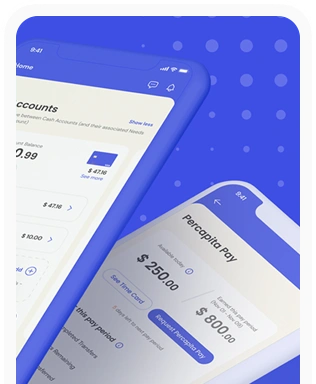
Percapita
We designed a full-fledged application for simplifying everyday finances.
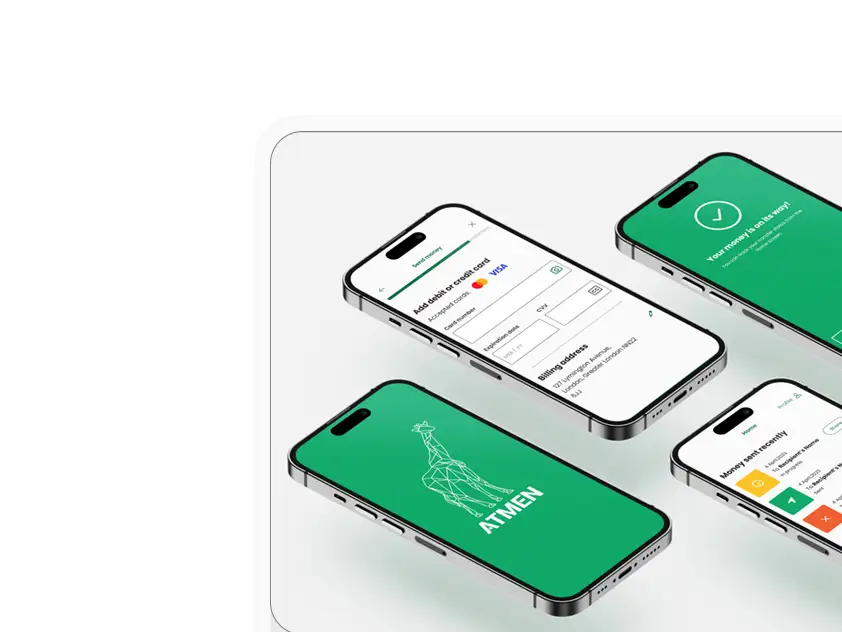
Atmen Fintech
Mobile App
Designing a Minimum Viable Product for a Diaspora Neobank Startup
Sterling Archer
By applying the DDD framework, we created multiple digital tools for a US based Data Company.

Ergomania and NGOs in the Netherlands
UX design for Fintechs, banks and financial startups is the everyday work of Digital Product Design company, Ergomania based out of Budapest, Hungary.

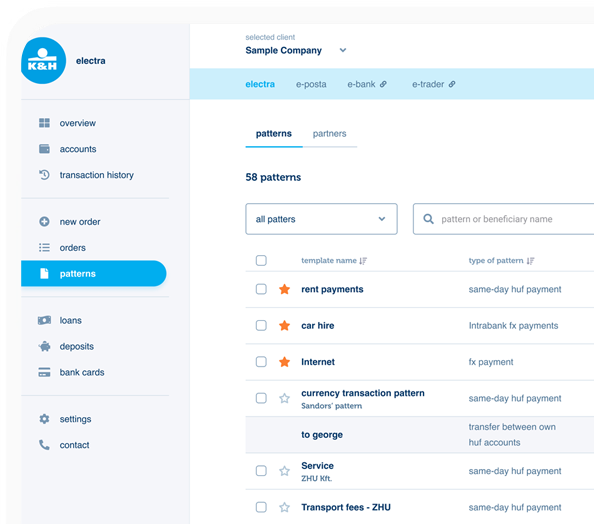
K&H Bank's Corporate Netbank
The K&H Electra Netbank App consolidates all financial needs into a single, user-friendly application. With its intuitive design, businesses can effortlessly manage their company's cash flow, transactions, and investments from one centralized hub.
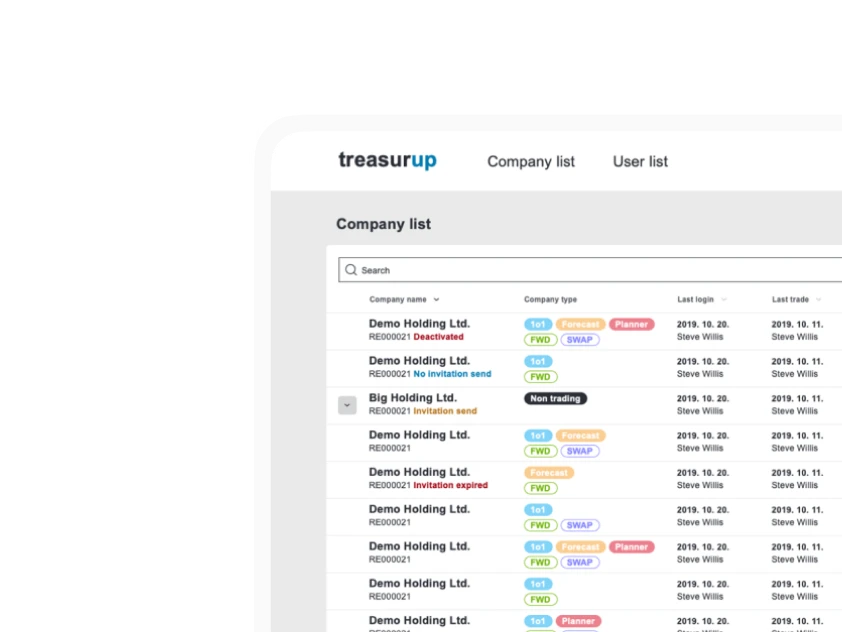
TreasurUp
We established written and visual consistencies and guidelines for TreasurUp’s financial platform.
Simple by OTP
Simple by OTP Bank is Hungary's No.1 mobile payment app for cashless payments with 1M+ downloads, and 1 million+ transactions.

White Label Banking App
We provide full-blown next-generation mobile banking solutions for sales-oriented banks.
Want to read more
about UX, fintech and banking?
Subscribe to our biweekly newsletter and get the latest of our news and thoughts!