Practical AI in Banking and Fintech: From Hype to Production
Everyone is talking about AI, but what actually works in a bank's digital product development, and where is the real bubble hiding? At Ergomania's business breakfast in Prague, as part of Fintech Week, Czech and Slovak industry professionals sat down to look behind the superficial hype. One thing emerged from the discourse: currently, there is no single exclusive "right" path for AI implementation. The real stake is creating the delicate balance of innovation, strict regulation, constantly changing customer expectations, and cybersecurity responsibility.
The Prague event was co-organized by Ergomania and its long-standing professional partner, Tapix by Dateio, a company dealing with transactional data enrichment. The two companies have been working together for nearly a decade, the roots of their cooperation tracing back to a meeting in Amsterdam. The panel was moderated by Dr. András Rung, Founder and CEO of Ergomania. His guests were Jiří Raška, CTO of Partners Banka; Martin Hajný, Head of the AI Competence Center at Raiffeisenbank Česká republika; and Ivan Dovica, Co-founder and CEO of Tapix by Dateio. The opening was intentionally focused: not another general AI presentation, but insights usable in daily practice at the intersection of digital product design and business strategy.
Agents as the New Junior Colleagues in the Organization
The opening question hit the nail on the head: Where are the real, working use cases beyond the fact that the technology is exciting? According to Raška, banks must already think in the agentic (agent-driven) era. The declared goal of every development and business team is to have their own "junior AI avatar" that performs repetitive, monotonous tasks. Traditional prompting is a thing of the past; efficient organizations today work with agents in all areas of the bank – from product development to digital design.
Modern banking management struggles with integrating a junior workforce because the leadership consists exclusively of seniors. However, AI has now opened the path for the scalable application of virtual junior colleagues. In the development teams of Partners Banka, the toolset is unified and tools are continuously tested against one another. They use an OpenCode-based agent environment, GitHub Copilot (with 28 different models), AWS Bedrock, and Google Gemini in parallel, taking advantage of the new capabilities of the models appearing monthly. The real breakthrough, however, is knowledge sharing. The departments present their latest agent experiments in Friday educational circles, helping the organization's transition from prompting to genuine agentic operation.
The Hidden Bubble: Token Prices vs. Stock Market Valuation
The costs of technological implementation brought a sharp contrast to the panel. Partners Banka transparently shared the numbers. They spend $69 per developer per month on agentic tools. As Rung pointed out, this means a "cheap junior" workforce compared to the volume of work performed. Hajný, however, highlighted a different strategy. At Raiffeisen, this amount hovers around a mere $0.50 per user per month, while they conduct interactions in the magnitude of tens of thousands. The secret is that they do not buy pre-packaged subscriptions (such as M365 Copilot) en masse, but integrate the "clean model" and build their own environment independent of third parties on it – which can mean a serious competitive advantage during scaling.

One of the panel's most important statements also stemmed from this financial reality. According to Hajný, the AI bubble in the market is not to be found in stock market valuations, but in token prices. Currently, industry giants (OpenAI, Anthropic, AWS, Azure, Nvidia) offer artificially subsidized tokens for the sake of acquisition. Once this phase concludes, the bill for maintaining the infrastructure could suddenly be much higher than the business profit derived from it. Another important aspect is that while global, group-level developments are taking place in backend systems and cloud infrastructure (e.g., within the RBI group), the frontend experience must be designed locally. Local customers expect a culturally relevant experience, which cannot simply be "translated" with a central AI model.
Workflow vs. Agent: The New Definition and the Fate of Human Juniors
From a technological perspective, Dovica sees the presence of AI in the financial sector in three dimensions: in the development (coding) phase, in the professional support provided to banks, and in building their own fintech products. According to him, the most difficult terrain currently is the operational level, where business and product development professionals (product owners, managers) encounter the technology; there, the competence gap is still huge.
Dovica also drew an important conceptual distinction: what most companies are running today are not true agents but AI-assisted workflows. The difference is fundamental: an agent makes decisions autonomously and initiates new tasks to achieve the goal, while a workflow is a well-structured pipeline that is started by a human and runs through specific steps to the end.
However, if virtual agents slowly begin to really perform junior work, the question arises: What will happen to human junior colleagues? Hajný drew attention to the fact that while experienced professionals are developing "junior agents," fundamental skills may slowly disappear from the new generation. High school students learning to program today and their teachers are equally clueless, as classic junior tasks – writing a simple loop or function – have become completely automated.

The solution, according to Dovica, is that the role of human juniors will transform. Employees will be needed who are able to delegate to and manage AI from day zero. AI is a "faceless, emotionless junior" that is incapable of giving advice with a human context, which is why it requires continuous micromanagement. Anyone who cannot provide validated feedback even as a human, and cannot differentiate between good and flawed output, will not be able to effectively direct an AI junior either. Furthermore, in a large, complex banking system, even AI itself can easily get lost, and we cannot yet fully entrust the security or authentication layers of coding to a machine – highly trained professionals who understand the context are still needed here.
The Paradox of Code Quality and API Documentation
On the issue of quality versus speed, the experts expressed cautious optimism. According to Raška, the quality of development remains unchanged for now, only the speed of delivery increases, since the right of verification remains in the hands of human professionals. Dovica, however, drew a sharp distinction between a "good AI result" obtained during internal development and a live solution acting as a product put in front of the customer. In the latter case, the generated results often feel "robotic" and still require fine-tuning for proper UX.
Cosmin Cosma, CEO of Finqware, a company specializing in open banking, joined the conversation from the audience with an illustrative example. Previously, banking APIs had to be connected by humans because a machine struggled with documentation written by a human, which was often flawed or incomplete. However, ever since AI has had direct access to extensive corporate GitHub codebases, it sees through global patterns. It recognizes the typical documentation errors of hundreds of APIs – it "learns," for example, that if a specific error occurred at UniCredit Romania, it is highly likely that its source is the same at UniCredit Slovakia – and automatically writes the fix. In this dimension, the classic junior-senior setup is completely overturned. There are "juniors" who are brilliant at prompting and managing AI, while some experienced seniors reject the technology, struggling with their own prejudices. Since AI has no emotions, it performs better than humans in the monotonous documentation tasks avoided by everyone.
The Client-Side Experience (UX) and the George Lesson
In the field of client-facing, direct AI solutions, the panel stayed grounded in reality. Hajný mentioned Erste's (Česká spořitelna) George app. Despite the great expectations accompanying the introduction, the bank is experiencing a decline in the use of the chatbot. The reason is simple: Customers expected a much more advanced, human-like conversation from the system than what it was technologically capable of, so they are returning disappointedly to traditional, well-structured navigation. The lesson is that before development, actual user needs must be examined; a technology should not be blindly forced onto the market purely because of hype.
There is risk in it, too. If banks do not provide an adequate digital experience, users will turn to public AI tools with their financial questions – which indicates that financial institutions are not reacting fast enough to the market's pace. In the long run, it is a realistic danger that these models will take over the role of the banking interface. In the Prague tech bubble (which is a negligible fraction of the population), this is already the present tense, but true adaptation must be measured at the level of average users.
The Strategic Crossroads of Banks: Infrastructure or the Next Revolut?
One of the most important threads of the conversation dissected the future business role of banks. According to Dovica, financial institutions often do not even realize what a massive built-in advantage they start with in the digital space. An average fintech or e-commerce application has to constantly fight for the user's attention, whereas people are forced to use banking applications, even dozens of times a month, since that is where they keep their money. This comfortable position led to banks not caring about usability at all a decade ago: they didn't mind if an account opening process consisted of four steps, and in each phase they lost 20% of potential customers.

Today, financial institutions stand before two paths: they either maintain their customer relationship dominance with strong UX developments, or they suffer the fate of telecommunication companies. Telcos were once the stars of digitalization, but today they operate as invisible infrastructural service providers in the background – the average person often doesn't even know off the top of their head which company provides their mobile internet.
Cosma also confirmed this. With the mandatory EU directives and the gaining ground of PSD3 (Payment Services Directive 3), open banking APIs (e.g., PISP payment initiation services) are completely transforming the market. The "next Revolut" will most likely not be a traditional mobile app, but an omnipresent conversational bot, where the user doesn't care which large bank performs the transaction in the background. Despite this, the retail sector is currently strongly resilient. Building trust takes decades, and the average customer often accepts a worse experience – an outdated but familiar application – if they trust the institution behind it. As Rung noted, this trust can be reallocated slowly but surely. This is proven by the success of Revolut and ChatGPT becoming a global brands in four years. If banks are eventually squeezed out of the primary customer relationship, the ultimate winner will presumably be a player who does not even exist in the market today.
Hidden Data Leakage and the Human-Centricity of the Future
The closing round of the discussion focused on the dark sides of development. Raška called attention to the cybersecurity risks of large language models (LLMs). The majority of users are not aware of new vulnerabilities such as prompt injection, and companies underestimate that through uncontrolled AI usage they are leaking sensitive corporate and customer data to American or Asian servers. Dovica added to this at the level of corporate networks: If an organization allows agents into its internal systems, it technically opens up a completely new attack surface for hackers, through which the entire data asset of the company can be compromised – and the sector is currently only learning how to defend against this.
The vision of the future, however, remained realistic. The industry tends to overestimate the impact of AI in the short term – the full automation promised by management for six months will not materialize; but in the long term, it underestimates the profound, structural changes of the technology.
Hajný formulated the most important conclusion of the Fintech Week breakfast in Prague: "The future is not in artificial intelligence, but in us." During digital design, human needs and the true motivations of users must first be understood, and only then should the toolset be reached for. The adaptation of AI will be the result of not weeks, but years of persistent work in the banking sector; those systems that are introduced hastily and with unrealistic expectations will fail within a short time. The key to sustainable success has remained responsible, human-centric design and secure integration.
About the authors
Balázs has been working in content for more than 20 years, having the role as an editor at one of the first and largest news sites, later helping to establish the content marketing business for media publishers and agencies. Today, Balázs serves as content producer at Ergomania Ltd.
Related case studies
Prefixbox
Prefixbox is a Hungarian e-commerce scaleup. We helped them design an AI agent that gives more accurate product recommendations to shoppers with generative AI.

Percapita
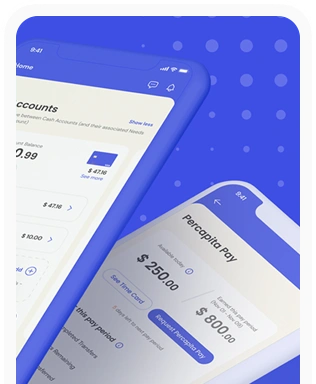
We designed a full-fledged application for simplifying everyday finances.
Atmen Fintech
Mobile App
Designing a Minimum Viable Product for a Diaspora Neobank Startup

Sterling Archer
By applying the DDD framework, we created multiple digital tools for a US based Data Company.

Ergomania and NGOs in the Netherlands
UX design for Fintechs, banks and financial startups is the everyday work of Digital Product Design company, Ergomania based out of Budapest, Hungary.

K&H Bank's Corporate Netbank
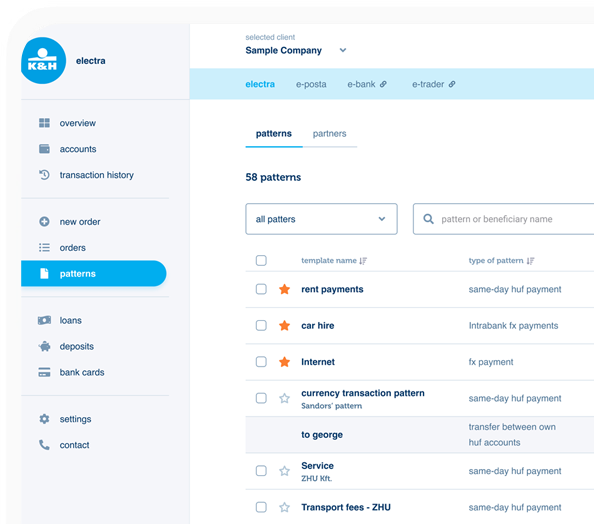
The K&H Electra Netbank App consolidates all financial needs into a single, user-friendly application. With its intuitive design, businesses can effortlessly manage their company's cash flow, transactions, and investments from one centralized hub.
TreasurUp
We established written and visual consistencies and guidelines for TreasurUp’s financial platform.

Simple by OTP
Simple by OTP Bank is Hungary's No.1 mobile payment app for cashless payments with 1M+ downloads, and 1 million+ transactions.


White Label Banking App
We provide full-blown next-generation mobile banking solutions for sales-oriented banks.
Want to read more
about UX, fintech and banking?
Subscribe to our biweekly newsletter and get the latest of our news and thoughts!