The Product as a Mirror: How Organizational Disharmony Becomes a User Obstacle
At the recent Ergomania Business Breakfast, we examined a complex set of connections that touch upon one of the deepest, often unexplored layers of digital product development. Moderated by design strategist Ádám Drágus, and with the help of neuroinclusive designer Eszter Daniss-Bodó and design strategist and leadership advisor Péter Klein, we explored the provocative yet fundamentally important hypothesis that digital interfaces, applications, and systems are exact imprints of how the organization that created them thinks, communicates, and makes decisions.
During the discussion, it became clear that product development is essentially inseparable from organizational development. User experience (UX) is not an isolated technical layer, but rather the direct projection of the employee experience, the internal communication culture, and the self-awareness of leaders.
The Doorbell Paradox: When Entering a UX Company Is Difficult
An ironic yet instructive anecdote set the tone. Péter noted that although he had arrived for an event at a UX-focused company, he struggled for minutes to find the entrance and the correct doorbell.

"What does this say about the organization?" he asked. The answer contains the essence of the topic. An organization can be excellent in its profession, but if it doesn’t pay attention to its internal processes and entry points, it creates tension in the visitor, or the user. This effect also appears in the digital space. If the organization is defensive ("We only rent the office") or lacks empathy toward the user's circumstances (“You found it eventually”), it immediately manifests as a tangible obstacle. The goal is not to judge the mistake, but to recognize it. Getting lost in a physical or digital space is not a sign of the user's stupidity, but a symptom that may indicate a lack of designer and organizational communication.
The Symbiosis of Product and Organization
The fundamental premise of the professional discussion was the observation that the shortcomings of products or services can be directly traced back to the internal dynamics of the organization. As Péter phrased it: "A flaw in the product or service is a reflection of the organization's flaws." For the UX profession, this thought represents a continuous discovery phase: we don’t treat it as a ready-made truth, but rather investigate where this connection can be caught in the act.
The most illustrative examples come from the banking sector. When 16 fields must be filled out for a simple transfer in a banking application, and the same process can be completed in three steps at a competitor or a fintech company, we can really speak purely of technological limitations. In the background, there are many differing organizational attitudes, risk-taking strategies, and internal approval processes. Where compliance pressure and the legal department dominate user needs, and there is no real dialogue between departments, the product will also be strict, cumbersome, and over-administered. In contrast, where engineering and business areas are capable of dialogue and co-creation, solutions become more streamlined.
The product is therefore a mirror: it provides feedback on how capable the various silos – IT, marketing, business, legal – are of understanding each other. Eszter highlighted that terminological inconsistency within a website – for example, when the same function is called "client support" on one subpage and "customer service" on another – accurately indicates a lack of internal communication. In such cases, the user not only encounters poor wording, but also perceives the organization's disintegrating internal reality as a cognitive load. The organization "does not talk to itself," and the user pays the price for this silence by not understanding the interface.
A Neuroaffirmative Approach: More Than Accessibility
One of the deepest layers of the conversation was the business and human aspect of neurodiversity and neuroinclusive design. Eszter introduced the audience to the neuroaffirmative approach. The essence of this is to treat as a fundamental premise that human nervous systems are wired in many ways, and this diversity is a value, much like biodiversity. There is no "normal" and "semi-normal" – there are different modes of functioning that coexist.
A significant part of society has a different neurotype (whether it is ADHD – attention deficit hyperactivity disorder, the autism spectrum, dyslexia, or other modes of functioning). Our products should serve this diversity. This is not a charitable act, but a fundamental business interest and the key to retaining talent. Neuroinclusivity expands the classical concept of accessibility. While accessibility often focuses on physical barriers or legal compliance, neuroinclusivity integrates the diversity of cognitive processes. During the design process, the clarity and concreteness of phrasing, as well as predictability, are crucial.

According to an example mentioned during the discussion, questions regarding abstract emotional states, such as "How do you feel?", can be difficult to interpret and answer in certain cases (e.g., for those living with autism). Such questions can even cause anxiety, because users are not always able to verbalize their bodily sensations. In contrast, concrete, physical experiences – such as perceiving that "the shoe is tight" – represent much more tangible information. Digital interfaces become truly inclusive when, instead of uncertain, abstract concepts, they assist the user's orientation and decisions with precise, easily identifiable keywords.
This mindset also has an internal effect on the organization. When designing the workplace environment, taking into account the needs of neurodivergent colleagues – whether it involves noise-canceling headphones, a quiet room, or choosing the appropriate communication channels – is not merely a matter of comfort, but a basic condition for efficiency. If this safe environment is provided, complementary cognition can prevail: the collaboration of analytical (those who delve into details), creative (those who switch quickly), and systemic thinkers (those who see the big picture), results in far more innovative solutions than the work of homogeneous teams.
Organizational Congruence: Carl Rogers in Business
While using an application, why do we sometimes feel that something is off, even if it works technically? Péter explained this phenomenon using a concept borrowed from one of the fathers of psychology, Carl Rogers: congruence (self-identity). According to Rogers, a congruent person is one whose feelings, thoughts, and actions point in the same direction. For instance, if we desire an energy boost in a situation and want an external stimulator for this, such as wanting to drink coffee (feeling), deciding to drink it (thought), but failing to do so (lack of action), it generates tension and frustration.
Elevating this model to an organizational level, we can see that similar mechanisms operate within companies. An organization functions congruently if its vision (what it says), its internal processes (how it operates), and its actual market behavior (the product) overlap. If leadership speaks of innovation and customer centricity, but internal regulations turn every innovation into a bureaucratic obstacle course, it breeds organizational incongruence.
This tension seeps into the product, and the user feels the disharmony. A beautiful design is pointless if the underlying process is rigid and untrusting. The product often reflects the leader’s personality traits as well. Under a controlling leader, products can also become rigid, whereas under a leader who builds on trust, they are more flexible. The self-reflection of leaders thus directly impacts business effectiveness.
The Price of Decisions and Memorizing the Poem
Today's economic environment is characterized by uncertainty and rapid changes. But is the weight of our decisions greater than in the past? Péter nuanced the picture with an interesting historical parallel. In the past, the number of decisions was fewer, but their individual stakes were perhaps higher. In primary school, if someone did not memorize the mandatory poem, they were not admitted to high school, which determined their entire career path. Today, however, it is the frequency of decisions and informational noise that burdens us. A Gen Z youth has to make thousands of micro-decisions daily, while on the organizational side, the price of decisions has increased exponentially due to the accelerated market. If a company fails to act in time, or misjudges a technological shift, the consequences can be immediate and drastic.
In this context, cognitive safety becomes increasingly valuable: do employees dare to ask questions, dare to make mistakes, and have time to make decisions without feeling rushed? If cognitive safety is lacking in an organization, innovation halts, because everyone strives to play it safe, leading to mediocre products.
Dismantling the Silo Effect: Lawyers and Designers at the Same Table
One of the most instructive anecdotes of the discussion concerned the relationship between legal compliance and UX. Ádám recounted that at a previous event, a legal expert was invited. They were expected to be the bottleneck, dictating what could not be done and why. Instead, the audience was in for a huge surprise: the legal expert lined up the same arguments as the designers: comprehensibility, transparency, and user interest.
The problem was not with the goals, but that the two areas never sat at the same table at the beginning of the process. Everyone worked within their own silo, based on their own assumptions.
The solution lies in early involvement and co-creation. Enforcing the principle of "understanding, not convincing" in internal communication allows legal limitations to serve not as obstacles, but as the creative frameworks of design.
Tools for Empathy: Situational Cards
How can this kind of understanding be brought into everyday life, especially in an engineering environment where soft skills might be less emphasized? Eszter presented a highly practical tool: situational cards.

It is often difficult to imagine what it might be like to have dyslexia or autism, but everyone understands what it is like to be hungover, sleep-deprived, or working next to a crying toddler. These transient states (temporary disabilities) place a similar cognitive load on the brain as permanent conditions. If developers and designers must test the product using such life-situation cards – "Try to complete the transfer while a child is screaming in your arms (meaning with noise and one hand)" – they suddenly understand why simplification, large buttons, or clear wording are important. This is the gateway to empathy.
From Diagnosis to Organizational Wisdom
The connections uncovered during the discussion call on market players to view digital developments as organizational diagnostics. The friction appearing in products is not merely "bugs," but symptoms. These symptoms indicate stalled internal communication, incongruent leadership, or a lack of cognitive safety.
The key to future-proofing is the kind of wisdom that moves beyond mere data collection. As Péter highlighted, data becomes information, information becomes knowledge, knowledge becomes experience, and experience turns into wisdom. But perhaps the most important takeaway comes from biology and can be captured in the phenomenon of co-regulation. Just as a newborn is not viable alone and needs social regulation (touch, connection), organizational units and employees are also unable to exist in isolation, within silos.
Organizations that recognize this and invest in a neuroinclusive, congruent, and psychologically safe environment not only create better products but also build a more livable reality.
Since building this more livable, inclusive reality requires long-term commitment and continuous learning, we have by no means closed the topic. We will continue this conversation in the future.
About the authors
Balázs has been working in content for more than 20 years, having the role as an editor at one of the first and largest news sites, later helping to establish the content marketing business for media publishers and agencies. Today, Balázs serves as content producer at Ergomania Ltd.
Related case studies
Prefixbox
Prefixbox is a Hungarian e-commerce scaleup. We helped them design an AI agent that gives more accurate product recommendations to shoppers with generative AI.

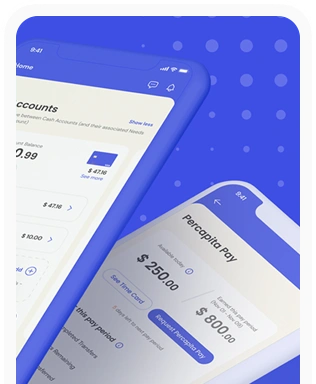
Percapita
We designed a full-fledged application for simplifying everyday finances.
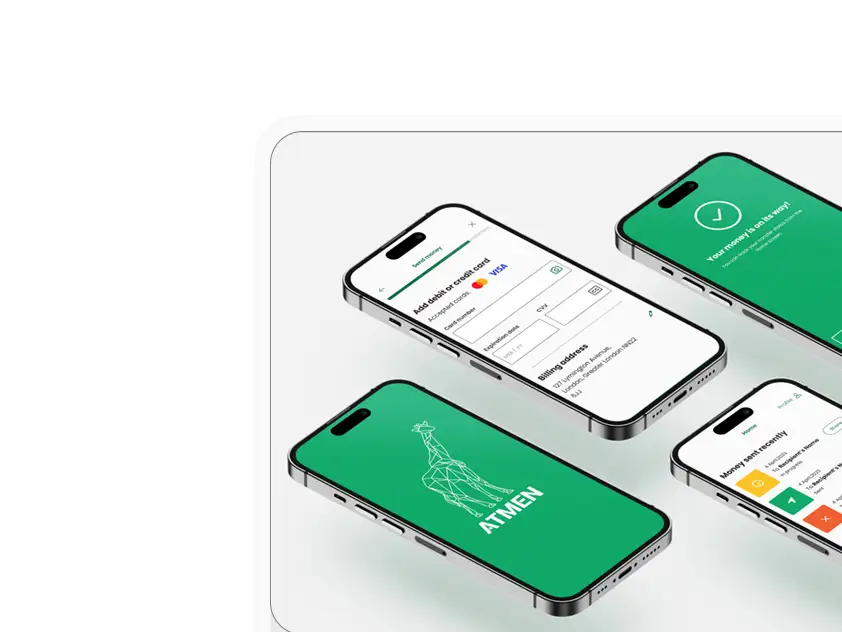
Atmen Fintech
Mobile App
Designing a Minimum Viable Product for a Diaspora Neobank Startup
Sterling Archer
By applying the DDD framework, we created multiple digital tools for a US based Data Company.

Ergomania and NGOs in the Netherlands
UX design for Fintechs, banks and financial startups is the everyday work of Digital Product Design company, Ergomania based out of Budapest, Hungary.

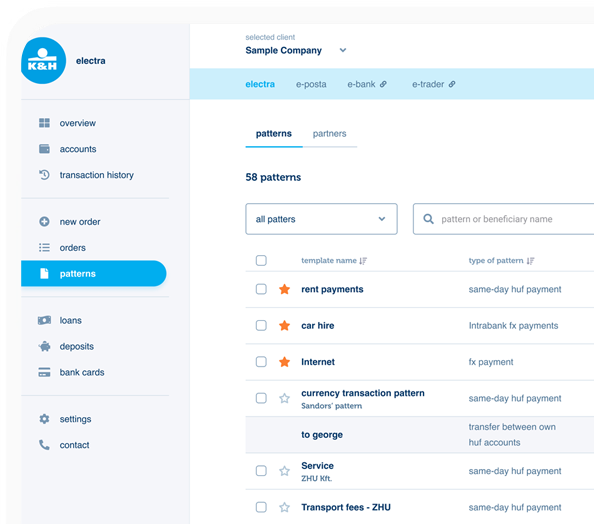
K&H Bank's Corporate Netbank
The K&H Electra Netbank App consolidates all financial needs into a single, user-friendly application. With its intuitive design, businesses can effortlessly manage their company's cash flow, transactions, and investments from one centralized hub.
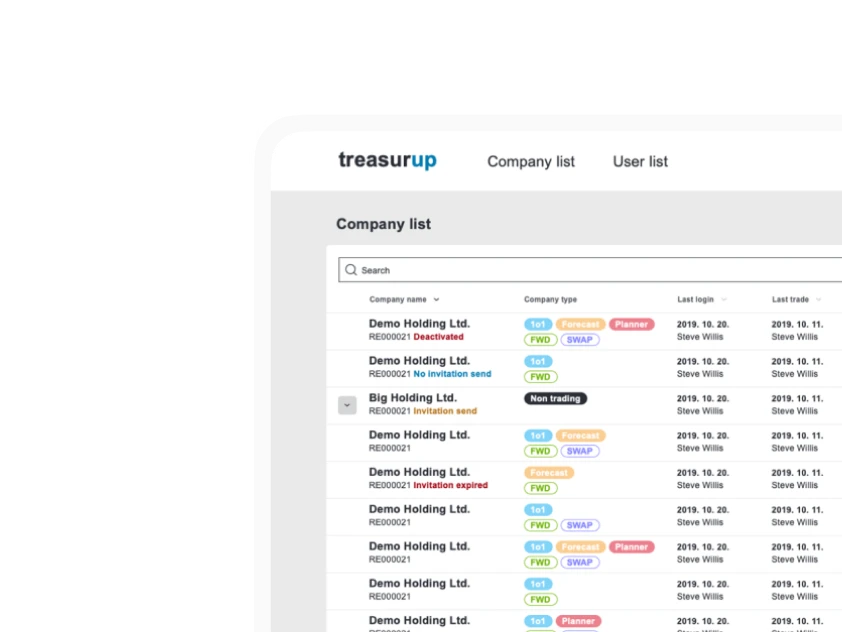
TreasurUp
We established written and visual consistencies and guidelines for TreasurUp’s financial platform.
Simple by OTP
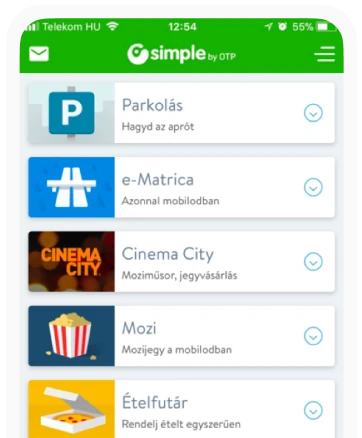
Simple by OTP Bank is Hungary's No.1 mobile payment app for cashless payments with 1M+ downloads, and 1 million+ transactions.

White Label Banking App
We provide full-blown next-generation mobile banking solutions for sales-oriented banks.

Want to read more
about UX, fintech and banking?
Subscribe to our biweekly newsletter and get the latest of our news and thoughts!