‘We’re just getting started’ – the rise of Djoin Indonesia
The first question to the Chief Product Officer and President of Djoin, ‘on a mission to empower grassroot communities through strong cooperatives’ is how to say the name of this Indonesian Fintech. Is it Dee-join? Or Duh-join, or …? Farzikha Soerono explains, “My partner and co-founder Indra Adhi Suputra was visiting his grandma’s place, and she had an old calendar with the Dutch spelling of Djoin on it.” Indonesia was a Dutch colony until the 1940s, and the old word inspired Indra because it expressed the idea of an organization where everyone is included and is eligible to become part. So it’s written Djoin, and pronounced as the English word ‘join’ – a good description of the company’s activities in creating microfinance services for cooperatives in four of Indonesia’s thirty-eight provinces. Powering Djoin’s activities is a custom AI-based credit decision engine helping cooperatives and Microfinance Institutions reduce non-performing loans by over 60%, while growing their loan portfolios sustainably.

Building technology solutions on financial services
Farzikha explains how Indra was the initial ‘brain’ of Djoin, with ‘the impact guy’ being Putu Takumi Wijaya who came in from the consulting arm of McKinsey. Meanwhile back in 2016 Farzikha gained experience of the cooperative space on job assignment working in a remote area of East Java. Here he witnessed a very rural area with a lot of farmers and few technology solutions and saw firsthand the need for simple financial solutions to provide water pumps or sanitation. No banks were interested in supporting or financing such small activities however. By 2021 Farzikha’s own experience of the sector had deepened, so when he met up with Indra and Takumi there was a strong feeling that they could work together towards building technology solutions on financial services and moving towards solving the many problems faced by cooperatives.
The scale of Indonesian co-ops
To understand the scale of the Indonesian cooperative movement, there are around 130,000 active in the country, almost all needing ‘last mile’ financing to achieve their often very modest aims. However there was historically a lot of fraud involved, with mismanagement and operational issues, along with accounting mismatches and very poor underwriting. This tended to lead to poor and underperforming loans. The trio that would go on to form Djoin could see that they had the skillset and motivation to bring more professionalism and reliability to the cooperative area.
Farzikha was coming from time working with the largest Fintech in Indonesia, SuperApp Gojek (now listed on the Indonesian Stock Exchange as Goto) where he had led product management for the financial services team. Their BNPL solutions were built and in operation even before Klarna had become operational in Europe. “We were really pioneers at delivering Fintech for both consumers and SMEs in Indonesia, building financial technology solutions for millions of users across the country.”
Indra in turn had gained very direct microfinance experience working with his father’s co-op in Bali, which had been impacted by the problems of securing loans and avoiding fraud.
 Farzikha Indrabhaskara Soerono
Djoin’s North Star
So it sounds like the impetus behind Djoin was social impact. While Farzikha acknowledges this to some extent, he also points out that there has always been a strong business model. “It used to be that Indonesia and Southeast Asia were the Venture Capital darlings. But a lot of the investments went through different types of startups, including those with the social impact angle – agriculture and fisheries, for example. There were a lot of peer-to-peer lending companies providing financing.” The mindset was on growing the numbers rather than growing the impact which was not significantly measured. Djoin’s ‘North Star’ is profitability and growing revenue, but generating impact is also crucial. Examples of this include analysis of how loans are distributed between urban, suburban and rural areas, and particularly in the distribution of loans to women.
Of the four provinces that Djoin is currently active in – Central Java, East Java, Bali, and East Nusa Tenggara – 70% of loans disbursed by the company’s cooperatives go to micro, and small and medium enterprises. Of these the majority are headed up by women because, “There is a traditional belief in Indonesia that women are a lot more responsible than men, and there are already a number of microfinance companies in Indonesia who only do lending to women.” These include two of the largest Indonesian microfinance companies, Amartha ‘Empowering women micro-entrepreneurs through business capital support,’ and BTPN Syariah.
The Warung phenomena
Farzikha describes how Djoin’s technology solutions are now employed by over 150 clients, and at the close of 2024 the amount of loans disbursed was about $70 US million, mainly to Warung ‘Mom and Pop’ enterprises. ‘Warung’ is used in Indonesia to describe a small, often family-owned business – typically a shop or cafe that is an essential part of daily life. With the support of the co-ops and Djoin, some of these Warung are also now expanding into online selling. Loans average 16 million rupiah ($1,000 US) across the regions, with some loans in the most rural areas as little as 4 million rupiah. While Djoin does not necessarily provide the actual loans, its tech solutions provide better financial analysis and underwriting, which support the credit decisioning process. Going digital helps reduce fraud and mismanagement and while previously non-performing loans were as high as 50%, this figure has now been halved overall.
Djoin’s collection app is also working to mitigate fraud and theft, and Farzikha describes how collectors go door-to-door for cash repayments, where typically from a 1 million rupiah repayment, up to 200,000 used to mysteriously disappear on its way back to the co-operative!
Government-backed expansion of the co-op ecosystem
The situation with cooperatives had become increasingly grim with up to ten major co-ops being convicted of fraud, after customer deposits were spirited away. However in 2024 the new president of Indonesia, Prabowo Subianto – who Farzikha says has a deep interest in growing rural economies by empowering cooperatives – set out to establish 80,000 government-backed co-ops by 2030. That’s on top of the existing 130,000 so there is massive scope for expansion of the ecosystem, while at the same time regulation around the sector is ever more stringent. After the chaos of many Fintechs going bankrupt in recent years, often because of massively over-geared and predatory loans (both given and disbursed) there is a new reality emerging. From the side of the cooperatives Farzikha believes the new realities may come good, and as for the Fintechs, increasing regulation may limit rampant and unproductive growth.
Attracting international attention
Djoin’s own growth has been steady, starting from Solusi Anak Sakti – a software provider for the ecosystem of micro-financial institutions in Bali – to becoming an important technology enabler. The company lists a key achievement as being the closing of seed funding from the 500 Global VC group in May 2024, ‘Despite the tech winter.’ Farzikha says, “What’s interesting is that everybody wants to come to Indonesia because the market is the largest in Southeast Asia. We have 280 million people, which is huge, but disposable income is lower compared to other neighboring countries.” There are many foreign startups interested in Indonesia, but already some US tech companies wanting to expand to Indonesia have tried and failed. It’s very much because of the cost ratio, where talents and technology from abroad cost around twenty times more than homegrown skills, but it also points to a lack of understanding of Indonesian culture. “Indonesia is a very relationship-based culture, right? You get a deal by hanging out, not by doing pitches online. Even between countries like Singapore and Indonesia, the cultures are very different.” Hanging out was Farzikha’s mission when he attended and presented at the Catapult: Inclusion Southeast Asia 2025 accelerator program hosted by LHoFT – Luxembourg House of Financial Technology supporting Fintechs advancing financial inclusion. Djoin was selected as one of the ten winning startups presenting at the 2025 Asian Development Bank Finance Forum in Manila. As the Djoin team reported at the Luxembourg meeting, ‘Real impact is built from the ground up – and we’re just getting started’.

Pragmatism vs optimism
That sounds pretty optimistic, so is that how Farzikha is feeling? “I am pragmatic. Not optimistic, but pragmatic. We have to adapt to survive. We’re looking at the new regulations that could be a good opportunity for us, but could also become a double-edged sword. The tech winter was a reminder to focus on the bottom line. But in general, if you talk to a lot of the startup founders in Indonesia, they tend to be a lot more pragmatic at this time, after seeing one out of three close down every month. A lot of our friends who raised millions of dollars before didn’t get enough traction. Last year Djoin launched the credit decision engine Kocek – the platform for managing credit decisions that can minimize credit risk – which has propelled our revenue growth. We’ve been able to grow by about two and a half times from the same period last year. We are looking to double down on this to expand aggressively in the four provinces where we are currently active.”
Indonesia is much more than just Jakarta
That’s the corporate goal, but what about Farzikha’s own ambitions? There’s a personal mission not only to empower the cooperatives, but also to set up and make teams work outside of Jakarta (population over ten million and growing). He admits that a personal metric of success would be that members of Djoin’s team become so empowered that Jakarta-based businesses will start head-hunting them!
It’s a slightly paradoxical thought, but shows the strength of belief the founders of Djoin have in their colleagues, their region of Bali, and their own vision.
About the authors
Harlan Cockburn is a writer and director based in Budapest, Hungary.
Related case studies
Prefixbox
Prefixbox is a Hungarian e-commerce scaleup. We helped them design an AI agent that gives more accurate product recommendations to shoppers with generative AI.

Percapita
We designed a full-fledged application for simplifying everyday finances.

Atmen Fintech
Mobile App
Designing a Minimum Viable Product for a Diaspora Neobank Startup

Sterling Archer
By applying the DDD framework, we created multiple digital tools for a US based Data Company.

Ergomania and NGOs in the Netherlands
UX design for Fintechs, banks and financial startups is the everyday work of Digital Product Design company, Ergomania based out of Budapest, Hungary.

K&H Bank's Corporate Netbank
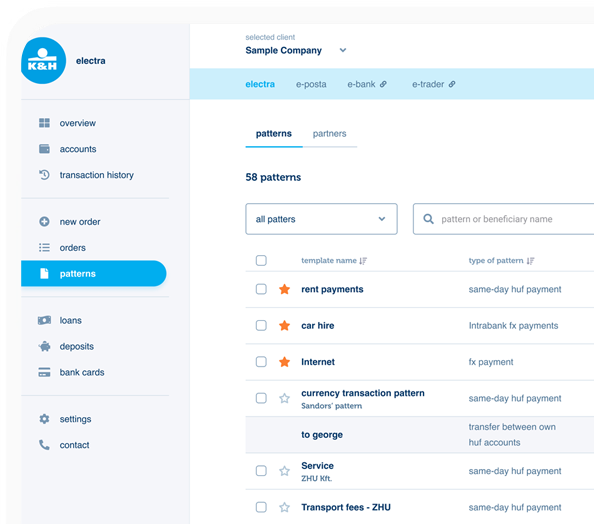
The K&H Electra Netbank App consolidates all financial needs into a single, user-friendly application. With its intuitive design, businesses can effortlessly manage their company's cash flow, transactions, and investments from one centralized hub.
TreasurUp
We established written and visual consistencies and guidelines for TreasurUp’s financial platform.

Simple by OTP
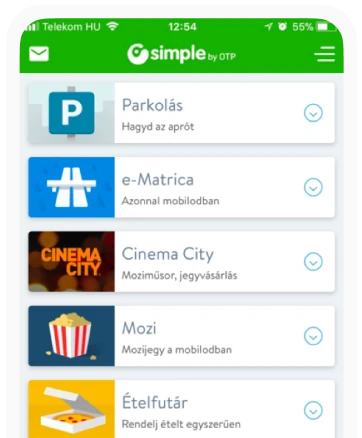
Simple by OTP Bank is Hungary's No.1 mobile payment app for cashless payments with 1M+ downloads, and 1 million+ transactions.

White Label Banking App
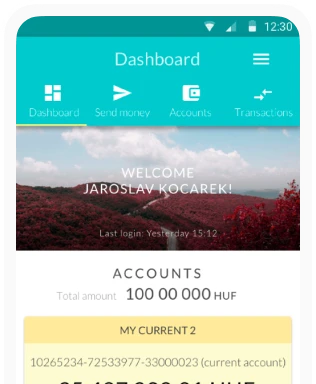
We provide full-blown next-generation mobile banking solutions for sales-oriented banks.
Want to read more
about UX, fintech and banking?
Subscribe to our biweekly newsletter and get the latest of our news and thoughts!