AI Powered, Human Led: Who Is in Control When Artificial Intelligence Draws?
If AI can generate a complete interface in seconds, what is left for the designer – and what happens in the organization if coding suddenly speeds ahead while design lags behind? At the latest roundtable discussion of the Budapest FinTech Summer Talks, banking executives and an AI transformation expert explored how generative AI can add real, measurable business value in product design beyond mere speed. The common denominator and most important lesson of the discourse became the "AI-powered, human-led" principle. Alongside technological acceleration, strategic decision-making, building customer trust, and genuine creativity remain firmly in human hands.
The panel took place within the framework of the Budapest FinTech Summer Talks, co-organized by the Hungarian Fintech Association, Deloitte, and Ergomania. The discussion was moderated by Dr. András Rung, Founder and CEO of Ergomania. Participants included prominent professionals from the domestic and regional financial and technological sectors. At the roundtable, Jiří Raška, CTO and Co-founder of Partners Banka; Zsolt Dunai, Head of Digital Marketing at CIB Bank; and Balázs Koltai, AI Advocate & Educator, Digital Transformation Leader, shared their experiences from everyday practice. The question? Is AI just another efficiency-boosting tool, or a change that shakes the foundations of digital product design.
Lagging Traditional Banks and Agent-Driven Neobanks
The opening question got straight to the point: How can AI create real value that customers can actually perceive in design processes, not just make those processes faster? Dunai offered a candid but forward-looking assessment, noting that traditional large Hungarian banks are still in an early stage of applying AI to service design. While AI has already become an integral part of everyday digital marketing optimization and content production, using it effectively in complex UX and UI design presents a more advanced challenge. Traditional financial institutions have historically focused their core capabilities on areas such as risk management and lending, often relying on external partners and agencies for design expertise. This also means there is significant potential for banks to bring AI-driven design capabilities closer to their core customer experience in the coming years.
Raška's status report was in sharp contrast to this traditional approach. As the CTO of Partners Banka, he stated that, for them, simple, manual prompting is already outdated; they're now living in the era of agent-based operation. In this system, autonomous AI agents are integral parts of the development and design processes, and thanks to this, the organization progresses ten times faster compared to its previous pace. Technology integration does not stop at software developers. AI is connected to design software, so designers and product owners are able to create new prototypes and interface versions in seconds.
Why Isn't AI Taking Off in Large Enterprises?
Koltai, who builds and manages AI transformation programs, and advises clients ranging from SMEs to large multinationals and banks such as the National Bank of Egypt employing 35,000 people, spoke of the difficulties of technological implementation. In his experience, there are two classic entry points for introducing the technology into organizations: enterprise-level automation and increasing personal productivity. Most organizations are currently struggling the most with the latter. Banks are running high-budget, detailed training programs, typically built on the use of Microsoft Copilot (obtaining licenses and getting compliance approval are the easiest here due to the existing Office 365 infrastructure). However, even though these training sessions have sometimes been running for a year and a half, the breakthrough is missing, and the system, as Koltai put it, "is still not taking off."

Although isolated islands emerge where individual teams work with autonomous agents on a daily basis, in an advanced manner – every organization produces its own "AI champions" – adaptation permeating the entire organizational culture stalls. According to Koltai, the combined presence of five critical components is indispensable for successful, in-depth adoption. The first is providing the license, which in itself is a serious security and budgetary obstacle at many companies. The second is proper, practical training. The third is executive support and facilitating the change in corporate culture, since redesigning our own work requires a completely new employee mindset. The fourth fundamental pillar is a practical company policy and framework for the users and the review of user access rights to all information repositories. And the fifth is the creation of tailored programs focusing on specific business problems by area (e.g., marketing, risk management, logistics).
The Horror Story of Permissions and Persona Agents
The review of company policies and access rights is a particularly critical point in the large banking environment. Koltai shared an instructive case with the audience. Within the corporate network, most personal AI assistants often have the same access rights to documents and sources as the user. This resulted in a situation where an executive entered a prompt asking for a simple summary, and within seconds the AI retrieved and listed a series of deeply buried, sensitive information and internal correspondence that he had forgotten he even had access to.
At the same time, this very technology also harbors creative potential in digital design. A solution has already been created at a client where the design team, with the help of AI, created "persona agents" embodying different, specific customer types (e.g., a retired saver, a young university student). The designers then engaged in dialogue with these virtual personas, bouncing their ideas off them, and asking them for immediate feedback on the planned customer journeys. This iterative method worked surprisingly well in practice.
The Abandoned Designers and the Speed Paradox
Despite the technological potential, design teams often face serious challenges in their everyday work. Rung highlighted a very real industry problem: In most cases, designers are left completely on their own when it comes to integrating artificial intelligence. On a personal level, the professionals are excited and enthusiastically experiment with the various tools, but for the time being, they do this haphazardly and irregularly. There is continuous pressure and expectation from management to use AI and reduce delivery times, but they do not receive guidance or organizational help for it.
Dunai confirmed this phenomenon, noting that the most visible efficiency gains from AI are currently appearing primarily at the individual level. For example, a developer working independently can significantly accelerate parts of their daily work with AI tools. However, when these solutions are applied to official, cross-functional corporate projects, adoption tends to become more gradual due to regulatory requirements and established organizational practices.

This asymmetrical development gives rise to one of the greatest current paradoxes of digital product development. Rung mentioned the example of a large Hungarian bank where, thanks to AI assistants (such as GitHub Copilot), development teams have accelerated to such an extent that design teams, which were often a bottleneck before, are no longer able to keep pace with them. The situation escalated to the point where the bank's management – unusually for the market so far – wanted to purchase dedicated AI training for its UX/UI designers, purely so that the designers would be able to catch up with the developers.
Frustrated Coders and the Webmasters of the 90s
This role shift generates serious tension among tech professionals. Koltai recalled a conversation he had with a bank CTO, which highlighted the human side of the problem. In an IT organization of hundreds of people, a significant portion of the employees earned their degrees 15-20 years ago, long before the generative AI revolution. Some of the developers previously considered exceptionally talented are almost jealous of AI today, because during their daily work they have to deploy AI-generated and optimized code that they may not necessarily fully comprehend in its entirety.
Another source of frustration is that in the agentic development environment, the boundary between traditional backend and frontend tasks is becoming increasingly blurred. Management now expects developers to step out of the pure coding bubble and move toward the logic of design, understanding customer needs, and business strategy. However, this shift demands a completely different mindset, and even fundamentally different personality traits and empathy.
At this point, Rung asked a provocative question: Is it really a completely new mindset, or is the industry simply returning to its roots? In the heroic age of the 90s, a single professional (a webmaster) did the graphic design, wrote the server-side and client-side code, and also handled the marketing. Later, this split into separate, highly specialized roles (UX researcher, UI designer, backend developer, frontend developer). With the rise of AI, however, it is quite possible that we are heading in the same direction again, with the difference that through technological assistance, a single person may be able to perform every phase of the process to a professional standard.
Raška agreed with the proposition. In startups, this polymath model is already a reality today, but in large enterprises, all this can only be achieved at the cost of a painful cultural transformation. According to Raška, the direction is clear. As code production becomes cheaper and faster, mere technological intellectual property loses its market value, and the true measure of corporate wealth will once again be pure human creativity and problem-solving ability. Dunai added to this from the demand side. Even though AI speeds up production, customer needs and expectations grow even faster, so the line of digital developments is practically endless.
When the Product Owner Draws
Speaking about the internal workings of Partners Banka, Raška said that their product owners no longer write long, text-based specifications, but work directly and visually. In the ideation phase, they ask the AI with simple prompts to draw up a wireframe or a concept, which the designers later fine-tune according to professional rules. Relying on the built design system, today anyone can type in "create five more screens for this process," and the AI instantly generates them through a server linked to Figma. They are also testing the method live on a complex crypto onboarding process. Weeks of specification are replaced by instant visual iteration.

However, this model also entails serious risks, which Rung drew attention to. There is a danger that a dominant product owner "falls in love" with the AI-generated interface they prompted, without actually understanding whether the solution is ergonomically or psychologically appropriate for the end user. In this setup, a highly trained UX designer can easily degrade into a simple pixel pusher whose only task is to finalize the product owner's visual fantasies. Raška admitted that this professional distortion is a realistic risk, just as the careless release of corporate data into AI models has already led to the bankruptcy of companies. The solution in all cases is to maintain the "human in the loop" approach: Even if AI takes over repetitive generation, the control points, the professional hierarchy, and comprehensive organizational control must remain inviolable.
Knowledge Transfer From Suppliers and the Human Monopoly on Creativity
In the closing stage of the roundtable, Koltai pointed out a remarkable market shift from his consulting practice. During project kick-offs, corporate clients are increasingly asking the question: "Can I do all this alone, from internal resources?" And although the answer for most complex AI implementations is a definitive no, companies today, almost without exception, choose those suppliers and agencies that not only deliver a ready-made boxed product but are also willing to transparently teach the internal team.
The goal is that upon the completion of projects, the strategic knowledge remains in-house. Isolated, theoretical training is soon forgotten in the daily rush, whereas mentoring conducted alongside a live, jointly delivered business project becomes permanently embedded in the organization's DNA. As Koltai noted, the barrier to development is never the technology. If an automation or design goal is important enough to top management, there will be dedicated resources for it.
The panel painted a cautiously optimistic picture of the future of digital design. According to Raška, many of today's technological skills and classic roles will disappear completely, but new ones will take their place – we will rename existing professions and fundamentally reorganize our workflows. Dunai's closing thought placed the "human-led" principle at the center. No matter what level generative models develop to, the most important currency of business life will continue to be personal trust, strategic communication, and empathy – which is exactly the genuine human emotion and intuition that AI will not be able to simulate in the foreseeable future. The digital processes of the future will be driven by AI, but the most important strategic decision-making and qualitative human judgment will remain in the hands of designers.
About the authors
Balázs has been working in content for more than 20 years, having the role as an editor at one of the first and largest news sites, later helping to establish the content marketing business for media publishers and agencies. Today, Balázs serves as content producer at Ergomania Ltd.
Related case studies
Prefixbox
Prefixbox is a Hungarian e-commerce scaleup. We helped them design an AI agent that gives more accurate product recommendations to shoppers with generative AI.

Percapita
We designed a full-fledged application for simplifying everyday finances.

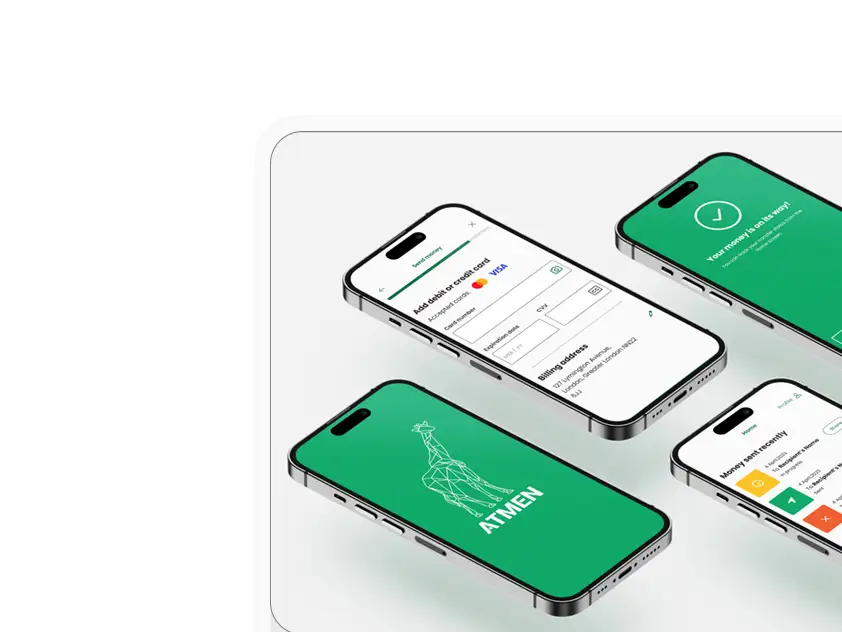
Atmen Fintech
Mobile App
Designing a Minimum Viable Product for a Diaspora Neobank Startup
Sterling Archer
By applying the DDD framework, we created multiple digital tools for a US based Data Company.

Ergomania and NGOs in the Netherlands
UX design for Fintechs, banks and financial startups is the everyday work of Digital Product Design company, Ergomania based out of Budapest, Hungary.

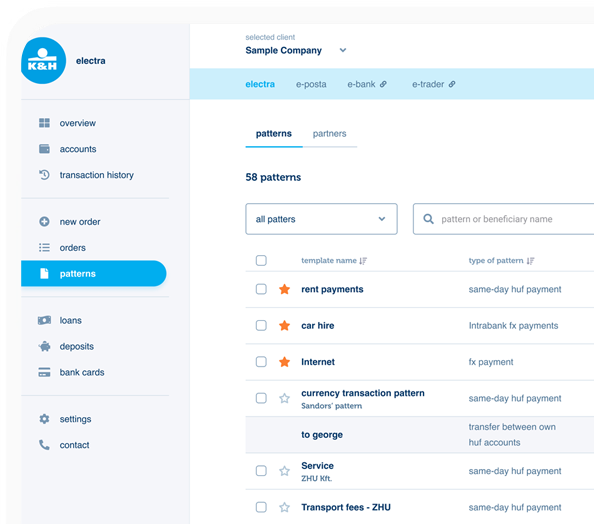
K&H Bank's Corporate Netbank
The K&H Electra Netbank App consolidates all financial needs into a single, user-friendly application. With its intuitive design, businesses can effortlessly manage their company's cash flow, transactions, and investments from one centralized hub.
TreasurUp
We established written and visual consistencies and guidelines for TreasurUp’s financial platform.

Simple by OTP
Simple by OTP Bank is Hungary's No.1 mobile payment app for cashless payments with 1M+ downloads, and 1 million+ transactions.


White Label Banking App
We provide full-blown next-generation mobile banking solutions for sales-oriented banks.

Want to read more
about UX, fintech and banking?
Subscribe to our biweekly newsletter and get the latest of our news and thoughts!