Before anyone touches a screen: AI as a strategic tool in design
Most design teams first look to AI for speed. Its more strategic value, however, appears much earlier, when teams are still deciding what is worth designing, which customer problem matters and what measurable outcome a product change should create. At Ergomania’s Vienna business breakfast, Stefanie Prinz, Head of UI/UX Design at Erste Group, and Dr András Rung, founder of Ergomania, talked about how AI moves up to the strategic level of the design process and what an organisation has to put in place first.
To place the discussion in context, it helps to understand the scale of the product. The George mobile app on iOS and Android is built on a single shared design system, with only a few elements, such as the navigation bar, differing between platforms. Alongside it are George Web for retail customers, George Business for corporate customers with its own version of the same web component library, and George Junior, which opens in the same app when a child user logs in.
Then there are the local variants. Local designers work on flows together with the central team through close collaboration and quality control.
Productivity and strategy: two separate questions
Working in a bank means operating within a strict security framework. Within approved environments, AI is already becoming part of the design workflow through language models, structured AI skills and selected connections to design and documentation sources.
This is precisely why it is worth paying attention to what has worked for the team, Prinz says: practices that work in a highly regulated environment can offer useful lessons elsewhere. AI undoubtedly enables more finished work: more screens, more variants and shorter turnaround times. But that is the productivity side.
The strategic question starts elsewhere: What should we design in the first place? Which customer problem are we solving? Which measurable outcome should change, and why should the business invest in it? Design has a particular challenge here because its outputs are highly visible. Almost everyone can react to an interface, a colour or a layout. But a leadership team cannot make an investment decision based only on whether a flow looks good.

This is also where AI can help designers move closer to the business. It can support them in understanding business models, interrogating metrics, exploring scenarios and translating customer insight into language that decision makers can act on. The objective is not simply to make designers faster at execution. It is to help them contribute earlier to deciding what should be executed at all.
Usability remains essential, but on its own it is not a complete business case. Designers need to connect improvements in the experience to customer and business outcomes: fewer errors, higher completion, better adoption, lower service demand, greater trust or more appropriate use of digital channels.
Interrogating the brief
Within selected George Product Design pilots, AI is introduced at a very specific point: before anyone touches a screen. A traditional process may start with a feature brief and then move into design, research, prototyping, testing and development. The risk is that teams begin designing before they have sufficiently challenged the original problem definition.
Now the designers stop at the brief, before touching a screen. The designers then use structured instruction packages, or “skills”, that ask an AI assistant to examine a brief from specific perspectives. Depending on the question, the model may act as a product sparring partner, a research reviewer or a critical challenger. They work with approved and appropriate inputs, including available UX research, relevant data and stated assumptions, and look for blind spots.
According to Prinz, this has rarely come up empty in the pilots so far: almost every brief has revealed something that could be improved or clarified. The point was not that AI had discovered the customer need independently. The relevant customer evidence already existed. AI helped the team connect that evidence back to the brief and question the initial emphasis before significant design work began.
The brief also has to state which metric it is intended to improve. That gives the team a basis for discussing the initiative with the business as an investment in an outcome, rather than presenting only a new interface. Rung added that AI also helps sharpen KPIs because it is easy to choose the wrong metric. Engagement, for example, can be high simply because users are getting lost in the app.
AI therefore does not replace product judgement. It gives the team another way to question its assumptions. The team runs several frameworks with AI, but according to Prinz, the model can also fabricate information, overlook context and present weak reasoning in a highly convincing form. Manual checking cannot be skipped, even when the use case is tightly constrained.
Three hours instead of three weeks
In the design phase, AI can accelerate the groundwork. Designers can use curated market references and analysis supported by AI to compare established interaction patterns, understand how similar problems have been approached and broaden the initial solution space. The purpose is to study patterns, understand the advantages and disadvantages, and identify which interaction principles may be relevant.
Prinz says caution is needed here because generated UI often does not yet meet the team’s quality bar. Designers therefore have to look past the visuals and consider the idea and interaction. How designers use this varies by task, experience and working style. Some use AI to broaden the initial reference space, while others apply it more selectively to challenge an existing direction or investigate a specific interaction.
The bigger change has been in prototyping. The team’s goal is to produce a detailed and realistic prototype from the start, because showing fifty screens and asking stakeholders to imagine what happens after each click can be misleading. As long as the designer is explaining, everything seems fine. Once you pick up the phone, the problems become visible. However, a proper Figma prototype takes a long time to build. iOS prototypes are now built through an MCP connection between Figma and Xcode, and in one exploratory case, work that used to take up to three weeks took around three hours.

The time saved is only one of the gains. The more important point is that the cost of being wrong drops significantly. After several weeks of work, a team is understandably less likely to discard a direction completely. After a few hours of prototyping, starting again remains a realistic option. In a bank operating across multiple markets, development requires coordination across countries, backend systems, security and regulation. AI does not remove that complexity, but it can help the team validate a direction before larger investments begin.
In Prinz’s words, one prototype is worth more than a thousand slides. In a working version, every flaw becomes visible immediately, and it is better for the decision maker to experience the idea than to receive an explanation of why something should work.
It does not work without a design system
There is a precondition to prototyping with AI support: the AI needs to understand the design system it is expected to use. The purpose of preparing the George Design System was therefore not simply to improve its documentation. It was to make the system usable by AI during prototyping.
Without that foundation, AI tends to generate generic interfaces or approximate components that may look convincing but do not necessarily follow the correct George variants, behaviours and design rules. When the team started this work, the Figma library, implementation and documentation were not always fully aligned. Some knowledge of the system was also implicit rather than formally documented.
According to Prinz, where there is no order, AI does not create order; it amplifies the inconsistency. Preparing the system for AI therefore required the team to make its components, behaviours, rules and constraints more explicit.
The result is more consistent prototypes that are closer to production. It also makes the workflow repeatable and scalable, enabling the whole team to start from the same shared system rather than explaining or recreating it for every new prototype. This helps move the work from experimentation into the normal workflow.
Creativity: liberation or settling for the first result?
Does AI increase the team’s creativity? Prinz sees it going both ways. The risk is that what AI produces on the first try looks good enough and there is no further iteration.
Figma encourages iteration because designers move things, drag them around and try them out. In a code environment, moving a single button may mean prompting and waiting again, and the token budget can become a further deterrent. Someone who would once have drawn five flows may therefore stop at one.
For others, this is exactly what shakes them out of their habits. For some designers, including those who had not previously worked directly with code, the tools make interactive ideas tangible much earlier. Seeing their own idea come to life in their hands for the first time is a genuine moment of success.
This is also visible in the way interfaces look. Over the past five to eight years, apps have increasingly adopted the platforms’ own appearance, which saved a great deal of time and money. Now, after a long period of convergence, unique UI elements are appearing in mobile apps again, Prinz says. Prototyping with AI support allows designers to explore interactions that previously required substantially more engineering support.
Why the design profession is not over
Rung pointed out that pressure from the business is becoming noticeable in several areas. Managers try the generative tools and see most of the work as almost done. Prinz’s answer was unambiguous: Producing a convincing first version has become cheap, but quality has not.
Generative tools can create the impression that most of the work is already done. A prototype may look finished while still lacking accessibility, maintainability, real data, edge cases, localisation, security and the wider requirements of production software. Code generated by AI can be highly valuable for exploration, but production use still requires engineering ownership, testing and maintainability over the long term. She expects the current enthusiasm to be followed by a more realistic phase as the limitations become clearer.
That does not mean the designer’s work stays the same. She tells her own team that the goal is not to turn designers into product managers. Roles should remain distinct. Designers’ strength is their direct connection to users and their ability to bring structured customer evidence into product decisions.
Business, product, data and technology teams contribute other essential perspectives. Designers help bridge customer needs, business priorities and the experience that is ultimately delivered. Knowledge should be extended, not the role replaced.
The business value of design and visibility
Many of the audience’s questions centred on one topic: how the business impact of design can be demonstrated. Prinz says that return on investment often cannot be measured directly, so designers have to talk about their work in the language the business uses.
Design’s contribution is not always attributable to one isolated interface change, so the team connects its work to measurable customer and business outcomes. Depending on the initiative, these may include higher task completion, fewer avoidable errors, better adoption, more successful digital service interactions or fewer avoidable support contacts, while preserving easy access to human support when customers need it.
 Stefanie Prinz, Head of UI/UX Design at Erste Group, Dr András Rung CEO, Founder and Maria Amidi Nouri UX Architect, Partner @Ergomania
They also run a short survey with two questions every quarter. It measures both ease of use and experience, and provides an industry comparison that works well with decision makers. App Store and Google Play ratings can also be used: users write about how easy the app is to use without being asked.
The other half of this is visibility. Prinz actively encourages the visibility of design work within the organisation. When a designer ships something, she encourages them to communicate it in internal channels, explaining not only what was created but also which customer problem it addressed and which customer or business outcome it was intended to improve.
Her reasoning is simple: she cannot automatically know what developers, testers, analysts or other teams are doing unless they make their work visible. The same applies to design.
The relationship between price and value came up as well. George is positioned differently across markets, including paid and free models, so price alone cannot be the basis of differentiation. According to Prinz, the brand opens the door and the experience is what keeps the customer there. If the experience is poor, customers may leave even a free service. If it is good, they may choose to stay with a paid one.
Areas the team is exploring for 2027
Asked which larger areas the team is exploring as part of its 2027 design vision, Prinz pointed to two directions. One is the generative interface. George has an AI assistant that customers can talk to about their finances. The team is now exploring how the system could also generate the appropriate presentation for the answer itself, such as the right chart. The aim is not arbitrary interface generation, but the use of governed, approved components and visualisations within clear product, accessibility and customer control constraints.
The other direction is making George more interactive through motion, animation and transitions. These elements are typically left until the end of projects, but they can contribute a great deal to the experience when used purposefully.
About the authors
Balázs has been working in content for more than 20 years, having the role as an editor at one of the first and largest news sites, later helping to establish the content marketing business for media publishers and agencies. Today, Balázs serves as content producer at Ergomania Ltd.
Related case studies
Prefixbox
Prefixbox is a Hungarian e-commerce scaleup. We helped them design an AI agent that gives more accurate product recommendations to shoppers with generative AI.

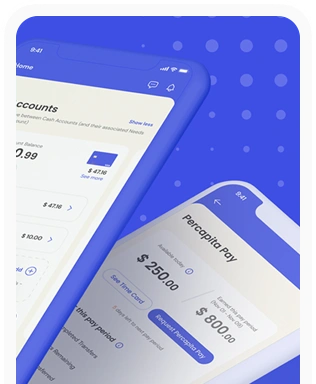
Percapita
We designed a full-fledged application for simplifying everyday finances.
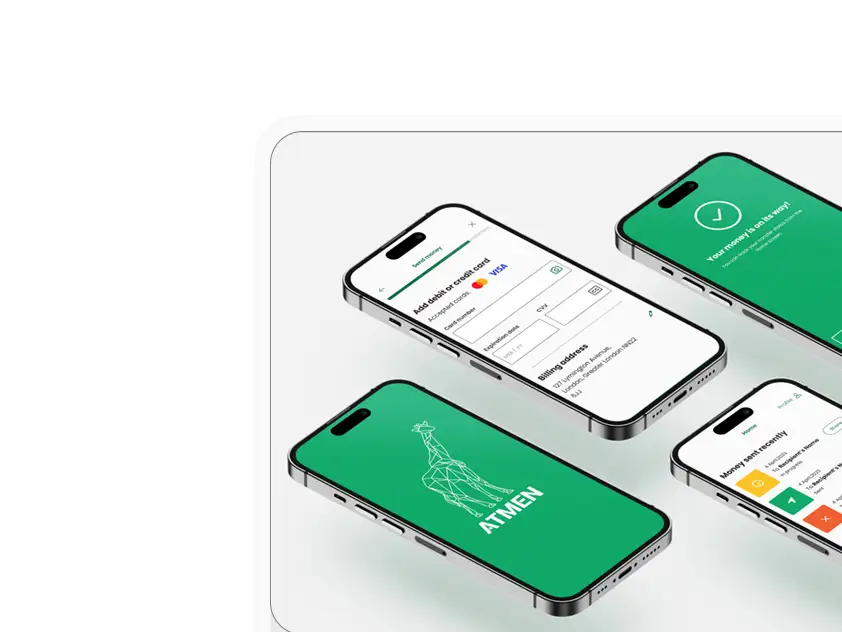
Atmen Fintech
Mobile App
Designing a Minimum Viable Product for a Diaspora Neobank Startup
Sterling Archer
By applying the DDD framework, we created multiple digital tools for a US based Data Company.

Ergomania and NGOs in the Netherlands
UX design for Fintechs, banks and financial startups is the everyday work of Digital Product Design company, Ergomania based out of Budapest, Hungary.

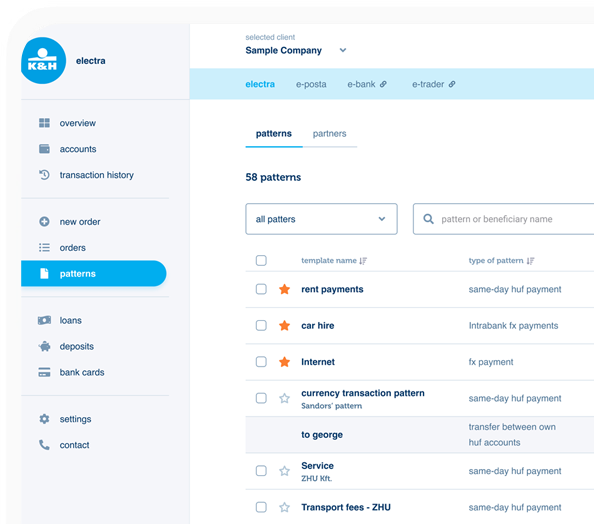
K&H Bank's Corporate Netbank
The K&H Electra Netbank App consolidates all financial needs into a single, user-friendly application. With its intuitive design, businesses can effortlessly manage their company's cash flow, transactions, and investments from one centralized hub.
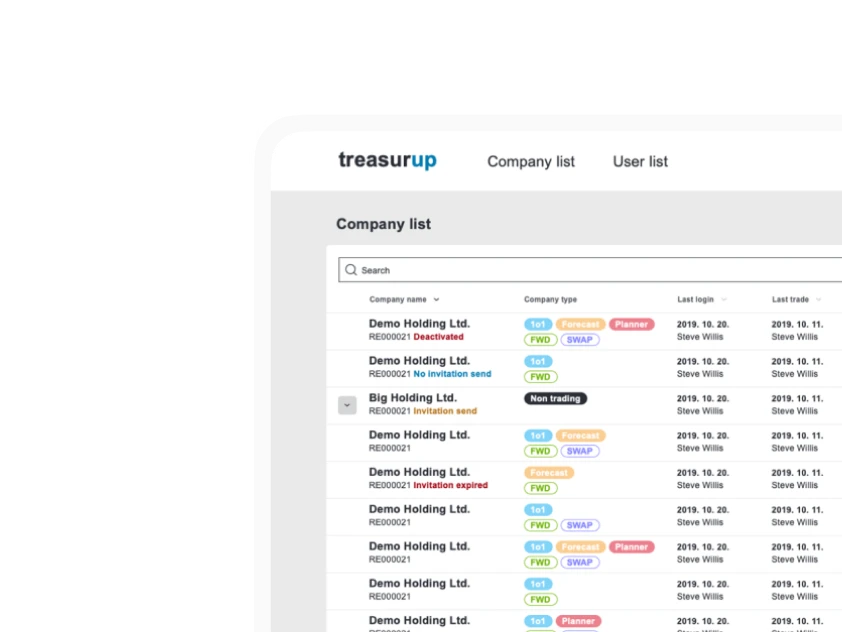
TreasurUp
We established written and visual consistencies and guidelines for TreasurUp’s financial platform.
Simple by OTP
Simple by OTP Bank is Hungary's No.1 mobile payment app for cashless payments with 1M+ downloads, and 1 million+ transactions.

White Label Banking App
We provide full-blown next-generation mobile banking solutions for sales-oriented banks.

Want to read more
about UX, fintech and banking?
Subscribe to our biweekly newsletter and get the latest of our news and thoughts!