Who Designs the Future? Internal Teams, Agencies, and the New Division of Labor With AI
If AI can generate 800 interface variations in seconds, what is left for the designer – and do we even need an agency anymore? At Ergomania’s latest Product Design Talks event, a keynote and a five-person panel explored how AI is rearranging the roles of internal teams and external partners. The surprising consensus was that the more AI takes over drawing, the more important everything it cannot do becomes: strategy, organizational diplomacy, and decision-making.
In the packed Rudas Bistro, first Balázs Tárkány-Kovács, Head of UX at Ergomania, gave a keynote – which by his own admission intentionally contained few reassuring promises. Then Dr. András Rung, Founder and CEO of Ergomania, convened and moderated a panel of speakers: Ildikó Petheő, Head of UX at Raiffeisen; Imre Fónai, Head of Digital Product at K&H; András Fábián, Principal Product Designer at Graphisoft; Péter Boóc, CEO of Dog & Pony marketing agency; and Balázs Tárkány-Kovács, Head of UX at Ergomania.
A Tool, Not a Fortune Teller
Tárkány-Kovács stated right at the beginning that he is not the right person to predict the future. His favorite example is Facebook. If they had shown it to him as a prototype back then, he would have said “This is really cool, play around with it some more.” It would never have crossed his mind that the product would later decide elections. Therefore, he preferred to stay grounded and talk about what AI is used for today, what works, and what will obviously work tomorrow, but just isn’t quite there yet.
In his reading, AI is currently a tool, a tool with which one can work faster, more efficiently, and better. But for him, the values, principles, and operating models that have held so far have not changed yet. This might be different tomorrow; but until something moves him from there, he continues to work with the “hammers” he has believed in for years.
The Hammer Principle: Starting From the Simplest
The backbone of his presentation was an everyday object. The basic version of the ideal product is always the simplest form – for a hammer, this is the mass and the handle, with which you can accelerate it. A claw hammer, a rubber mallet, or a chipping hammer are merely derivatives brought to life by specific use cases. The lesson: You don’t start designing by saying “I’ll buy a bunch of rubber,” but from the simplest version, onto which you build the features based on the use cases. The swing is the same: the base is a board hanging on two ropes; light, sound, and rotation are only added later, based on research.

For a banking product, according to Tárkány-Kovács, three things must be mixed well. The first is the image of the ideal product in our heads – what a perfect transfer or parking reservation flow looks like – with the admission that no one has ever put something textbook-perfect on the table. The second is the system of constraints and opportunities: regulations, century-old backend systems, marketing, the processes of sister companies. The third is that the path to the ideal is not linear, but iterative, regardless of whether you work alone, with an external partner, or with AI.
Here came the core of the internal-external question. Banks don’t make the simplest thing because the circumstances won’t let them. What could be improved is the conscious decision about what they allow to be cut from the ideal – and that this is continuously checked back. As an internal employee, this is difficult because whoever lives with the product day to day, due to internal political battles, has a hard time letting go of the minor details of their own area. That is why there is a need for the perspective of an external partner, who strips away the fluff, and who is more up-to-date with market trends because they are constantly exposed to new impulses. Furthermore, good design requires parametric, modular thinking: just as bridges and railway crossings narrow down the possibilities in advance on a Békásmegyer–Nyugati route in Budapest, the designer must also be able to outline the solutions before having all the information in hand – from these, first the “problem cluster” is built, and then the solution cluster.
In this picture, AI excels in assistance. It churns out variations in text, images, and summaries in seconds, but it doesn’t make real strategic decisions because it isn’t intelligent; it collects statistically. And with organizational diplomacy and the complex business environment, it has absolutely no idea what to do.
Internal or External? It’s the Wrong Question
In the first round of the panel, it became clear that many consider the “internal or external” setup to be a false dilemma. According to Fónai, the boundary between the two is blurring. In their UX team, internal UXers and external agency UXers, who after a while are assimilated by the banking culture anyway, sit next to each other. It doesn’t matter where someone came from, but whether they bring the necessary competence. Where the product team is well-stocked with UX, everything flourishes; where it is not, the UXers suffer.

Petheő’s team merged with the service designers a year ago, so they see all channels together. They are also internal, but during resource shortages, they call in an agency for a project. The great advantage of this is that agencies see a lot of industries and broaden the perspective. Fábián believes in the hybrid model: an internal team develops, but they work with agencies for methodological knowledge. Boóc, as the head of a ten-person marketing agency, pointed out the difference: In marketing, the goal is for the agency to integrate into the company’s culture, whereas in design, the value lies in the fact that the external partner retains their outside perspective, and can shake the organization out of its fixations.
The Trap of the Pixel Pusher
However, the external value can quickly wear off. Fónai was honest. He would like to believe that UX can give much more, but this quickly gets exhausted in a bank – without the power to assert interests, a person is easily downgraded to a pixel pusher. In a good product team, they can preserve their values, but in purely deadline-driven projects, they get ground down quickly.
According to Tárkány-Kovács, in an aggressive, “blood-spilling” type of business environment, it is hard to expect the same person to deliver day to day and develop the new medicine on the side – that calls for a separate researcher role. UX had a golden age when you could sell anything by making it look pretty, but today the underlying operations need to be put in order. Representing this in an organization is damn hard. His analogy is fitting: It’s like when the head physician analyzes the findings, but the “family members” overrule it due to internal politics. Petheő added that research has a breakthrough power in convincing management, but building design maturity is brutal work – which is why she encourages her team members to share their AI experiences once a week.
Conversational Banking – And the Protection of Drawing
One of the most practical threads of the conversation was about conversational interfaces. Fónai said that there is already a digital assistant concept at K&H, where the conversational designer does a completely different job than someone who designs classic mobile interfaces. Here the conversation itself carries the banking function, with plenty of branches instead of linear button presses. The open question is whether this will remain within the banking interfaces, or if it will take place through the agents of the big AI providers.
Fábián reported on the conversational agent in Graphisoft’s architectural software, which has had a mixed reception; engineering users expect a rule-based interface, and prompting does not provide the accustomed visual feedback. The task, therefore, is designing the synergy of UI and conversation.
From here unfolded one of the most personal debates of the evening. According to Boóc, from now on the designer will take the understood intention forward through the AI, and the “psychologist-engineer” hat will become the stronger one – at the expense of drawing. Fábián disputed this: Dialogues are also drawn, because physical drawing itself aids thinking. Tárkány-Kovács warned that the real value is that we invent crazy things without constraints; if we only prompt, the iterating, the straining, and the search for connections can be lost, which is exactly what drawing stimulates.
800 Variations – And the Decision That Remains Human
What happens if AI churns out variations? The panel unanimously emphasized decision-making and discovery. Petheő fears that the results will be too formulaic, and trusts that as long as we are designing for humans, a human brain will be needed. According to Fónai, AI will take over screen drawing, but the real value of UX is discovery – uncovering what the actual problem is, and whether we are doing something meaningful at all. Petheő tied this to the roots of design thinking: what the business goal is, what the client wants, what the KPIs are.

Fábián argued with numbers. AI can generate 800 variations, but it won’t make the decision for us. Choosing well from the many options requires good concepts and criteria, and this human task is becoming increasingly important. Tárkány-Kovács added that in UX it is much harder to identify the “false notes,” the bad solutions. The way out of this is measurement, but in the traditional banking environment, iteration is very slow – the profession must win strategic recognition, and drawing as a communication language must not be let go. As Fónai summarized, sometimes it seems we are looking for a wildcard in the UXer – someone who strategizes, handles internal politics, facilitates, and even draws.
How to Proceed? It Takes Away Drawing, Not Strategy
The closing round focused on the next two to three years, with the panel pointing in one direction. Boóc illustrated the pace. Three years ago, we didn’t even know the word AI; today, a startup can be coded in months without a developer. The nature of work is completely transforming. According to Tárkány-Kovács, AI will replace UI drawing very well, but organizational diplomacy, complex planning, and decision-making? Not yet. Whoever enters the field now, therefore, shouldn’t focus on pixel-perfect drawing, but on strategy and problem-solving.
According to Fábián, design as human problem-solving will remain – the content changes, but empathy and facilitation will always be needed. Fónai projected that UX will merge into product teams; we will be much faster with the tools, but strategic decision-making and facilitation will remain with the human. Petheő pointed out the other half of the stakes: AI is a brilliant tool today, but the big question is whether the regulatory and governance environment can keep pace with this exponential development.
The evening thus concluded with a rare, reassuring consensus: AI does not make the designer redundant, but makes drawing cheap, and by doing so, it illuminates exactly what has always been the true value of the profession: the right question, the right decision, and the person who dares to say what the real problem is.
About the authors
Balázs has been working in content for more than 20 years, having the role as an editor at one of the first and largest news sites, later helping to establish the content marketing business for media publishers and agencies. Today, Balázs serves as content producer at Ergomania Ltd.
Related case studies
Prefixbox
Prefixbox is a Hungarian e-commerce scaleup. We helped them design an AI agent that gives more accurate product recommendations to shoppers with generative AI.

Percapita
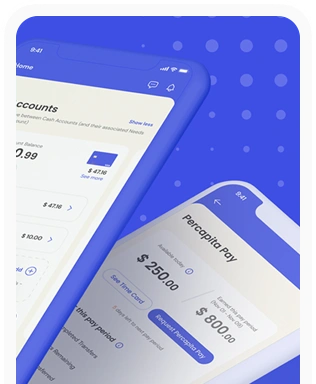
We designed a full-fledged application for simplifying everyday finances.
Atmen Fintech
Mobile App
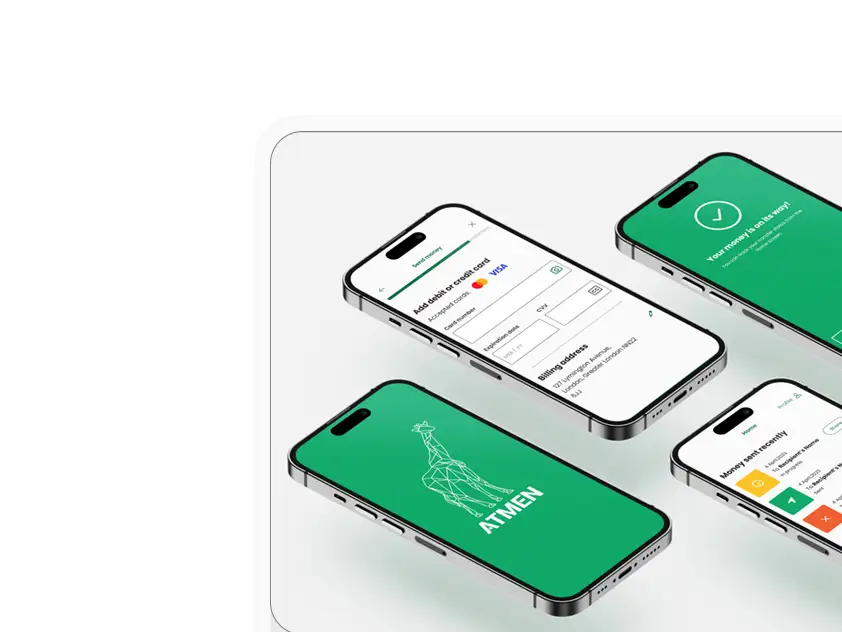
Designing a Minimum Viable Product for a Diaspora Neobank Startup
Sterling Archer
By applying the DDD framework, we created multiple digital tools for a US based Data Company.

Ergomania and NGOs in the Netherlands
UX design for Fintechs, banks and financial startups is the everyday work of Digital Product Design company, Ergomania based out of Budapest, Hungary.

K&H Bank's Corporate Netbank
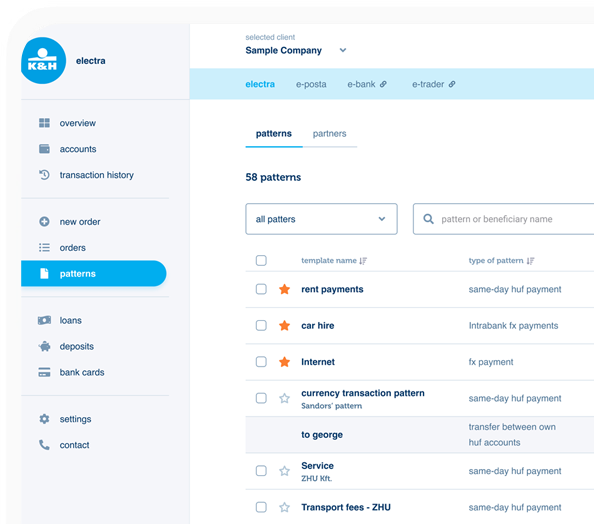
The K&H Electra Netbank App consolidates all financial needs into a single, user-friendly application. With its intuitive design, businesses can effortlessly manage their company's cash flow, transactions, and investments from one centralized hub.
TreasurUp
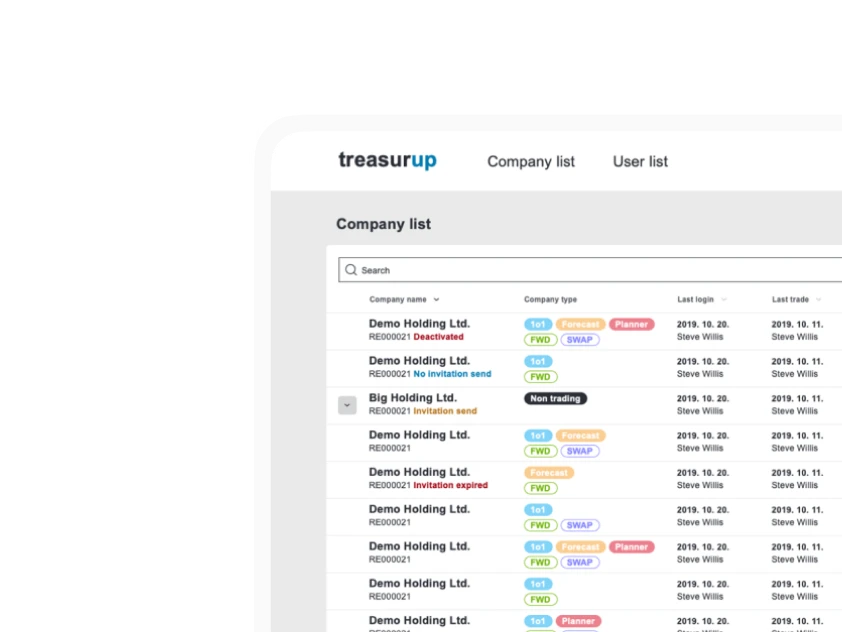
We established written and visual consistencies and guidelines for TreasurUp’s financial platform.
Simple by OTP
Simple by OTP Bank is Hungary's No.1 mobile payment app for cashless payments with 1M+ downloads, and 1 million+ transactions.

White Label Banking App
We provide full-blown next-generation mobile banking solutions for sales-oriented banks.
Want to read more
about UX, fintech and banking?
Subscribe to our biweekly newsletter and get the latest of our news and thoughts!