Stablecoins, Payment Chains, Autonomous Systems: What the Amsterdam Fintech Event Is About This Year
Has the euro stablecoin moment finally arrived? What sets a product apart when every competitor runs on the same technology? Who captures the value when payment moves directly between bank accounts? This year's Amsterdam Fintech Event is about rebuilding financial infrastructure. It organizes the two days around five themes: autonomous systems, next-generation payments, stablecoins and tokenization, embedded finance, and regulation. We went through the program; here are the key questions it will raise.
Our report from last year covered a panel on the business use of stablecoins. What described the situation best was that requests for proposals (RFPs) had by then moved from innovation teams to business units – the technology had left the lab. The panel also noted that earlier pilot projects had run aground because they never worked with real money; what changed were the regulated euro and dollar tokens of licensed issuers, backed by actual reserves.
Two further questions came up, and both return in this year's program. One was European regulation, which the panel found risk-averse compared with US practice. The other was the end state: invisible money, where users won't know that the euros in their wallet are a stablecoin – but they will be. Last year that still sounded like a distant goal; this year it has made it into the title of one of the event's themes.
AFE26's central theme is the new financial infrastructure, with three attributes: autonomous, embedded, built on trust. Five themes circle the work of building it: the road from automation to autonomous systems, real-time and cross-border payments, stablecoins and tokenization, financial services built into other products, and finally how regulatory compliance can turn into a competitive advantage.
Who Will Own the Euro Stablecoin?
In Europe, the main question around stablecoins today is who issues the money. The market was built on dollar-based tokens, while European companies have to settle in euros – and EU rules set strict conditions for that.
Under MiCA (Markets in Crypto-Assets, the EU's crypto market regulation), only credit or e-money institutions can issue a token pegged to a single official currency. Reserves must always match the value of tokens in circulation; at least 30% of that has to sit in bank deposits, 60% for tokens classed as significant. Holders can redeem at par at any time. The panel criticized this deposit requirement last year. In their view, reserves built this way carry bank risk into the token itself. This year, the debate is no longer theoretical. In the summer of 2026, the transition period that let unlicensed issuers stay on the market expired, and European supply narrowed to regulated issuers.
 Panel at the Amsterdam Fintech Event 2025
The other question is scale. Individual projects work; what remains open is how this becomes standard practice in corporate finance. With tokenization, the question is who builds and who uses the new system. Because of the reserve rules, issuance stays largely in the hands of banks and the providers around them.
On the usage side, the direction sketched out last year still holds. Tokenized money is more than a faster transfer because it carries logic as well. You can specify that an amount may only be spent for a given purpose and within a given circle, and that the transfer of the asset and the payment happen in a single step. In corporate finance, this simplifies supplier payments and the handling of project-level budgets; in cross-border transfers it means a single settlement instead of a chain running through several banks. When these capabilities reach everyday products is an open question.
Who Captures the Value in Payments?
When a customer pays straight from their bank account, part of the card chain drops out of the transaction. The question is where the value stays: with the bank, with the merchant, or with the provider that delivers the payment experience. The answer rewrites the revenue model of everyone involved.
In the Netherlands, this is not an abstract proposition. For more than two decades, online payments have been built around iDEAL, which handles 1.5 billion transactions a year for some 350,000 merchants. That system is now moving to the European platform Wero. From October 2026, every Dutch issuing bank will be connected, and the full migration has to be complete by the end of 2027. Wero is built on direct account-to-account transfers, cutting intermediaries and their costs out of the payment chain. Consumers will see little of this. Merchants and providers, on the other hand, have contracts, systems, and business processes to adapt. The conference falls in the very month of the switchover, so the future of Dutch payment infrastructure is a practical question on site.
On the card side, the questions are what makes a premium card product attractive today, and how AI can be used to optimize fee structures on the issuing and acquiring side. Another recurring question is how a service can be fast and stable at once: built at fintech speed, yet reliable at bank level.
What Happens When Agents Go Live?
With autonomous systems, the emphasis this year is on working implementations. In a regulated environment, this raises the question of what can be entrusted to an agent at all, how far its mandate extends, and what happens when it gets something wrong. The answer comes down to how the user grants and withdraws authority, and how they can check afterwards what was done in their name.
For a system like this to go live at a bank, there must be a traceable log of the data and rules a decision was based on, a support process for cases where the user disputes the outcome, and someone inside the organization who owns the system. None of these is a technology task, and they usually decide whether a pilot turns into a service.
The other line of questions is commercial. If every competitor runs on the same technology, the difference comes down to what the user sees and what they understand. Two further topics come up here: the role of data and AI in management decisions, and the shift in the talent market as banks and fintechs rewrite what skills they look for.
 The transparency obligations of the EU AI Act took effect on August 2 this year
The regulatory backdrop has changed in the meantime. The transparency obligations of the EU AI Act took effect on August 2 this year. Anyone operating an AI-driven system has to tell users they are talking to a machine and label machine-generated content. The far stricter requirements for high-risk applications, however, were pushed back to December 2027 by a legislative package over the summer. The conference will ask whether regulation helps innovation by way of trust: the disclosure rules are already binding, while the stricter part is still ahead.
When the Service Disappears From View
Embedded finance promises that a payment or a loan blends unnoticed into another product: the checkout of a web shop, a carrier's app, an enterprise resource planning (ERP) system. The design question is exactly that: With no separate interface, where does the user find out what they are signing up for? Invisibility makes use more convenient, but it takes the decision out of the user's hands and blurs responsibility between the product owner and the financial provider.
Companies also have to decide whether a service is better built in-house, bought, or spun out as a separate company. The three routes mean different speeds and different risks: building is slow but keeps the knowledge in-house; buying is fast but comes with integration; spinning out gives freedom and takes away the advantage of the existing customer base. In practice, the choice is rarely a technology question.
Growth and Partnerships
Several sessions deal with what large financial players look for when they team up with a fintech, and what it takes for a company to become a leader in its own category. A separate item on the agenda is the Dutch round of the Mastercard for Fintechs program, where several companies present to a panel of judges. Last year, Cense, an Amsterdam regtech company that automates bank-side screening of crypto transactions, won that round and went on to win the European final in Barcelona.
Confirmed sponsors and speakers include Mastercard, Worldpay, bol Financial Services, Van Lanschot Kempen, the Dutch Crypto Industry Association, the Dutch Payments Association and Handelsbanken. Attendees will include representatives of banks, card companies, payment providers, regulators, and consultancies.
Ergomania will be there again this year, and we will follow up with a report after the event.
About the authors
Balázs has been working in content for more than 20 years, having the role as an editor at one of the first and largest news sites, later helping to establish the content marketing business for media publishers and agencies. Today, Balázs serves as content producer at Ergomania Ltd.
Related case studies
Prefixbox
Prefixbox is a Hungarian e-commerce scaleup. We helped them design an AI agent that gives more accurate product recommendations to shoppers with generative AI.

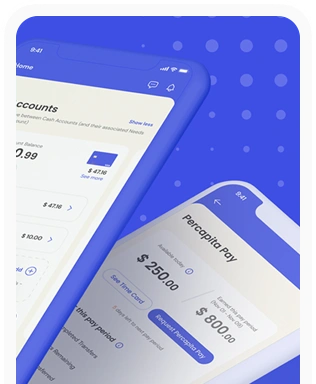
Percapita
We designed a full-fledged application for simplifying everyday finances.
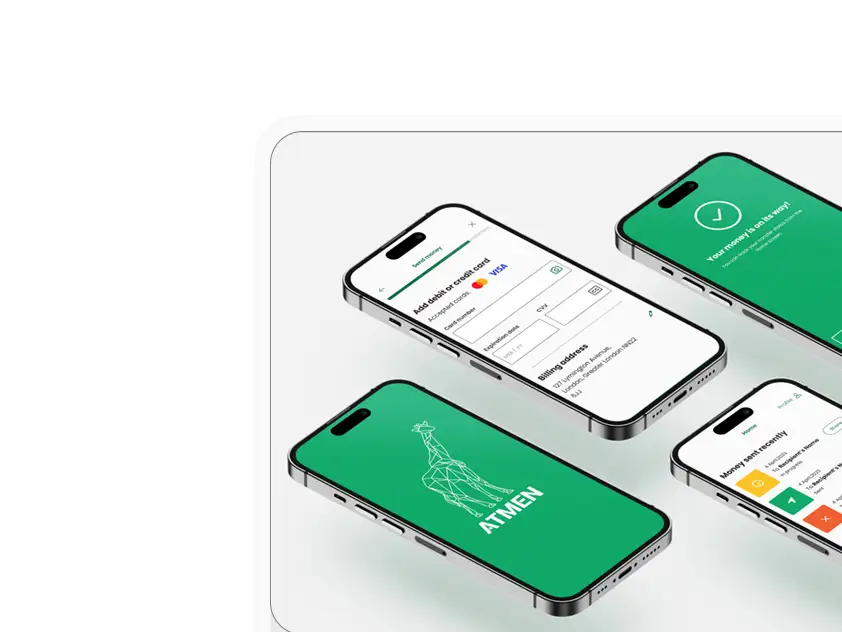
Atmen Fintech
Mobile App
Designing a Minimum Viable Product for a Diaspora Neobank Startup
Sterling Archer
By applying the DDD framework, we created multiple digital tools for a US based Data Company.

Ergomania and NGOs in the Netherlands
UX design for Fintechs, banks and financial startups is the everyday work of Digital Product Design company, Ergomania based out of Budapest, Hungary.

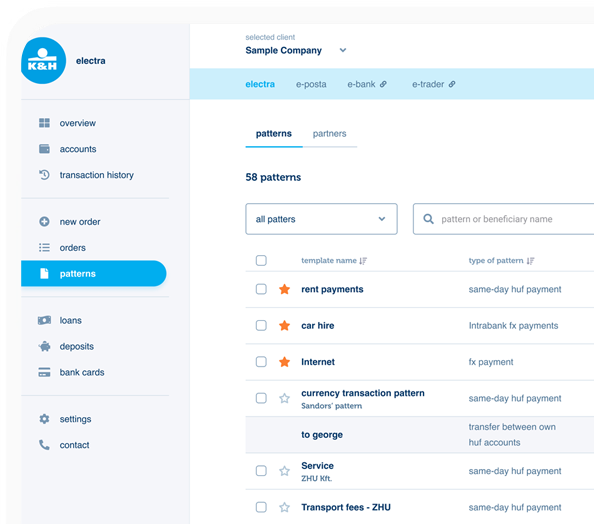
K&H Bank's Corporate Netbank
The K&H Electra Netbank App consolidates all financial needs into a single, user-friendly application. With its intuitive design, businesses can effortlessly manage their company's cash flow, transactions, and investments from one centralized hub.
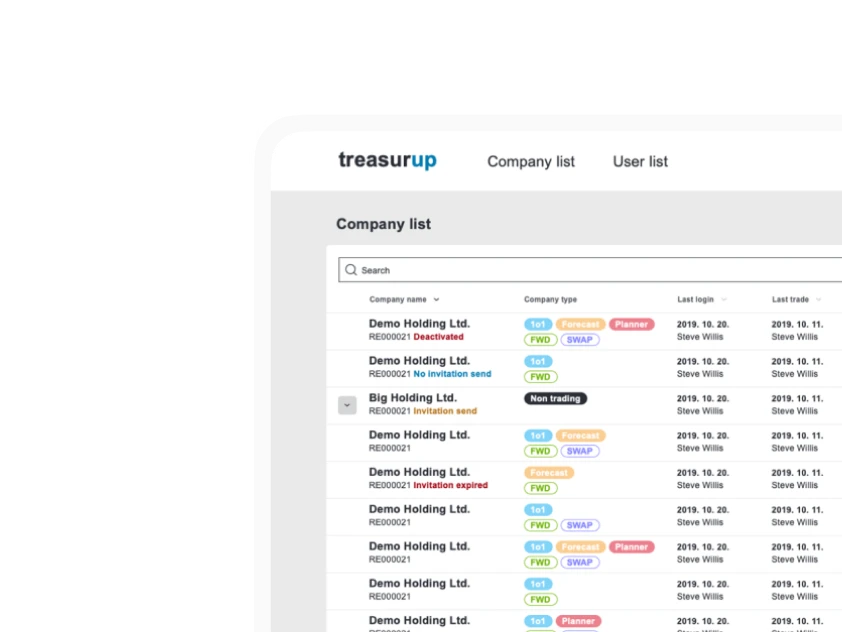
TreasurUp
We established written and visual consistencies and guidelines for TreasurUp’s financial platform.
Simple by OTP
Simple by OTP Bank is Hungary's No.1 mobile payment app for cashless payments with 1M+ downloads, and 1 million+ transactions.

White Label Banking App
We provide full-blown next-generation mobile banking solutions for sales-oriented banks.
Want to read more
about UX, fintech and banking?
Subscribe to our biweekly newsletter and get the latest of our news and thoughts!