Beyond Mental Models: Indi Young on Thinking Styles and Deep User Understanding
Indi Young is one of the most influential figures in the UX profession, whose work on mental models has impacted generations of designers and researchers. The original concepts have continuously evolved over the past two decades. In this conversation, we explored how these two concepts - skylines and thinking styles - fit into modern product strategy; why the traditional separation of "problem space" and "solution space" is flawed; and why a deep understanding of users' internal cognitive processes is essential for true innovation.
At the heart of our discussion is how the classic mental model has transformed into a much more nuanced tool. Indi uses a powerful visual metaphor: the Mental Model Skyline. In this metaphor, the "skyline" represents a map of your users' inner world. The "towers" on this skyline are not features; they are the users' goals and core concepts. The "windows" in those towers are the specific thoughts, feelings, and internal rules people have as they try to achieve those goals. Building on this, we discussed Thinking Styles, which describe how different people approach the same goal with different cognitive strategies (e.g., a "careful planner" vs. a "creative innovator").
To get the most out of the discussion, if you are new to the concept of mental models, we recommend starting with our foundational article here: Improve Your Research with Mental Models: A Key to a User-Centered Design Strategy.

Let's start with the concept you're so well-known for, which you've expanded upon: the mental model skyline. For those who are just getting to know this idea, can you explain what this "skyline" metaphor represents and how they can integrate it into their real-world product strategy? How has the concept itself evolved since you first introduced it, over the last 15, or even more, years?
Indi Young: It's been 25 years, and I'm still at it. I'm in the middle of making a new course on thinking styles, and as a beginning to that, I wanted to reintroduce this idea of where these tools sit in people's worlds. I came up with a new diagram to show that no matter what design or product process you use - like the double diamond, or as Andy Budd says, the triple diamond because no one wants to do the first diamond - you're working in what's called the solution space.
A lot of product people believe there is a problem space within the solution space, which is technically that first diamond, but they give it maybe a day, or even just a meeting. Andy Budd's article in Smashing Magazine pointed out that people basically come up with an idea, then they want to develop it, and then they'll test it. They have this idea, and my question is: where does the idea come from? When you are ideating, that is also part of the solution space because you're coming up with solutions.

So in my diagram, I call this whole thing the team build space. It's all about creating a thing, from idea to outcome. Let's walk away from "problem space versus solution space." I've been trying to fight that my entire career, to teach people that the problem space is actually much bigger than you think and deserves a lot more attention. This diagram really took off because it encapsulated all of that in the team build space.
Below it, there is something I called the people space. This is where you spend a chunk of time - maybe 10 hours a week for 14 or 16 weeks - discovering what is going through people's minds as they're addressing the thing your organization is trying to help with.
Most of the time, people come at it already up in the team build space saying, "I've got this idea. Let's prototype it and see what people think." Their idea is not going to fall that far from the tree, shall we say. When you start your ideation just based on your own idea, you're not going to push the envelope or create for a broader set of people.
If we want to truly innovate and create for people who are not exactly like us, we need to know what's inside their head. The problem with most big data is that it's full of guesses. When we go and ask people what's inside their head, the amount of detail you can see is incredible. This allows you to start an ideation session on a much more guided and informed foundation.
It sounds like this deep dive into the "people space" and their cognition is the foundation for what you now call "thinking styles."
Indi Young: Yes. The way you understand people's cognition is by listening sessions. It's not an interview. It's about being able to say, "Hey, we know that you've been doing XYZ a lot and you've been thinking it through. I want to know what went through your mind the last couple of times you were doing it."
For example, we needed to create thinking styles for a client around cooking dinner. Our conversation about what we needed to know lasted two months. We ended up deciding we needed to know what people who think of themselves as a creative home chef have going through their minds. So, we did listening sessions with a bunch of people about what went through their minds as they cooked dinner recently. We always do an intro session with them ahead of time because the people we get from a recruiter don't always actually have a lot of cognition about the topic. Having that cognition is really important to a listening session.
What is a Listening Session?
Indi Young distinguishes listening sessions from traditional interviews. While an interview often follows a structured Q&A format to gather facts or validate a hypothesis, a listening session is an empathetic, deeper exploratory method.
The goal is to understand a person's inner cognitive world: their thought processes, emotional reactions, and unstated guiding principles as they relate to a topic. The researcher acts as a catalyst, allowing the participant to think aloud and explore their own cognition, often revealing insights that a direct question-and-answer session would miss.
How do you get clients to be interested in this deeper approach?
Indi Young: We show them examples where the kind of gaps you see on the mental model skyline are not what you expected. Or we show them gaps in existing support for different thinking styles, where we can say, "Oh, we're really only paying attention to one thinking style here, and there are two others."
Here's a story I told at a conference. We found three thinking styles within the cooking data. One was a Culinarian who is the nuanced chef-type cook. At the other end was the Careful Planner, a person who sees something they want to cook and, core to their approach, wants it to turn out exactly like they saw it. For them, it becomes an issue of not messing up the recipe. In the middle was the Creative Innovator, who is creative in all aspects of their life.
Thinking styles have two uses: measurement and ideation. For ideation, the thinking style is like a hat. I create a cast of characters, like in an episodic TV show. We were doing an "episode" for a nutrition council that wanted to figure out how to get people to eat more leafy greens. In our ideation session, we started with the story of a character wearing the Careful Planner hat who saw a meal they wanted to make that called for coriander. The leafy green of coriander is cilantro. So the team started brainstorming how to get that character to put cilantro in the meal.
They thought of the usual solutions: ads on the phone around dinnertime, public service posters at the grocery store near the leafy greens. One person in the room said, "Wait, no! We're supposed to support the thinking styles, not change them." Then another asked, "Well, where did he get that recipe?" "From a cooking show." "So why don't we reach out to the cooking show producers to show meals with more leafy greens?" The insight was that the team's usual solutions were not very effective because they sought to change the person's thinking style, and supporting the thinking style of seeing something they love will result in much greater success.
When you have the thinking styles and the mental models skyline, how do you match those things? Do you highlight the thinking styles on the skylines, or are these two different things that support each other?

Indi Young: Thinking styles are layered onto the towers in a skyline. A skyline is like a city skyline with a bunch of towers. The towers have windows, and each window represents a summary of what somebody said. We can assign the thinking style of that person to their window. I typically use colors, keeping in mind to differentiate them for colorblind people.
So to confirm, you are essentially labeling each "window" - each summary of a person's thought - with their corresponding thinking style, perhaps using colors. This would then allow a team to see, at a glance, which thinking styles their existing (or proposed) features are actually supporting?
Indi Young: Exactly, yes. I've seen people do it in different ways, like with layers. The basic format of the skyline is the same as it was 20 years ago, but a lot has changed. Graphically inclined people draw it differently and more gorgeously. The groups of towers, we call those neighborhoods. Just like in a city, you don't plan them from on high; they kind of emerge in place.
Another thing that's different is that the text in the windows is longer to describe things better. There's a very specific way of writing this text so that the verb is first, the key point is next, and the rest is supporting detail. The verb could be an emotion, like "worry" or "feel cautious," or a personal rule, like "Avoid difficult situations..." The focus of mental attention is the name of each tower, for example, "Believe that change can happen." All of these are emergent (bottom up) patterns.
This approach seems like a powerful input for feature evaluation and structuring user journeys. Once you have this map, how do you see teams using it to move forward with solutions?
Indi Young: Thinking styles are good for two things: ideation and measuring. What you normally do with the skyline is put sticky notes beneath each tower that represent existing solutions to identify the places where there is existing support and where there are gaps.
Then you can use thinking styles to recruit for evaluative studies. The study focuses on only a few towers at once. Then you map the results back onto the towers. Then with your stakeholders you can show specifically how well this solution is working for the 'Careful Planner' thinking style.
But there's a harm scale as well. It starts with mild harm (frustration, confusion), then goes to serious harm, lasting harm, and systemic harm. Lasting harm could be when, because of the way an insurance company treated your accident claim, you suddenly lost your relationship with your mother-in-law.
The Harm Scale: Measuring the Negative Impact
A key part of Indi Young's measurement framework is the harm scale. It moves beyond simple usability metrics (like "frustration") to quantify the real-world negative consequences of a poor or misaligned solution. This scale often includes:
- Mild Harm: Frustration, confusion, wasted time.
- Serious Harm: Financial loss, missing a critical deadline.
- Lasting Harm: Damage to a relationship, loss of a job, or a significant negative impact on one's life or well-being.
- Systemic Harm: Reinforcing bias, automating discrimination, or excluding specific groups based on identity.

By mapping these harm levels back to the mental model, organizations can see where their solution is not just failing to help but is actively causing damage, providing a powerful incentive for change.
We've seen that a signal of low UX maturity is ignoring this type of research. Some organizations with relatively large design teams do, at most, some interviews here and there, not even getting close to mental models or thinking styles. Why don't people get it or use it?
Indi Young: There are so many reasons, and now AI is another reason. A team with a process may trust that process blindly. For example, in many cases, people use roles as their personas. A role is someone doing a thing. The assumption is that everybody doing this thing approaches it without cognitive variation. And I'm like, no they don't. When a team uses roles, they forget that the roles are people, and people have a variety of thinking styles when they address a process. A thinking style is just a preferred way of using your skills.
Do you see any concrete usage of AI in this field?
Indi Young: I would like to see AI used in a very specific way. Qualitative data synthesis is a two-step process. The first step is finding the pieces in the data. The second is putting the pieces together. The core of the data I use is interior cognition - inner thinking, emotional reactions, and personal rules. When we do data synthesis, we scoop only those interior cognition seeds out of the transcript of the listening session. My hope is that AI can help with that first part. We're working on it.
How do you see the future of the UX industry?
Indi Young: When we started Adaptive Path in 2001, we were trying to help people ("users") get what they want to get done in their way, better. But then the product manager role got created, and they were like, "You don't get to do that. You are only the pixel monkeys." Researchers were told, "You just have to make up the right questions so I get the validation that I want." But validation isn't scientific; curiosity is. Now in UX, everybody's throwing their hands up, going, "Wait, what just happened? Our whole job was taken away from us."
The sad part is that many organizations are focused only on growth and profit. Their customers are no longer people they support; they are people they milk. An author named Cory Doctorow coined the word "enshittify," which means to make the thing full of shit, harder to use, and more costly to the customer.
So, the future is that either we're completely doomed, or we can still fight the fight. I'm not giving up. Steve Portigal is not giving up. Erica Hall is not giving up. We're learning how to say that there's something here for your team. Most organizations have no measurement of how much value people get in their outcomes. If you want to move the needle, you have to understand what your customers are addressing and measure the value for them. That's what that harm scale is about - actual value.
Going back and mending existing solutions is very innovative. And it allows you to grow within the market you know. Once you understand the people, you can start to see what the gaps are, and you can start to fill them in. You don't have to boil the ocean; you can focus on just one or two towers of the mental model skyline for one thinking style that you're messing up.
You have so much positive energy. Where do you get it from? I guess you love people, based on this interview and your books, but what else gives you energy?
Indi Young: Oh, well, I do love working with people on this, and that gives me energy. But I also need downtime. I need time to let those ideas rub against each other until something comes out. So, it's either going on hikes or, you know, the typical having a shower. Hot water and sleep. That's it.
Cover photo: Laurie Bishop @ https://becomebeseen.com/
About the authors
A real veteran of UX by having 18 years of experience. Strong focus on business needs and innovation. András Rung has worked for various institutions and companies since 2002. He is the co-author of the first Hungarian usability book and author of the usability blog Ergomania.
Related case studies
Prefixbox
Prefixbox is a Hungarian e-commerce scaleup. We helped them design an AI agent that gives more accurate product recommendations to shoppers with generative AI.

Percapita
We designed a full-fledged application for simplifying everyday finances.
Atmen Fintech
Mobile App
Designing a Minimum Viable Product for a Diaspora Neobank Startup
Sterling Archer
By applying the DDD framework, we created multiple digital tools for a US based Data Company.

Ergomania and NGOs in the Netherlands
UX design for Fintechs, banks and financial startups is the everyday work of Digital Product Design company, Ergomania based out of Budapest, Hungary.

K&H Bank's Corporate Netbank
The K&H Electra Netbank App consolidates all financial needs into a single, user-friendly application. With its intuitive design, businesses can effortlessly manage their company's cash flow, transactions, and investments from one centralized hub.
TreasurUp
We established written and visual consistencies and guidelines for TreasurUp’s financial platform.
Simple by OTP
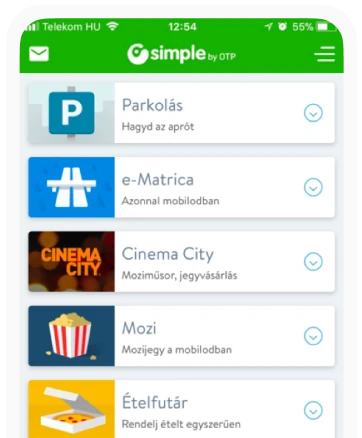
Simple by OTP Bank is Hungary's No.1 mobile payment app for cashless payments with 1M+ downloads, and 1 million+ transactions.

White Label Banking App
We provide full-blown next-generation mobile banking solutions for sales-oriented banks.

Want to read more
about UX, fintech and banking?
Subscribe to our biweekly newsletter and get the latest of our news and thoughts!