Europe's Payments Market in 2026: Finished Rails, Open UX Questions
The Payments Association EU has published this year's report on the key players in the EU payments market. Regulation and infrastructure have converged: instant credit transfers and Verification of Payee (VoP) have been mandatory since October 2025, the PSD3/PSR (Payment Services Directive/Payment Services Regulation) texts are final, and the digital euro legislation is running this year. Wero is at 54 million registered users, and in February it signed an agreement with four national schemes on a pan-European interoperability hub that would reach 72% of the EU population. One of the report's lessons is that the work of the coming years sits not only on the rails and in the rulebooks, but in the interfaces where the payment actually happens.
What follows draws on the report's Europe-level chapters, on Deloitte EMEA's overview, and on its interview with the European Payments Initiative (EPI). More than half of the report's length is given to the individual market profiles of the 27 member states, with licence counts, bank balance sheet totals, and acceptance statistics. We don't go through those here: anyone who needs data on a specific market is better served going straight to the original.
Rules Now in Force, Questions Left Open
The Instant Payments Regulation was still in progress at the time of the previous edition; it now applies in full. Since October 2025, eurozone providers have had to both receive and send instant credit transfers around the clock. Alongside that, they must offer VoP – the check that matches the payee's name against the account number before the money moves.
The report doesn't hide that this produces operational friction, and it names the source: false positives. The next two versions of the rulebook answer exactly that. VoP 1.1, with an effective date currently foreseen for September 2026, targets security, connectivity and customization, while VoP 2.0 covers extending the service to countries outside the eurozone, starting with Sweden, Poland, and the Czech Republic. On the product side, this is decided by the wording and the thresholds of the warning shown at the moment of approval. A warning that appears too often and always in the same form trains the user to click past it – including on the occasions when the alert is real.

From 2026, this carries a cost that can be measured in money. According to the joint European Banking Authority-European Central Bank (EBA-ECB) report, payment fraud reached €4.2 billion, a 17% increase year on year. Roughly 85% of credit transfer fraud losses are currently borne by the user, because the rules in force require no reimbursement where the user was deceived into approving the payment. The PSD3 and the accompanying PSR package are expected to strengthen user protection through additional liability rules, extending it to online fraud and the misuse of their data. The negotiating parties reached political agreement in late 2025, the texts were finalized in 2026, and application will start in phases over the following two years.
Where PSD3 Reshapes the Competition
Through the amendment of the Settlement Finality Directive, payment institutions and electronic money institutions can become direct participants in designated payment systems. This includes TARGET2, the Eurosystem's settlement system, where large-value interbank payments settle in real time in central bank money. Some non-bank providers have already obtained direct access to the TARGET services, including TIPS, the settlement service for instant euro credit transfers that runs without interruption. The package also touches data sharing, transaction monitoring, strong customer authentication, account access, and fee handling.
Two further deadlines fall due this year. The revised Consumer Credit Directive (CCD II) becomes applicable, with stricter affordability checks and disclosure requirements, which on the report's expectation will weigh in the short term on the profitability of BNPL – buy now, pay later, deferred instalment payment tied to a purchase – providers; the large players are themselves asking for clearer rules. And the overlap between the Markets in Crypto-Assets Regulation (MiCA) and PSD2 has already arrived: after the expiry of the EBA's transitional period on March 2, 2026, the providers concerned have to obtain dual authorization or discontinue the service in question. What compliance tasks stacking on top of one another mean at the level of the interfaces, and why a well-built design system makes them lighter, is something we have written about separately.
Sovereignty and the Acceptance Problem
The most concrete result of European payment sovereignty is Wero, EPI's A2A – account-to-account – solution, built on SEPA Instant rails, which we discussed at the Amsterdam Business Breakfast with Amos Kater, Chief Product Officer of Currence iDEAL. (Rails here means the transfer infrastructure the money moves over.) The P2P service launched in Germany in July 2024, then in France and Belgium in September; across the three markets there are around 54 million registered users. In France, where Wero replaced Paylib, it has more than doubled its predecessor's transaction numbers in two years. The ecommerce rollout started in Germany in the fourth quarter of 2025 with around 500 merchants; Belgium is starting now, and in France, according to the report, the partial launch began in the summer, with the full rollout expected in October or November.
In the interview section of the report, EPI states what the migration depends on. In Luxembourg, the Payconiq migration may close by September 2026, and in the Netherlands the switch from iDEAL runs in three phases through the end of 2027. Dutch users' attachment to iDEAL is real, EPI adds; willingness to adopt depends on whether the migration is smooth and preserves the experience users value.

The same logic explains the wallet strategy. EPI starts from the premise that at the moment of payment a single wallet is typically the default: the user picks one and wants to pay with it everywhere. That only works if the wallet in question is accepted everywhere – Apple Pay and Google Pay are; A2A acceptance is still patchy. While EPI pushes A2A as the preferred option, cards are being folded into the Wero wallet from the end of 2026, as a fallback for when A2A payment isn't available. The competitive conditions here were opened up by the Digital Markets Act, which obliged Apple to open contactless access on the iPhone in the EU and to let users freely choose their default wallet. QR code acceptance is coming to Belgium and Germany in the medium term, and near-field communication (NFC) from 2027.
What A2A Has to Learn From Cards
For an A2A scheme to be a genuine card alternative, the rails are not enough. EPI's list includes instant payments and refunds, integrated fraud prevention, and dispute handling – the recourse functions that make cards feel safe to merchants and shoppers alike. According to the report, an asymmetry remains for now: certain obligations, for example AML (anti-money laundering) and KYC (know your customer) requirements, apply to Wero differently than they do to cards. The PSR is expected to rebalance this.
Pan-European scale has moved too. The memorandum of understanding signed on February 2, 2026 connects EPI with Italy's Bancomat, Spain's Bizum, Portugal's MB WAY, and the Nordics' Vipps MobilePay – around 130 million users in 13 countries, roughly 72% of the EU. The aim is a central interoperability hub that replaces bilateral connections with multilateral ones: each scheme connects once and reaches all the others. The partners undertook to set up the joint entity in the first half of 2026; no announcement of its establishment has appeared so far. The first phase is P2P – which needs a shared identifier base, phone numbers for instance, and routing rules between schemes – with ecommerce and POS following in 2027. Poland's BLIK has publicly signaled interest. The network is worth more the more schemes join.
The acceptance side, though, moves more slowly than the rails. Cash is holding firm in Germany and Austria too, according to the report, and the Iberian blackout of April 2025 showed in a single day what it means for a region to lose electronic payment. It isn't enough for the new solution to be free either: Hungary's qvik launched with zero merchant fees, and yet card use is growing faster by value. Switching is not a question of price but of acceptance and trust. The digital euro, meanwhile, has moved past the preparation phase: legislation is expected in 2026, the pilot in 2027, and first issuance toward the end of the decade.
New Interaction Layers
For online shopping, Worldpay's research this year has the digital wallet as still the most common choice; Apple Pay alone reports around 785 million users worldwide. This is the interface where the payment method gets chosen – in the wallet, not on the merchant's checkout page.

Agentic payment – where an AI agent initiates a payment based on the user's data, preferences, and contractual parameters, and coordinates its steps as well – could, on Deloitte's reading, gradually make the explicit checkout step unnecessary, as payment folds into the customer journey. This is where the questions of Sentient Banking begin. With no fixed checkout surface left, consent and review have to be assembled by the interface at runtime, around inferred intent – we have gone through the patterns for that separately.
Agents are already at work in screening, identity verification, and risk scoring, typically as a layer drawn over existing systems. The conditions are demanding. Without accurate data, digitized policies and mapped decision logic this doesn't work. The EU AI Act is tightening expectations on governance and auditability as well with transparency obligations applying from August 2, 2026. We have written about what they require of the interface here.
Identity and Tokenization
Under eIDAS 2.0 – the revised version of the EU regulation on electronic identification and trust services – every member state has to provide at least one compliant EU digital identity wallet by December 24, 2026. EPI is taking part in both large-scale pilots as a wallet provider and as a payment instrument. The same wallet holds the attestations tied to identity and serves as a payment instrument – which puts identification and payment approval on one surface. At account opening, the customer doesn't have to prove who they are with photographed documents; the wallet hands over an already verified attestation, and that same wallet can authenticate later payments too.
In traffic between banks and institutions, tokenization is in the experimental stage. Here money or an asset is represented by a token recorded on a shared ledger, with a tokenized deposit, for instance, remaining a claim on the issuing bank. SWIFT's blockchain-based shared ledger, announced in September 2025, closed its design phase in January 2026. The MVP phase now underway is expected to go live this year, at which point participating institutions start making real transactions with tokenized deposits. More than 40 institutions worldwide are now involved in the initiative. Stablecoins – the crypto assets whose value is pegged to a traditional currency – and tokenized deposits are on the agenda, and so are the unresolved questions: trapped liquidity, accounting treatment, and KYC models.
The deadlines are largely set. Execution, though, comes down to product design decisions: With what threshold and what wording will VoP warn? How will a familiar payment flow survive a scheme migration? What makes a wallet the default? And where do consent and recourse go if checkout disappears?
About the authors
Balázs has been working in content for more than 20 years, having the role as an editor at one of the first and largest news sites, later helping to establish the content marketing business for media publishers and agencies. Today, Balázs serves as content producer at Ergomania Ltd.
Related case studies
Prefixbox
Prefixbox is a Hungarian e-commerce scaleup. We helped them design an AI agent that gives more accurate product recommendations to shoppers with generative AI.

Percapita
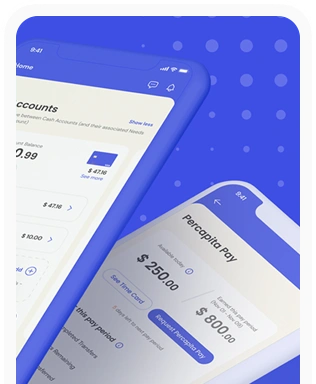
We designed a full-fledged application for simplifying everyday finances.
Atmen Fintech
Mobile App
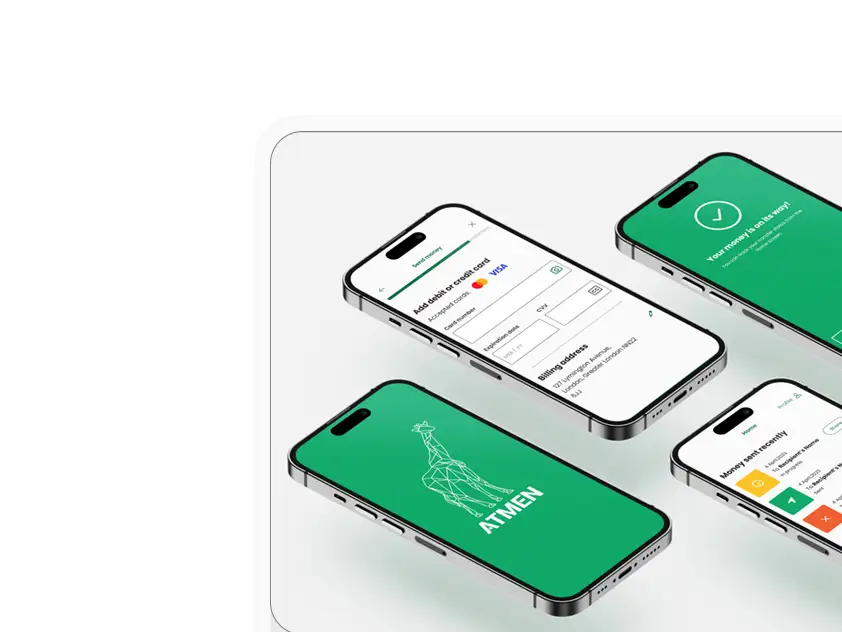
Designing a Minimum Viable Product for a Diaspora Neobank Startup
Sterling Archer
By applying the DDD framework, we created multiple digital tools for a US based Data Company.

Ergomania and NGOs in the Netherlands
UX design for Fintechs, banks and financial startups is the everyday work of Digital Product Design company, Ergomania based out of Budapest, Hungary.

K&H Bank's Corporate Netbank
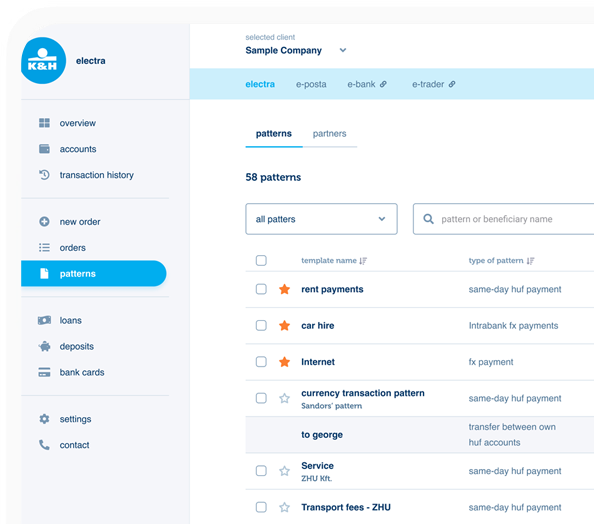
The K&H Electra Netbank App consolidates all financial needs into a single, user-friendly application. With its intuitive design, businesses can effortlessly manage their company's cash flow, transactions, and investments from one centralized hub.
TreasurUp
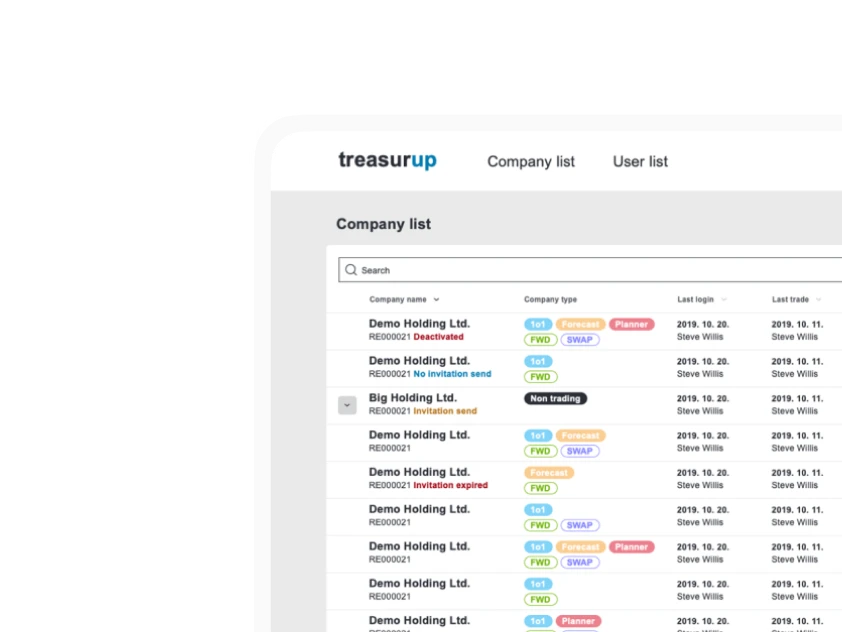
We established written and visual consistencies and guidelines for TreasurUp’s financial platform.
Simple by OTP
Simple by OTP Bank is Hungary's No.1 mobile payment app for cashless payments with 1M+ downloads, and 1 million+ transactions.

White Label Banking App
We provide full-blown next-generation mobile banking solutions for sales-oriented banks.
Want to read more
about UX, fintech and banking?
Subscribe to our biweekly newsletter and get the latest of our news and thoughts!