We don’t know what we don’t know
As the CEO of a company ‘leveraging Artificial Intelligence, Machine Learning and Deep Learning algorithms’, it seems a little counter-intuitive that Achille Yomi declares, “We don’t know what we don’t know.” It’s more usual to hear inflated claims being made for startups and their all-conquering new technologies and applications, so let’s find out more of Scenario X, Achille’s co-founded Geneva-based company.
Looking at the name itself, Achille explains that with his background as a mathematician, ‘X’ signifies the unknown, and it’s that which the company is seeking to understand in helping model Financial, Risk, Treasury, Capital and Liquidity issues. Achille says that this is far from crystal ball gazing, and gives a concrete example from American politics and finance, when Scenario X modelled an assasination attempt on the President of the USA. As we now know, an attempt did come in July 2024, when the company had already modelled the effect of this on the S&P 500, nine months in advance. “Just to make this clear,” Achille adds the caveat. “We could have been wrong, but in fact we achieved an accuracy of 99.5%.”
Evaluating stress
He describes the company goal as looking at scenarios that are unexpected, then doing the computations to assist decision-making based on the simulations that are arrived at. The more simulations that are done, the more it is possible to anticipate what may be coming down the line. Achille compares it in some ways to athletes who do training under stress conditions. You get to be resilient by pushing and testing the body. Or to put it another way, it’s relatively easy to navigate through situations when everything is ‘normal’. It’s when there is uncertainty in the system that new ways must be found to evaluate stress and change. It’s therefore arguable that we are all now living through times when an understanding of change and the consequences of change has never been more important.
Correlating the moving parts
Born in Cameroon, Achille moved to France to study, including at the prestigious EM Lyon Business School, then gaining his MBA in Shanghai. He also later studied AI at the University of California, Berkeley. His banking career took in time with BNP Paribas, and then HSBC, based in Singapore, where he was to spend three years as VP of Stress Test Analytics. Prior to this he worked for some five years with Standard Chartered Bank in Singapore, starting as Director of the Stress Test group, and rising to be Executive Director and head of Business Analytics, where he led a team of thirty. The point of stress testing is that it’s not just a nice to have, but a regulatory requirement for banks and financial institutions. Achille explains that following the 2008 global financial crisis it became clear that many financial institutions had not properly analyzed their risk exposure, and as a result stress testing became a must-have.
However the methodologies were cumbersome, with the leveraging of endless Excel spreadsheets, and hiring teams of consultants to come up with simulations which were then presented to regulators. This more often than not required mining legacy systems which, being highly silo-ed, generally meant that the risk system didn’t talk to the finance system, or capital, or liquidity, or treasury. There was therefore a clear need for an aggregated platform which holistically correlates the relationship between a dazzling number of moving parts. Which is where Scenario X enters the scene. The goal: to use AI machine learning, and the cloud, to make ever-more advanced calculations and simulations. And if AI is an exciting technology which to some already feels at the leading edge, the company adds quantum technology to the mix, bringing further precision and speed. “It's a hole-in-one platform leveraging AI and quantum in order to help financial institutions take faster and more precise decisions using our solution,” Achille neatly summarizes.
 Achille Yomi
Reaching an inflection point
OK, so Scenario X is up and running and getting traction? Achille admits that 2025 was sometimes a struggle, but also constituted an inflection point. This came especially through a successful pilot with a major Saudi financial institution, which greatly helped validation of the Scenario X concept. Now comes the time for sales, and there’s a confidence that the system has been proved, with a good pipeline to potential clients. There’s also non-dilutive funding from a Singaporean government entity, plus partnerships with the French quantum computing company Pasqal, and with Toshiba, where the engagement is to work on a quantum algorithm to be tested on Toshiba’s own quantum platform.
But the target remains banking and financial institutions, rather than predicting outcomes of extreme macro events such as an American President being attacked, right? Achille confirms that he and his co-founders have enough to do right now in applying their engine to forecasting levels of risk for asset and fund managers, wealth managers, and banks. The business model is a simple annual subscription.
Simulating the whole package
It’s possible that in time governments could be interested in harnessing the power of the Scenario X algorithm, but at present the big push is for ‘the low hanging fruit’. The company is already gaining good attention in the Middle East and North Africa, whereas the European market - because of its relative maturity - may take longer to crack. For now it’s a question of the most efficient allocation of resources for maximum effectiveness. Scenario X is not the only solution on the market, and Achille mentions Moody’s Analytics (now just known as Moody’s) as one competitor of note, however he points out his company’s holistic approach. “Essentially, we are not just looking at risk, we are not just looking at financial modeling or capital or liquidity. We are putting this together as a whole package, and simulating all this together.” He says that the other key points about Scenario X is that the company is very agile, and the technology is highly innovative, with few competitors currently using quantum. After a moment’s consideration, Achille adds, “Actually no competitors are using quantum. We are unique in Switzerland as a startup using quantum to do risk simulation.” There are already three quantum patents filed, and he describes how quantum processes are used, with a concrete example of Monte Carlo simulation.
True randomness
A Monte Carlo simulation, is ‘a powerful computational technique that uses repeated random sampling to model the probability of different outcomes in complex systems with inherent uncertainty, helping to understand risk and predict potential results. By inputting random variables and running thousands of scenarios, a Monte Carlo simulation provides a range of possible results, offering a clearer picture than single-point estimates.’
Achille expands, “Today many financial models use Monte Carlo simulation, which to operate has to generate random numbers. But the random number you're generated classically with all the computers out there today, are not purely random. This means that when you do multiple iterations of generating those numbers, you go into a sort of convergence. With quantum, the random numbers that are generated are pure random, and much more precise. So we use that concept in order to bring greater precision into a Monte Carlo simulation to do multiple matrix calculations.”
OK, so some random numbers are more random and therefore more ‘pure’ than other random numbers? Interesting!

Precision and granularity
“It's about precision,” Achille re-inforces the point. “Because one thing that people have to understand is that in finance, there are very few analytical solutions. It's all about estimation. We're looking for a local maximum, but it's always an approximation that’s being done. And when it comes to approximation, if you're able to bring greater precision, that’s a big benefit. This is what we've done with our innovation in quantum random number generation for Monte Carlo simulation.” What this means for financial institutions is more and more precise and granular detail. Achille gives as an example a mortgage customer where not only their own records will of course be assessed, but also many other factors of the market value of the property, or where LIBOR rates (for example) might be heading. The Scenario X solution can simulate the multitude of factors involved in risk management, and Achille is keen to point out that it’s definitely not a ‘crystal ball’ solution of mystical fortune telling. Instead it’s an analytic tool to anticipate the impact of markets on an institution’s exposure.
Challenging everything
While Achille Yomi is the lead founder of Scenario X, he brought three others to the project. Lionel Xavier is based in Singapore, and takes care of the Singaporean entity. CTO Cedric Kuassivi is in Geneva working on all the platform architecture and development. Ivan Exposito is the modeller who is building it and ‘pushing it all into the machine’. As an AI-based company, staffing is relatively light, with twelve people currently worldwide, growing to perhaps thirty-five by 2027. Naturally, Achille says it’s about recruiting the right talent rather than merely numbers.
A principle which has applied since the earliest days of the startup is that everyone involved can challenge everything, ‘starting from ground zero’. Achille says, “We start from the fundamental truth, and then progress to solving the problem. I may think I have an answer to everything, but if there's a question where I don't know the answer… Well, my answer will be: I don't know.”
The journey, not just the destination
This sense of humility was somewhat challenged by friends and colleagues when Achille decided to quit his rewarding corporate work with Standard Chartered in Singapore, to head back to Switzerland and life as a startup entrepreneur. However he says that 2026 is ‘the scaling year’ when his company will push forward with a commitment to deliver and execute. “That's what wakes me up every morning: I have to bring this forward. We have to succeed.” However he adds that there is never a single point in any entrepreneurial journey where ‘success’ can be judged as absolute, and that there’s no single destination as such. “Even when I’m not around anymore, the aim is that Scenario X will continue to survive past me, and be there for the next generation, and the next. That's already the vision I have and what I want to leave as a legacy.”
That’s a message that also encompasses a future for Achille’s two soccer-mad sons, who respectively support Barcelona and Real Madrid - a fiery rivalry! They do however both play for the same local junior team. So while constantly looking to the future, it seems that Achille and his colleagues are also rooted in the present, and enjoying the journey.
About the authors
Harlan Cockburn is a writer and director based in Budapest, Hungary.
Related case studies
Prefixbox
Prefixbox is a Hungarian e-commerce scaleup. We helped them design an AI agent that gives more accurate product recommendations to shoppers with generative AI.

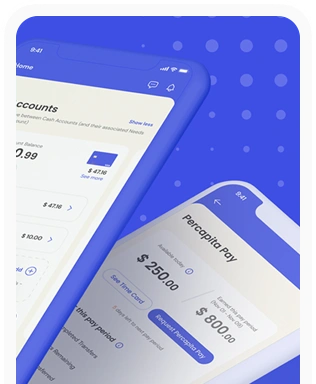
Percapita
We designed a full-fledged application for simplifying everyday finances.
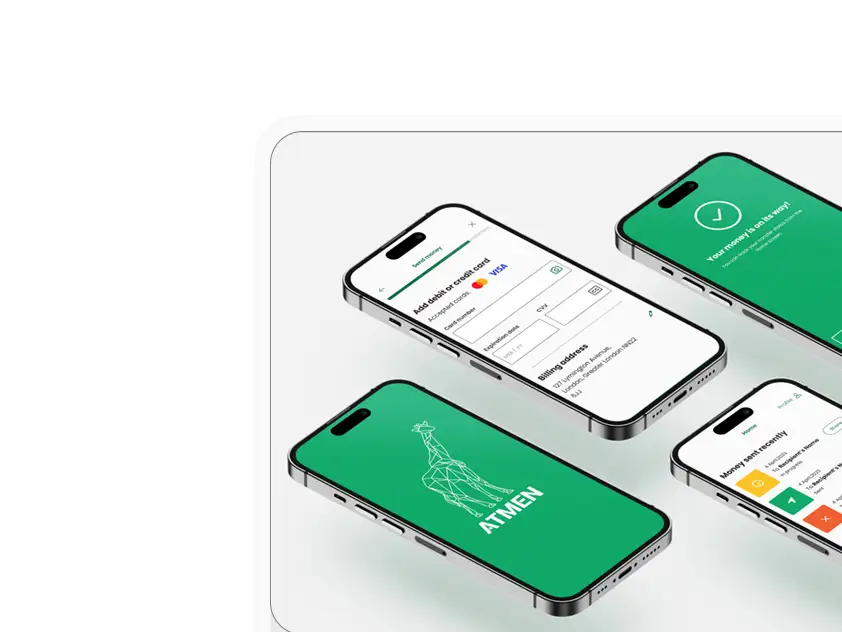
Atmen Fintech
Mobile App
Designing a Minimum Viable Product for a Diaspora Neobank Startup
Sterling Archer
By applying the DDD framework, we created multiple digital tools for a US based Data Company.

Ergomania and NGOs in the Netherlands
UX design for Fintechs, banks and financial startups is the everyday work of Digital Product Design company, Ergomania based out of Budapest, Hungary.

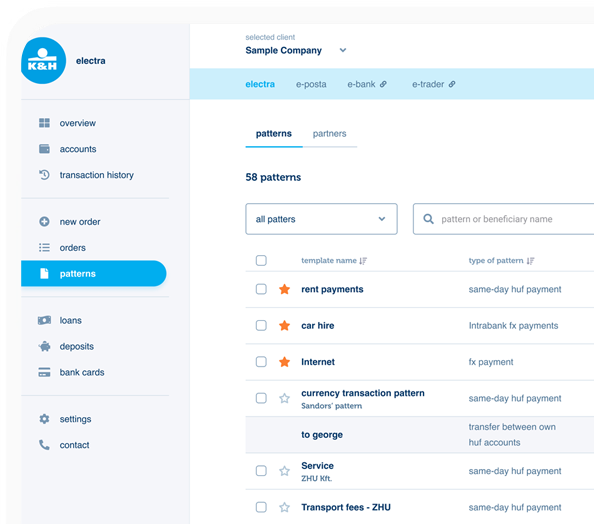
K&H Bank's Corporate Netbank
The K&H Electra Netbank App consolidates all financial needs into a single, user-friendly application. With its intuitive design, businesses can effortlessly manage their company's cash flow, transactions, and investments from one centralized hub.
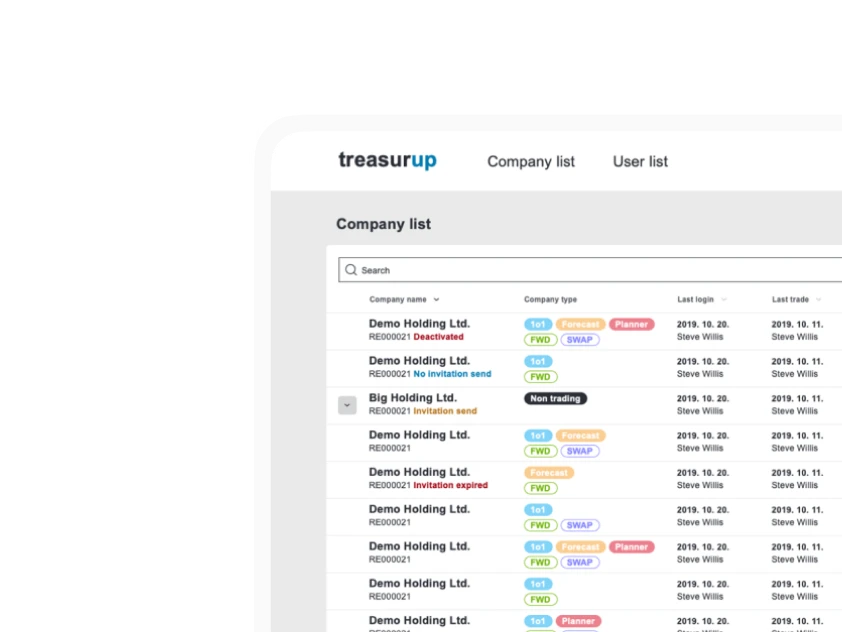
TreasurUp
We established written and visual consistencies and guidelines for TreasurUp’s financial platform.
Simple by OTP
Simple by OTP Bank is Hungary's No.1 mobile payment app for cashless payments with 1M+ downloads, and 1 million+ transactions.


White Label Banking App
We provide full-blown next-generation mobile banking solutions for sales-oriented banks.
Want to read more
about UX, fintech and banking?
Subscribe to our biweekly newsletter and get the latest of our news and thoughts!