What Does Sentient Banking Actually Look Like? Three UX Patterns That Change Everything
In the previous articles in this series, we examined the philosophical and technical foundations of Sentient Banking: why the self-service model has collapsed under cognitive overload, how intent-based interaction replaces command-and-control, and how hallucination-free AI can be connected to core banking systems. Now it’s time to make the abstract concrete. What does the customer actually see and experience? In this article, we present three distinct UX patterns that collectively define the visual and interactive grammar of Sentient Banking: the Bespoke UI, the Data Whisperer, and the Sculptor.
The gap between a well-reasoned strategy paper and a tangible UX is enormous in digital banking. Customers do not experience architectural decisions, API contracts, or intent-resolution engines – they experience the interface. They feel the friction or the absence of it. They sense whether the application understands them, or whether it is simply performing a clever imitation of understanding.
These three patterns are not independent inventions. They each address a different failure mode of the current generation of banking apps: the static dashboard that ignores context, the impenetrable data dump that fails to communicate, and the passive form that demands administrative labour from the customer. Together, they form a coherent, experiential layer for the Sentient Banking vision described by Josh Clark and others as the defining design challenge of the decade.
Pattern One: Bespoke UI – The Dashboard as a Fluid Canvas
The dominant metaphor of digital banking has been the dashboard. A fixed grid of widgets, always in the same place, always showing the same categories. The assumption underneath it is that a single, universal layout can serve a student checking their balance on a Monday morning, a traveler needing to convert currencies at an airport, and a grieving family member managing an estate equally well. This assumption is demonstrably false.
Bespoke UI abandons this premise entirely. Sometimes referred to in the literature as contextual shapeshifting, polymorphic design, or zero-UI, the pattern treats the interface as a generative canvas that autonomously assembles itself at runtime based on environmental signals, inferred intent, and life context. The core principle, drawn from Sentient Design methodology, is that the system surfaces only the most critical, actionable tools for the moment, and aggressively suppresses everything else.
The clearest real-world example is Travel Mode, pioneered by challenger banks and now spreading into legacy institutions. When Revolut detects a geographical shift – through GPS coordinates or a foreign cellular network handshake – it suppresses its standard domestic dashboard and replaces it with a hyper-localised toolkit pinned directly to the home screen: a currency converter, a global ATM map, travel insurance access, and localized payment rail integrations. Traveling through Portugal? Wero and Multibanco appear. Landing in Brazil? Pix and Boleto take their place. Qatar Islamic Bank takes a similar approach, instantly surfacing travel insurance, emergency financing options, and card magstripe activation tools the moment the system detects international usage.
But the most profound – and most sensitive – applications of Bespoke UI go beyond geography. Life events reshape financial needs far more radically than a timezone change. When a user is navigating a bereavement, a standard banking interface with its upsell banners, product promotions, and rigid menu structures becomes not merely unhelpful but actively harmful. NatWest's digital accessibility work has explicitly acknowledged this, building bereavement journeys that adapt the interface to provide document storage, account management, and pre-death planning support – while entirely suppressing all cross-sell algorithms. A user in a flagged bereavement status will never be shown a loan offer.
The Psychology of Context: Mitigating Spatial Disorientation
The psychological engine behind all of this is Hick's Law: decision time increases logarithmically with the number of choices. Traditional super-app banking violates this law structurally, forcing users to mentally filter out irrelevant options on every screen. Bespoke UI uses context as an invisible filter, doing that cognitive work on behalf of the user before they even open the app.
The central risk of this pattern is spatial disorientation. The human brain navigates interfaces using spatial memory – a mental map of where things live. When an interface continuously moves elements, hides menus, and reorganises its hierarchy, users lose that map. They cannot form the reliable task-specific retrieval structures that make habitual app use feel effortless. The result is frustration and a broken sense of agency, which in a financial context translates directly into eroded trust.
 The human brain navigates interfaces using spatial memory – a mental map of where things live
The solution is what UX researcher Gonzalo Uceda Castro has formalised as the Low Disruption Adaptation (LowDA) framework. The framework's core principle is that adaptation must happen within bounded dynamic zones, while absolute anchor points – primary navigation, account balances, core settings – remain spatially fixed across all contexts. Visual emphasis (contrast shifts, subtle elevation changes, micro-animations) guides attention toward contextually relevant features without invalidating the user's existing mental map. The philosophical goal is not maximum personalisation, but the minimum necessary change to achieve contextual relevance.
Pattern Two: The Data Whisperer – From Raw Ledger to Living Story
Banks sit on some of the richest behavioral datasets in the world. Every transaction is a data point about how a person actually lives: what they value, where they struggle, what is changing in their life. Yet traditionally, this data is returned to the customer as a raw ledger – an unsorted, chronological list of numbers that requires significant cognitive effort to interpret.
The Data Whisperer pattern represents the transition from quantitative data presentation to qualitative data storytelling. Using natural language processing and generative AI, the interface transforms transaction histories and financial metrics into human-readable, conversational narratives. This is closely tied to what UX researcher Josh Clark calls the Pinocchio Pattern – the process of turning raw data into a living, breathing reality using machine intelligence. The data stops being something the user reads, and becomes something they converse with.
The evolution of banking AI assistants illustrates this shift clearly. The first generation of chatbots operated on rigid decision trees that crumbled the moment a user phrased a question naturally. Today, systems like Bank of America's Erica go considerably further: they proactively surface insights – a subscription quietly increasing its price, a spending category trending upward, a cash flow window that suggests an ideal moment for a savings transfer – without waiting to be asked.
The vanguard of this pattern is Generative UI (GenUI): static dashboards replaced by intelligent agents that process a natural language query and instantly generate a bespoke interactive visualization in response. When a customer asks "How did my dining spend compare to groceries last quarter?", the system does not navigate them to a pre-built report page. It generates the appropriate chart, writes a contextual summary, and places both directly in the conversation. A prominent case study comes from Cieden's design for an AI-native loan experience serving over 200 million customers. As users conversed with a digital assistant called FinPilot about loan requirements, the system rendered interactive EMI calculators and financial comparison cards directly within the chat stream, bridging the gap between conversational AI and functional GUI in real time.
Cognitive Dynamics: Verification Efficiency and Epistemic UIs
The cognitive justification for this approach lies in a critical distinction between execution efficiency and verification efficiency. In traditional banking, the cognitive load is front-loaded – the user must navigate to the right tool, configure it correctly, and then interpret the output. In a GenUI system, execution is nearly instantaneous. The cognitive burden shifts to verification: Does this summary accurately reflect reality? This is a fundamentally more manageable demand, provided the interface is designed to support it.
It also exploits a deeply human cognitive strength. Narrative engages frameworks associated with language comprehension and episodic memory; an abstract financial trend explained as a story is more memorable, more comprehensible, and more actionable than the same information in a bar chart. The prominent enterprise data expert, Scott Taylor – who is, ironically, widely known in the industry by the moniker "The Data Whisperer" – articulates the foundational rule for this approach as "Truth Before Meaning". Institutions must establish a clean, mathematically sound data architecture first, and only then apply the AI-driven narrative layer that makes those numbers relatable.
 The goal is not to slow things down arbitrarily, but to ensure the user remains an active cognitive participant
The primary risk in this pattern is hallucination. Unlike a deterministic database query, a generative model can misinterpret subtle financial nuances or synthesize a plausible-sounding but inaccurate narrative. In a grocery app, a hallucination is embarrassing. In a banking context, it is potentially catastrophic for trust and potentially for compliance. The mitigation is the design of epistemic UIs – interfaces that explicitly communicate the system's confidence levels and flag ambiguity rather than papering over it. When the data is unclear, the UI surfaces that uncertainty directly, redirecting human attention to the areas that require judgment.
There is also a deeper tension: efficiency is not always the correct goal. Removing all friction from financial data consumption creates the conditions for automation bias – the tendency to accept an AI summary without critical scrutiny. In high-stakes moments, the interface must strategically introduce calibrated friction: an artificial pause before a credit check, an explicit consent flow before a significant reallocation, a multi-step confirmation for any irreversible action. The goal is not to slow things down arbitrarily, but to ensure the user remains an active cognitive participant in their own financial story, rather than a passive audience.
Pattern Three: The Sculptor – Co-Creating the Financial Future
The third pattern addresses the most consequential interactions in banking: complex, long-horizon financial planning. Historically, these interactions have been mediated by static, linear forms. The mortgage application. The pension fund setup wizard. The investment risk questionnaire. These forms treat the user as a data-entry clerk, collecting inputs for a black-box model that produces an output the user has little power to interrogate or adjust.
The Sculptor pattern inverts this entirely. Instead of a form, the user encounters a dynamic, exploratory environment where parameters are manipulated in real time – via sliders, visual nodes, or conversational feedback loops – and the projected outcomes update instantly. Each adjustment to a retirement savings rate, each shift in a risk tolerance slider, each change to a loan term generates an immediate visual response in the projected outcome model. The locus of control, as we discussed in the philosophical context of this series, is definitively returned to the human.
The historical precedent for this paradigm is the spreadsheet itself, which transformed finance by allowing anyone to change a variable and instantly observe the cascading effects across an entire model. Modern Sculptor interfaces carry this logic into a tactile, visual, AI-augmented experience. The user does not need to understand the underlying calculus of compound interest or amortization to feel, viscerally, what happens when they push a slider three years to the left. This is embodied cognition at work: the physical act of dragging a control on a touchscreen creates a pseudo-physical feedback loop that makes abstract mathematical relationships intuitively graspable.
Instructive parallels exist well outside banking. In orthodontics, the iTero Invisalign Outcome Simulator Pro has transformed patient consultations using pure Sculptor mechanics: a clinician and patient collaboratively adjust sliders for arch selection, midline alignment, and spacing, watching the realistic 3D simulation update in real time. The decision to proceed with treatment shifts from an act of faith in an expert's word to a collaborative, visually grounded conversation. In wealth management and retirement planning, the psychological dynamic is identical: an abstract 20-year projection becomes emotionally legible the moment the user can physically interact with it.
Subtractive Sculpting and the Triple-Layered Architecture
The most important cognitive mechanism underlying this pattern is Subtractive Sculpting. The human brain struggles with blank canvases. Generating a complex multi-variable financial strategy from nothing is cognitively exhausting and produces poor results. But humans are exceptional editors and critics. The optimal Sculptor UI, therefore, begins by having the AI generate a maximalist initial scenario: an idealized, fully diversified retirement portfolio, or a complete mortgage model. The user then sculpts downward, removing asset classes they are uncomfortable with, reducing risk parameters that feel too aggressive, and overriding allocations that conflict with personal values. The intelligence of the system is expressed not in replacing the human's judgment, but in doing the first draft so the human can focus on what they actually do well: applying their own preferences, constraints, and life context.
 The intelligence of the system is expressed not in replacing the human's judgment, but in doing the first draft so the human can focus on what they actually do well
The architecture that enables this is a triple-layered model. The first layer handles intent specification in broad strokes: "I want to retire at 60 with a moderate risk profile." The second layer is AI orchestration – the system autonomously generates the initial plan. The third, and non-negotiable, layer is the direct-manipulation fallback – the traditional GUI remains fully intact, allowing the user to tap, drag, and adjust individual values with granular precision. This matters because conversational intent specification is remarkably efficient for broad orchestration but deeply inefficient for precise correction. Forcing a user to type "please change the interest rate in year three to 4.5% while keeping the principal unchanged" when they could simply drag a handle on a graph is not progress – it’s regression. The mature Sentient Banking interface uses language for the macro and direct manipulation for the micro, fluidly and without friction between the two.
The primary risk specific to this pattern is model drift. In extended, iterative planning sessions, the underlying model can quietly lose track of original constraints as the number of parameter adjustments accumulates, producing outputs that are internally inconsistent or mathematically unsound. The interface must maintain a persistent visual anchor showing the active constraints and assumptions at all times – a kind of cognitive dashboard for the planning session itself – so that no adjustment inadvertently overrides a principle the user had previously established.
The Three Patterns as a System
Bespoke UI, the Data Whisperer, and the Sculptor are not three separate products. They are three registers of the same underlying philosophy: the interface should do cognitive work, not merely host it.
Bespoke UI reduces the effort of orientation. The Data Whisperer reduces the effort of comprehension. The Sculptor reduces the effort of planning. Together, they define an interface that meets the customer where they are – contextually, emotionally, and cognitively – rather than demanding the customer meet the interface on its own rigid terms.
As we noted in the opening article in this series, the competitive race in digital banking is no longer for the most feature-rich dashboard. The institutions that will define the next decade are those that master calibrated intelligence in their interfaces: knowing when to act proactively and when to wait, when to simplify and when to preserve friction, when to speak in narratives and when to hand the user a slider. The three patterns described here are the practical expression of that mastery – the places where the strategic vision of Sentient Banking becomes something a customer can actually see, feel, and trust.
In the next article in this series, we’ll examine how financial institutions can begin the transition toward these patterns in practice: which organizational and technical conditions must be in place, and which of the three patterns offers the lowest-risk entry point for banks still carrying the weight of legacy infrastructure.
About the authors
Balázs has been working in content for more than 20 years, having the role as an editor at one of the first and largest news sites, later helping to establish the content marketing business for media publishers and agencies. Today, Balázs serves as content producer at Ergomania Ltd.
Related case studies
Prefixbox
Prefixbox is a Hungarian e-commerce scaleup. We helped them design an AI agent that gives more accurate product recommendations to shoppers with generative AI.

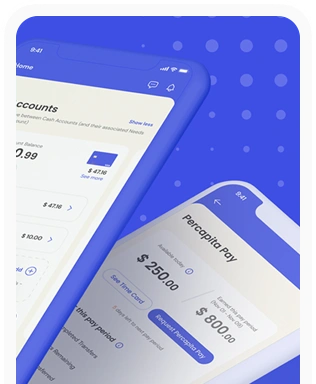
Percapita
We designed a full-fledged application for simplifying everyday finances.
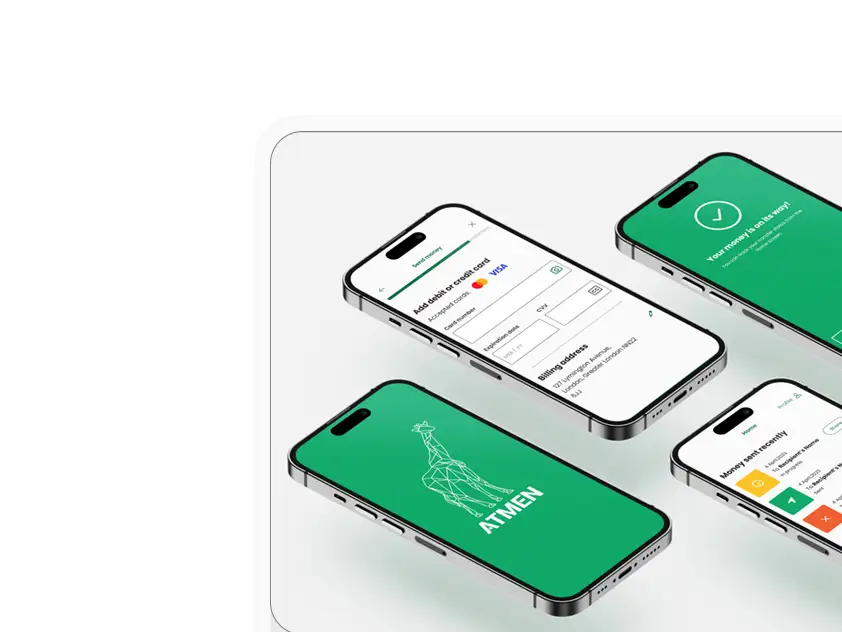
Atmen Fintech
Mobile App
Designing a Minimum Viable Product for a Diaspora Neobank Startup
Sterling Archer
By applying the DDD framework, we created multiple digital tools for a US based Data Company.

Ergomania and NGOs in the Netherlands
UX design for Fintechs, banks and financial startups is the everyday work of Digital Product Design company, Ergomania based out of Budapest, Hungary.

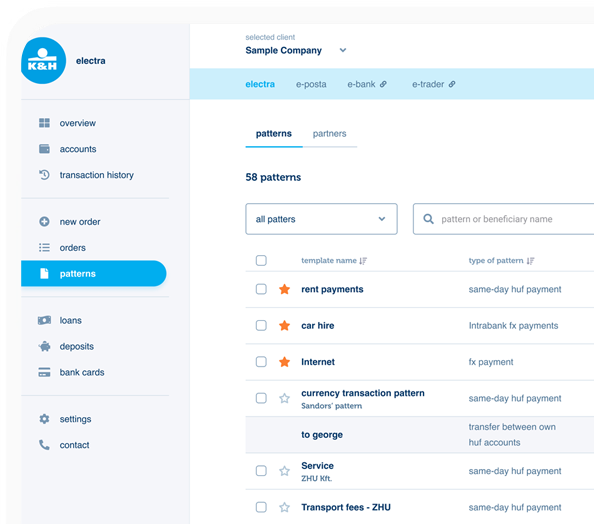
K&H Bank's Corporate Netbank
The K&H Electra Netbank App consolidates all financial needs into a single, user-friendly application. With its intuitive design, businesses can effortlessly manage their company's cash flow, transactions, and investments from one centralized hub.
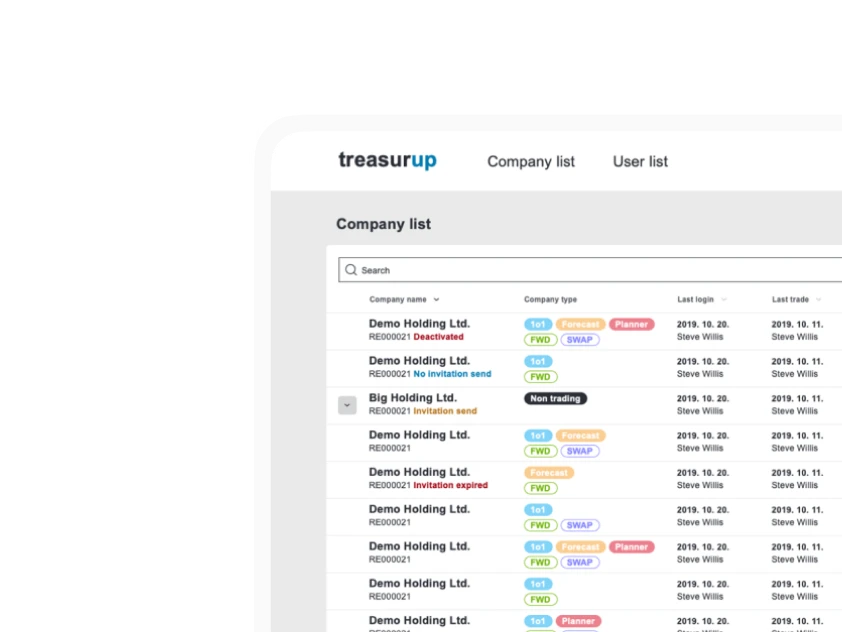
TreasurUp
We established written and visual consistencies and guidelines for TreasurUp’s financial platform.
Simple by OTP
Simple by OTP Bank is Hungary's No.1 mobile payment app for cashless payments with 1M+ downloads, and 1 million+ transactions.

White Label Banking App
We provide full-blown next-generation mobile banking solutions for sales-oriented banks.
Want to read more
about UX, fintech and banking?
Subscribe to our biweekly newsletter and get the latest of our news and thoughts!