The Paradox of Excellence: The ROI Ceiling of Banking Apps
European digital banking has reached the limits of its current technological model. Over the past decade, the financial sector has systematically migrated retail and corporate functions to mobile applications through massive capital investments. From a technological standpoint, this process has been successful: today's leading banking apps are stable, feature strict biometric security, and offer such a broad network of self-service functions that customers can initiate almost any transaction from their phones.
With this systemic development, however, the market has run into the "paradox of excellence." Major banks have essentially perfected their traditional, reactive applications, but in parallel, they have hit a clear user and business growth ceiling. Today, flawless technological operation is merely a baseline expectation. Previously, introducing a new feature guaranteed an increase in market share and a surge in daily active usage. Today, the continuous expansion of features neither yields a proportionate financial return on investment (ROI), nor meaningfully increases customer loyalty.
This exhaustion is also reflected in market valuations. Although the banking sector achieved a record global profit of $1.2 trillion in 2024, according to Banco Santander's New Strategies for New Times report, the sector's market valuation (price-to-book ratio) lagged approximately 67% behind the average of all other global industries.
Traditional, menu-driven applications that wait for user input are now actively hindering increased customer satisfaction. Being used to a frictionless experience in e-commerce or logistics, consumers today expect their bank to be more than just a passive repository for their money; they expect it to act as a proactive partner capable of anticipating and solving financial tasks.
The Global UX Ceiling and Feature Fatigue
Mobile banking applications have unequivocally become the primary channel of engagement for consumers. According to Forrester's data, 73% of online adults in Australia, 68% in the UK, and 65% in the USA expect to be able to handle all their financial tasks exclusively on their phones.
Historically, banks responded to this demand by cramming everything into their core applications. Modern apps now include everything from instant cross-border payments and algorithmic wealth management to carbon footprint trackers and embedded insurance portals. However, this compulsion to expand features has induced widespread feature fatigue among users.
 Users facing cluttered interfaces struggle significantly to make confident decisions
When a digital environment is oversaturated with various tools and menu items, users experience cognitive overload. According to Feature Integration Theory, users facing cluttered interfaces struggle significantly to make confident decisions. In banking, this translates to concrete business losses evidenced by high abandonment rates for complex product applications (such as applying for a loan or opening an investment account), and an increased reliance on expensive telephone customer service.
The Structural Limitations of Traditional Interfaces
The root of the problem lies in the fundamental architecture of modern banking applications: the Direct Manipulation Graphical User Interface (GUI). Since the proliferation of smartphones, banking has operated within a system where the user interacts with icons, hierarchical menus, and buttons to execute a command.
While this works for simple tasks, it has severe limitations when it comes to complex problem-solving. The fundamental flaw of the system is that it requires the user to know the exact administrative path needed to achieve their goal.
If a user wants to dispute a fraudulent transaction, they cannot simply state their problem. They must navigate through a rigid path determined by the bank's internal system (Main Menu > Customer Service > Claims and Disputes > Transaction History > Select Specific Transaction > Submit Form). This structure shifts the burden of process knowledge and logical work onto the non-technical user. The limitation of reactive applications is therefore not a design flaw, but a fundamental defect of the menu-driven operating principle itself.
Sentient Banking and Intent-Based Interfaces
The difference between today's banking apps and the technology of the future is described in industry terms as sentient banking. The essence of this is that, through artificial intelligence (AI) and a continuous flow of data, the banking app is no longer a passive piece of software that the user has to click through. Instead, it becomes an autonomously acting assistant that understands the given situation and performs complex financial tasks on behalf of the user.
 We simply need to describe what we want to accomplish
To move beyond the clunky, menu-driven apps of the past, the most responsive banks are shifting to intent-based interfaces. The concept is simple: instead of us having to search for the right buttons in a menu, we simply need to describe what we want to accomplish.
In an intent-based framework, the interface is not fixed. It is generated in real time based on what we want to do and what our previous transactions were. For instance, if the system detects a suspicious double charge, it doesn’t wait for us to find the customer service form; it automatically sends a notification and opens a unique, clean screen displaying only the transaction in question and a "Dispute this charge" button. Once we press it, this unique interface disappears.
The AI Autopilot and the Five Phases of Proactive Banking
All of this relies on an autonomous AI (Agentic AI) working in the background. Unlike traditional chatbots, these AI agents can plan complex workflows, communicate with other systems, and execute multi-step tasks without human intervention. Such a "financial autopilot" can, for example, automatically rebalance our investments based on market changes, or predict a cash shortage for next week so that we can avoid an overdraft.
The transition toward proactive banking is realized in five distinct phases:
- Descriptive phase (The past): The system provides digital statements and static charts of past transactions. It is purely reactive, with a high cognitive load.
- Predictive phase (The present): The system uses basic machine learning to forecast upcoming recurring bills and signal immediate overdraft risks.
- Prescriptive phase (The advice): The system provides specific, actionable advice (e.g., suggests the transfer of a specific amount to a higher-yield savings account).
- Automated phase (The execution): The system autonomously executes strict logical rules pre-set by the user (such as algorithmic monthly investments).
- Autonomous phase (The proactive level): The AI agent dynamically manages finances, negotiates interest rates, and rebalances portfolios based on market conditions, without pre-programmed rules, solely with the user's ad hoc approval.
European Case Studies: The Practice of Transition
Shrinking net interest margins and competition from fintech companies have forced the European banking sector’s elite to move beyond purely volume-driven strategies. The examples of three major European players best illustrate how this transition is happening in practice.
Spain's BBVA is executing one of the most aggressive technological transformations in the European market. Its strategic program, called "The Eight," integrates AI agents into every bank process, from risk management to software development. Its goal is to provide a highly proactive experience, which is closely tied to an expected cumulative profit of €48 billion for the 2025–2028 period and achieving an outstanding 22% RoTE (Return on Tangible Equity). The clearest example of this intent-based approach is that BBVA was the first in the world to integrate its native banking application into OpenAI's ChatGPT interface in Italy and Germany, completely bypassing traditional, menu-driven app navigation.
 BBVA’s app within ChatGPT
The Dutch ING Bank approaches the issue from an engineering and regulatory perspective. For ING, AI is not an isolated experiment. According to McKinsey's analysis, ING has built a comprehensive Generative AI framework that serves over 37 million customers across 10 global markets. In retail lending, for example, AI assesses applicants and automatically processes documents. ING's management defines autonomous systems as "digital employees" subject to the same rigorous control, compliance, and escalation protocols as the human workforce, ensuring strict risk management.
As a third example, Klarna, the European fintech giant with Swedish roots, demonstrates the most spectacular impact of Agentic AI on operational costs. In its very first month of deployment, the company's proprietary AI assistant took over two-thirds of global customer service inquiries. The system not only provides information but also autonomously manages refunds, modifies payment schedules, and resolves transaction disputes in 35 different languages. With this single step, it performs the work of roughly 700 full-time agents, drastically reducing the company's structural costs and customer wait times.
New Metrics and Infrastructural Challenges
The introduction of autonomous systems also demands a drastic change in a bank’s performance evaluation (KPI) focus. Metrics like "screen time" or "daily active users" become counterproductive: if the AI agent works in the background, the user performs fewer manual interactions. The focus shifts to metrics that reflect true value creation:
- Time saved (Friction reduction) quantitatively measures the decrease in cognitive load and manual interactions while achieving a complex financial outcome (such as loan refinancing).
- Autonomous yield optimization tracks the financial advantage automatically generated by the AI (e.g., extra yield from fixed deposits, or avoided overdraft fees).
- Intent Resolution Rate (IRR) shows the percentage of complex requests the system can resolve without directing the customer to telephone customer service.
The technological transition also holds serious regulatory and infrastructural challenges. Compliance with the European DORA (Digital Operational Resilience Act) cybersecurity guidelines is essential. Furthermore, the industry must account for AI’s physical limitations. As the ING Think economic research report highlights, running generative AI models requires massive data center capacity and exponentially increasing energy consumption. Financial institutions must ensure that technological developments do not conflict with their environmental, social, and governance (ESG) goals.
The Future: Not More Menu Items, but Invisible Finances
Digital banking has moved past the era of feature-cluttered applications built on direct manipulation. Further expansions only increase feature fatigue, while business ROI decreases. The shift observed in the market and the technological investments of leading institutions clearly prove that the industry's focus has turned toward autonomous finance and Agentic AI.
The next strategic cycle will be dominated by those institutions capable of rebuilding their internal data architecture and using technology not merely to create more menu items, but to forge intelligent financial assistants working autonomously in the background. The true competitive advantage will be determined by a bank's ability to make complex financial operations completely invisible and frictionless for the user.
About the authors
Balázs has been working in content for more than 20 years, having the role as an editor at one of the first and largest news sites, later helping to establish the content marketing business for media publishers and agencies. Today, Balázs serves as content producer at Ergomania Ltd.
Related case studies
Prefixbox
Prefixbox is a Hungarian e-commerce scaleup. We helped them design an AI agent that gives more accurate product recommendations to shoppers with generative AI.

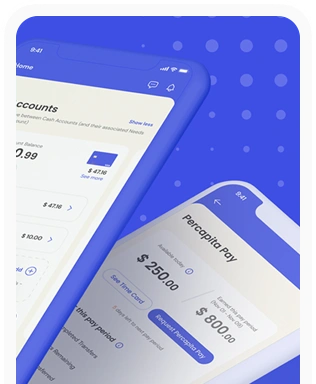
Percapita
We designed a full-fledged application for simplifying everyday finances.
Atmen Fintech
Mobile App
Designing a Minimum Viable Product for a Diaspora Neobank Startup

Sterling Archer
By applying the DDD framework, we created multiple digital tools for a US based Data Company.

Ergomania and NGOs in the Netherlands
UX design for Fintechs, banks and financial startups is the everyday work of Digital Product Design company, Ergomania based out of Budapest, Hungary.

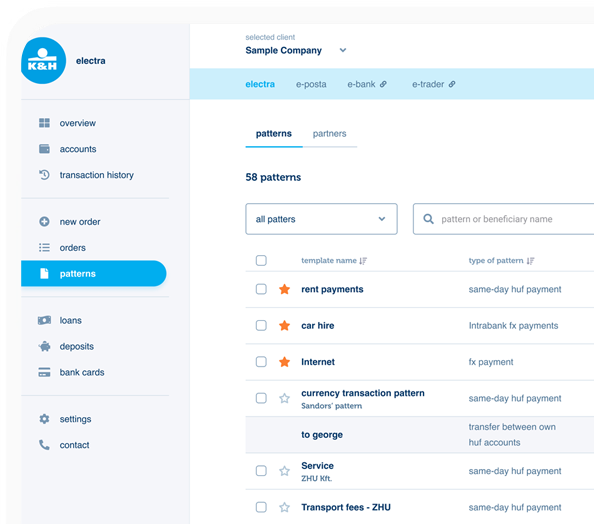
K&H Bank's Corporate Netbank
The K&H Electra Netbank App consolidates all financial needs into a single, user-friendly application. With its intuitive design, businesses can effortlessly manage their company's cash flow, transactions, and investments from one centralized hub.
TreasurUp
We established written and visual consistencies and guidelines for TreasurUp’s financial platform.

Simple by OTP
Simple by OTP Bank is Hungary's No.1 mobile payment app for cashless payments with 1M+ downloads, and 1 million+ transactions.


White Label Banking App
We provide full-blown next-generation mobile banking solutions for sales-oriented banks.

Want to read more
about UX, fintech and banking?
Subscribe to our biweekly newsletter and get the latest of our news and thoughts!