Beyond the Hype: Where Does AI Create Real Value in Banking Development?
The gap between the expectations around AI and everyday banking reality is still considerable. In some areas the technology already delivers measurable benefits, in others we’re still busy creating the preconditions. At Ergomania's Business Breakfast, Gábor Sudár, Managing Director responsible for the development and operation of digital customer solutions at MBH Bank, and Dr. András Rung, founder of Ergomania, discussed where AI creates measurable value in a bank's operations today, and where it’s still at the experimental stage.
Sudár's remit covers customer-facing solutions as well as the front-end system used by branch staff, the interactive voice response (IVR), and the call center, development and operation alike. The people working for him are developers, product owners, operations engineers, and systems experts – the roles most organizations expect AI to affect the most.
Twenty Channels, Tens of Thousands of Messages
Where does AI create real value in a bank's operations today? Sudár believes the right approach is for an organization to go through its own processes and look for places where AI can be usefully involved end to end.
He sees the biggest untapped potential in processing customer feedback. At MBH, feedback arrives through some 20 channels: official complaint-handling routes, public Facebook forums, three or four separate points related to the mobile app, and the contact center, where every conversation is transcribed. That comes to tens of thousands of written messages a month.
Because of the fragmented architecture, major faults are easy to notice – there just aren’t many of them. What gets lost is the mass of small problems, each affecting a few dozen people, but a great many of them in aggregate. AI is good at finding these patterns in unstructured text. It needs no knowledge of the internal architecture to do so. This is pattern recognition and classification. The results feed a dashboard that shows how customer satisfaction is changing in each area.
This feedback is typically not about spectacular issues, but about having to wait a long time, or a credit assessment taking longer than promised. According to Rung, when a mobile bank is being redesigned, sometimes even the first step is simply to make the interface work reliably, because 95% of complaints are about slowness. Optimizing the user journey comes after that.
MBH has other solutions that have already proven themselves: the automation of back-office tasks, and an internal assistant for colleagues who serve customers. In incident management, AI synthesizes the transcripts of the crisis work that runs on Microsoft Teams, and the chatbot built from these joins the relevant Teams channel when a new incident comes up, where it actively helps out on the basis of earlier cases.
Producing Code Is Easier Than Maintaining It
On code generation, Sudár drew attention to a basic law that is often forgotten: producing code is easy; the hard part is reviewing it and taking long-term responsibility for it. "AI generates 3,000 lines, but who is going to review them? A junior or a senior developer? Will there be a senior developer who just reads through 3,000 lines, says this will be fine, and takes responsibility for it?"
Rung added that review is not simply less work, but a different kind of work, and, in many cases, a more demanding one. The senior developer who enjoyed complex logical puzzles may not be keen to read through code eight hours a day.

From the other side, however, Sudár brought up a recent case study: the rewrite of the Bun JavaScript runtime. AI agents rewrote an entire codebase from one programming language into another in a fraction of the time. (According to the published figures, 535,000 lines of code were involved. The rewrite took 11 days with around 64 agents running in parallel at peak, at a token cost of roughly $165,000 at API list prices. According to the project lead, doing it by hand would have taken three developers a year. It’s worth adding that the code did not come out flawless, but even so the process was significantly faster.)
At MBH, this is not a theoretical question. They have systems running on 25-year-old technology where the greatest risk is how to develop them further, because they’ve not been able to retire them. "You have to try, because what is the alternative? That we call Károly back from retirement, because he still knows the system?" He wouldn’t dare, however, to hand the clean-up of the back-end systems over to AI. The retail channel interfaces are so fragmented that they have three separate internet banking entry points.
AI Has Not Read the Bank's Internal Documentation
Large language models (LLMs) know what they’ve read on the internet. This is an enormous body of knowledge, but it doesn’t include the bank’s internal architecture and their earlier documentation. This missing knowledge would therefore have to be fed into the model somehow – except that at MBH, this internal documentation is scattered. "I sometimes put it this way: we still operate three banks," he said, referring to the fact that the institution created by the merger of three banks still carries three architectures despite the integration. The documentation of each predecessor bank was produced in a different format, and in places the architecture specification is still incomplete.
From this follows what Sudár considers everyone's first task today: to produce documents that AI understands. Rung refined this: we shouldn’t send the model images and Word files, but structured formats. The toolkit for this is already available, but the processes have to be adjusted.
There are places where this has already come together. At MBH, 24 internal policies running to more than 400 pages describe the development processes, and in principle everyone who starts a new development request has to know them. They built an internal chatbot and uploaded the whole lot into it, diagrams included. "You can ask it: this is where I am now, what do I have to do?" On how much colleagues use tools like this, Sudár said: “If the solution is good, it spreads virally.”
He nevertheless sees the biggest step forward in the demand management process, starting from step zero, the formulation of the business need. The more ambitious vision, in which every IT role gets its own agent, one writing the specification, another checking it, a third producing diagrams, with the human only supervising, he considers hype for now. "Everyone is very far from that, and it is not even certain that it would be of great value."
Not Afraid for His Job, but Afraid of the Button
Rung said he sees a dual attitude elsewhere: enthusiasm and fear at the same time. A colleague is glad that AI makes their work easier, while fearing that this is exactly what makes them redundant. According to Sudár, this is not the situation at MBH. What he perceives is rather distrust about the quality of the output. For him the bigger problem is the opposite: colleagues already have a strong appetite to use these tools, but this is a bank, so there’s strict oversight and there are policies. "The basic rule is that everything is forbidden that has not been permitted."
In practice, this shows up when an AI function suddenly appears in a piece of software already in use, and colleagues don’t know whether they’re allowed to touch it. "They have not received an official letter saying, 'Hi, here is Figma AI, good luck using it,' so until then they click the button in fear. They are afraid of the button, but the demand is there."

Sudár finds the obligatory exercise of AI strategies stifling, because AI has by now become so embedded in almost every tool that writing a separate strategy for it is, in his view, pointless. The question isn’t whether to have it, but what to use it for and how. "Writing an AI strategy these days is like writing a mobile phone usage or Excel usage strategy." He considers the supervisory authority to be behind the times and too cautious, and this is not only a Hungarian phenomenon. "We really do ban things first, then we regulate, and then companies try to innovate within the regulated framework, but right now that is going very badly." He quoted the meme: “Europe's innovation is regulation.” Rung added an anecdote from a conference, where the participants of a roundtable grew gloomier and gloomier as the talk turned to China and the United States, until someone threw in that EU regulations, on the other hand, are excellent. "I’m not sure that is what we should be proudest of," he said. The same tension exists toward suppliers as well. Answering a question from the audience, Sudár revealed that MBH has a policy on suppliers' use of AI, and prohibits it, yet partners use it anyway. He doesn’t really mind, as long as the work is good.
When Source Code Travels Through American Servers
The infrastructure behind these tools is hardware-hungry, graphics cards are in constant short supply, and the large providers push the newest versions to American data centers first. As a result, it’s almost unavoidable that the traffic goes through North American servers, whether we’re talking about Figma or GitHub.
In Sudár's view, this is no longer a data protection question, since no personal data is sent out. The source code and system specifications of a Hungarian or European bank, however, are extremely sensitive commercially. "Some people already reject these tools for that reason. But why? Data can go through French and German servers, but not American ones?"
A legal expert in the audience took the thought further. The more deeply we embed the technology, the fuller the picture anyone with access can get of us; this makes us vulnerable economically and in terms of security. But if we don’t use it, we’re the ones who fall behind in the market, and there’s no real European alternative. He also recalled the case of the Swiss company Crypto AG: the embassies of many states used its encryption devices to communicate with their capitals, while the CIA stood in the background and had the decryption keys.
Sudár's answer was that this is a political question rather than a legal or technological one. The question isn’t whether we allow them, but whether we’re afraid of them. As an example, he highlighted Australia, where a standalone, "sovereign" LLM is being built in local ownership, in Australian data centers, trained on Australian data, precisely so that it offers an alternative that reflects the nation's language and values as against the overseas systems.
Agents: Employed by the Bank or by Big Tech?
On customer-facing solutions, Sudár is more reserved. MBH already has a public chatbot that can answer questions about the Workers' Loan. They’re also working on another chat solution that will let customers put questions to the mobile app, but he’s skeptical that customers are genuinely open to chat-based banking yet. In his view, people are used to buttons and processes where it’s clear what’s happening in front of them, while many are wary of free-text input, because they don’t feel certain that the system understood exactly what they meant.
Rung brought up Deutsche Telekom's app-free phone built purely on a chat interface, and K&H's similar direction. According to Sudár, even there it’s not only chat, there are buttons and numbers too. The interesting question is how the chat-oriented and the traditional UX can be combined. Nor is it a side issue what persona we give the chatbot: a robot with a robot face, the bank itself, the AI, or the user's own assistant.

Sudár doesn’t feel customer pressure toward an agentic experience yet; he expects the breakthrough to come rather from the big public assistants, from ChatGPT or Gemini opening up to integrations and moving in the direction of agents themselves. Whether the agent will sit at the bank or at a big tech company isn't settled. In financial matters, though, in his view, trust pulls toward the banking channel: a customer will share their financial situation and goals more readily with their bank than on a big tech company's chat interface.
Accessibility came up through an audience question: Can AI and accessibility be connected in development? In his answer, Sudár started from what they do and don’t entrust to AI in interface design today. On public interfaces there’s a ban in principle. They put no AI-generated content there, neither photos nor graphics. They already use it for copy, and it also serves them well for low-fidelity designs and early concepts. This is where accessibility comes in: they're examining whether AI is capable of the kind of code analysis that filters out accessibility errors and suggests fixes for them.
In the End You Need a Person Who Says, “I Take Responsibility”
On roles, Sudár sees that whoever he talks to in IT and in the business, be it a UX designer, a developer, a tester, or an operations engineer, everyone uses these tools and wants to use them as an aid, where the human directs and checks, and the AI works alongside. According to him, it’s the value of experienced professionals that has grown, not because a human is better than AI, but because a colleague with more experience can use AI more skillfully than a beginner. AI throws up 20 ideas, but someone is needed to pick the two that are good.
This immediately raises a problem, though. If juniors are not hired because experience is what gets valued, where will the seniors of the future come from? Sudár believes that what makes someone good at their profession is changing too. Previously, the good software developer was the one who coded quickly and to a high standard; today it’s increasingly the one who knows how the bank and its functions work, because they’re the one who has to instruct the agents. Rung referred to a futurist who says that IT departments will not shrink; rather, the development part will become smaller, and developers open to business and design will migrate over to the other side. Sudár agreed. UX knowledge will be needed even if the basic interface design is already generated by AI. "There will be UX and UI people in the future too, who no longer push pixels and do not edit components, but the profession will remain, it will just change."
One thing, in his view, cannot be handed over in any division of roles. "Responsibility cannot be deflected. If AI writes the code or the test case, in the end you need a person who says, ‘I take responsibility’."
The most delicate thought of the conversation belongs here as well. In most customer complaints, the bank acts in line with its policies, so it is in a legally protected position; AI can put it nicely why the decision is the right one. But when the customer is in a difficult life situation, the bank could also decide differently. If we automate everything, this human judgment is lost. To decide what we do and don’t hand over to AI is therefore primarily a management responsibility.
About the authors
Balázs has been working in content for more than 20 years, having the role as an editor at one of the first and largest news sites, later helping to establish the content marketing business for media publishers and agencies. Today, Balázs serves as content producer at Ergomania Ltd.
Related case studies
Prefixbox
Prefixbox is a Hungarian e-commerce scaleup. We helped them design an AI agent that gives more accurate product recommendations to shoppers with generative AI.

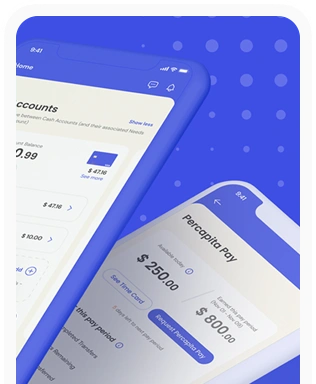
Percapita
We designed a full-fledged application for simplifying everyday finances.
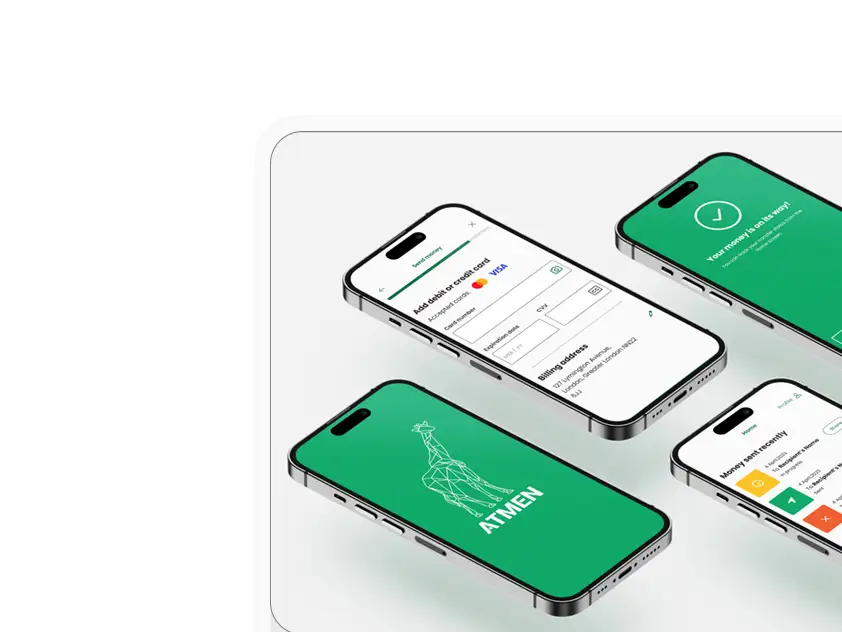
Atmen Fintech
Mobile App
Designing a Minimum Viable Product for a Diaspora Neobank Startup
Sterling Archer
By applying the DDD framework, we created multiple digital tools for a US based Data Company.

Ergomania and NGOs in the Netherlands
UX design for Fintechs, banks and financial startups is the everyday work of Digital Product Design company, Ergomania based out of Budapest, Hungary.

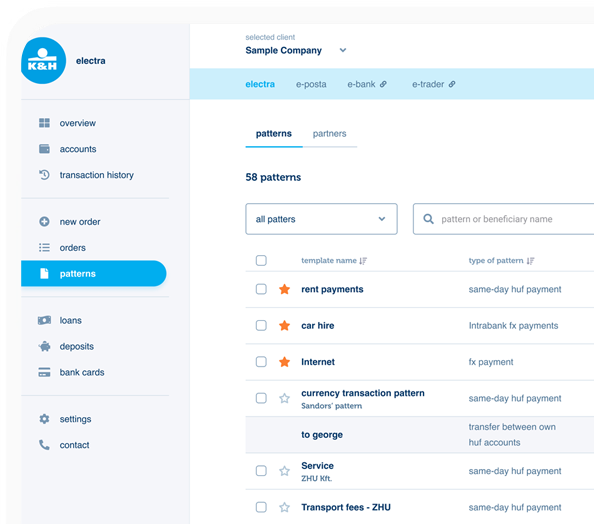
K&H Bank's Corporate Netbank
The K&H Electra Netbank App consolidates all financial needs into a single, user-friendly application. With its intuitive design, businesses can effortlessly manage their company's cash flow, transactions, and investments from one centralized hub.
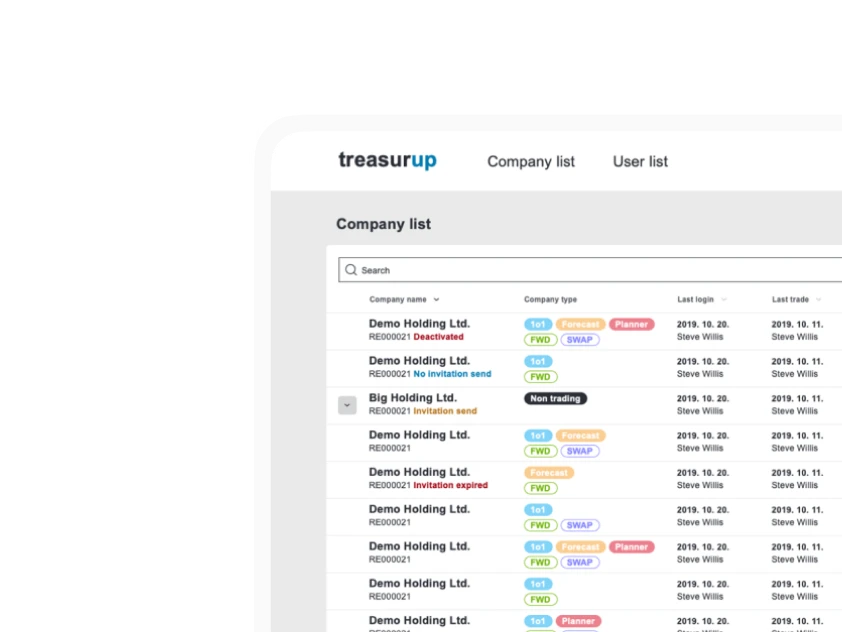
TreasurUp
We established written and visual consistencies and guidelines for TreasurUp’s financial platform.
Simple by OTP
Simple by OTP Bank is Hungary's No.1 mobile payment app for cashless payments with 1M+ downloads, and 1 million+ transactions.

White Label Banking App
We provide full-blown next-generation mobile banking solutions for sales-oriented banks.
Want to read more
about UX, fintech and banking?
Subscribe to our biweekly newsletter and get the latest of our news and thoughts!