Banking Armageddon Has Started – In Mexico
Neobanks won the app era. Revolut and Nubank are now profitable, full-stack banks with 214 million customers between them. Traditional institutions cannot match either their economics or their speed. But the ground is shifting again. The next round of competition won’t be fought on screens, but through sentient banking – a bank that senses your situation, understands your intent, and acts on your behalf. This is the round that will decide who survives.
On a Tuesday morning in January, I landed in Mexico City. The first thing I saw was Revolut. Not one poster but many. The terminal was covered in them. A British bank with no branches, advertising itself to arriving passengers in a country where four incumbents hold nearly 90% of payroll accounts. That same day, Revolut switched on full banking operations in Mexico, opening with up to 15% interest on savings deposits – a number designed not to compete with Mexican banks but to humiliate them. It was the first independent digital bank to win a Mexican banking license through direct application. It committed over $100 million for year one and projected 1.5 million customers in its first operating year.
Revolut wasn’t arriving in empty territory. Nubank had been there for years. Its Mexican arm, Nu México had exceeded 15 million customers by early 2026, reached break-even, and become the third-largest financial institution in the country. Its customer base had grown roughly seven-fold in four years, serving roughly 15% of Mexico's adult population: 78% of its customers live outside major cities; over 60% belong to low- and middle-low-income households. Nu Mexico received full banking-license approval in April 2025 and final CNBV (National Banking and Securities Commission) authorization to begin banking operations in July 2026. It became an operating bank on August 6.
Two of the most capable digital banks on Earth, both fully licensed, both flush with capital, are now fighting over a market where banking penetration hovers around 60%, credit card penetration sits near 16%, and nearly 90% of payroll accounts are locked inside just four incumbent banks. It is a market designed to be disrupted.
If you want to see the future of banking, don't look to London or Frankfurt. Look to Mexico City. What gets forged there will land in your market in 18 to 36 months – battle-tested, packaged for export, and priced to win. And traditional banks are structurally paralyzed to respond. Worse, the ground is shifting underneath the whole contest: the next era will not be fought on glass screens at all, but through AI-driven, sentient banking.
The Reality Banks Keep Avoiding
For a decade, banks blamed low interest rates for weak profits. Then rates spiked and profits surged and nothing fundamental changed. Leadership celebrated record returns while the architecture and the frontend beneath them quietly rotted. Now, as margins plateau and digital natives cross into full-stack profitability, the banking industry has entered its Darwinian phase.
The numbers are no longer debatable. Revolut closed 2025 with 68.3 million retail customers, £4.5 billion in revenue (up 46%), and £1.7 billion in pre-tax profit (up 57%) – its fifth consecutive year of profitability – and has since passed 75 million customers worldwide. Its valuation hit $115 billion – more than Deutsche Bank. In Europe, one in five working-age adults now uses the app. Nubank ended the year with 131 million customers and $2.87 billion in net income on $16.3 billion of revenue. In Q2 2026, it delivered its first billion-dollar quarter: $1.1 billion in net income on nearly $5.9 billion of gross revenue, at a record 33% return on equity (ROE), with 139 million customers worldwide. In Brazil, it’s now the largest private financial institution by customer count – three out of five Brazilians bank with it.
 If you want to see the future of banking, don't look to London or Frankfurt. Look to Mexico City.
Two companies. A combined customer base of 214 million. Roughly $4.6 billion in 2025 profit. And both compounding. That puts them in the same league as Commerzbank, Société Générale, or Barclays – institutions that took a century and a half to build what these two have assembled in a decade.
The comfortable assumption that neobanks only handle low-margin daily banking and currency exchange – while the real profit pools stay safely with incumbents – just collided with reality.
The Easy Money Is Gone
The International Monetary Fund’s (IMF) analysis of over 2,500 European banks confirms what many executives privately suspect: the 2023–2024 profit boom was almost entirely a gift from central banks, with roughly 90% of the increase in net interest margins expected to fade as rates normalize. The European Central Bank's (ECB) deposit rate sits at 2.25% today – barely half its 4.0% peak – and the Fed has been easing since late 2024. The extraordinary tailwind is gone.
This matters because the windfall created a dangerous illusion. Banks used the breathing room to run incremental optimization plays – a UX refresh here, a chatbot there – instead of confronting the structural rot underneath. Worse, when they did cut costs, they often cut in exactly the wrong places, often from the digital division, shrinking the one team that might have built the future.
The last two years weren't a renaissance. They were anesthesia.
To be fair, large, systemically important banks remain well capitalized. This isn’t a story about system collapse. It’s about a long, grinding stratification in which the slow, the small, and the structurally rigid vanish – not with a bang, but with a merger announcement. And there have been plenty of those. European banking M&A deal value quadrupled from $17.5 billion to $73.5 billion in 2025. In the USA that same year, over 150 deals were announced. The consolidation is already underway – and it carries a hidden cost. Every merger pulls executive attention, technology resources, and design capacity away from the customer for two to three years. The bank that emerges is bigger, but slower.
Meanwhile, the neobanks ship.
Neobanks Are No Longer Apps ‒ They’re Full-Stack Banks
While traditional banks were celebrating margins, neobanks stopped being pretty interfaces on top of someone else's rails and became diversified financial institutions. Revolut's 2025 results tell the story. Eleven distinct product lines each exceed £100 million in revenue. Interest income – the lifeblood of traditional banking – makes up roughly a fifth of Revolut's revenue – $1.3 billion of $6.0 billion – insulating the business from rate cycles far better than most incumbents. The lending portfolio grew 120% in a single year. The company offers mortgages in Lithuania, zero-commission exchange-traded funds (ETF) plans across the European Economic Area (EEA), branded ATMs in Spain, and mobile phone service in the UK and Poland. It’s also testing a pound-denominated stablecoin – and since July, European customers can buy into private-market funds from Apollo and Ares and Partners Group from as little as €1. Territory once reserved for private banks, sold at supermarket entry prices. Meanwhile the licenses keep coming: a fully operational UK bank after exiting mobilization this spring, and in July, the first full Australian banking license ever granted to a global fintech – Revolut Bank Australia, its first licensed bank in the Asia-Pacific region (APAC). All of it built from scratch in the smartphone era without a single legacy system to defend.
 Nubank offers credit cards, transaction accounts, savings, loans, payroll-deducted lending, insurance, and a full investment platform
And every one of these products lives inside a single, coherent experience – one sign-up, one interface, one design language. No separate app for investments. No redirect to a third-party portal for loans. No PDF to download, print, sign, and scan. The UX is not a layer on top of the product. The UX is the product.
Nubank's stack is even deeper: credit cards, transaction accounts, high-yield savings, unsecured and collateralized loans, payroll-deducted lending, insurance, and a full investment platform. Its cost to serve remains $0.80 per active customer per month – a number most traditional banks cannot match even on their best digital channels. Its ROE has held at a record 33% – and in Q2 2026 it crossed $1 billion in quarterly net income for the first time, running the entire bank at a roughly 20% efficiency ratio – about a third of a typical European incumbent's cost-to-income. And it has now received conditional OCC (Office of the Comptroller of the Currency) approval to operate as a nationally chartered bank in the United States, bringing a model with proven unit economics directly into the most competitive banking market in the world.
These aren't isolated cases. In South Korea, KakaoBank serves 25+ million customers with record profits. In Russia, T-Bank (formerly Tinkoff) runs a lifestyle-plus-finance super-app for over 40 million customers at a 30%+ ROE. In Kazakhstan, Kaspi.kz dominates the entire digital economy – payments, marketplace, and banking in one platform. Dutch-based Bunq claims 20 million users across Europe. In Germany, N26 crossed €500 million in revenue in 2025 and posted its first full year of net profitability – with Q1 2026 profit already six times the full-year figure. In the UK, Monzo and Starling are both profitable. In the USA, SoFi just delivered its first billion-dollar revenue quarter with 13.7 million members, and Chime went public at an $11.6 billion valuation.
The profitable, full-stack digital bank is not the exception anymore. It's the new baseline.
The Myth That Needs to Die
Meanwhile, McKinsey and the IMF both confirm what anyone inside a large bank already knows: most institutions have failed to fix structural cost and technology issues despite years of "digital transformation." BCG (Boston Consulting Group) estimates that genuine front-to-back digitization can cut costs by 15–25% and lift NPS (net promoter score) by 20–40 percentage points – but only a small minority of banks have executed this at scale. Singapore's DBS is the most cited example – its digital customers generate twice the income of traditional ones at a 34% cost-to-income ratio, versus 54% for the rest of the bank. Spain's BBVA is another, with 57 million mobile customers; it rolled out ChatGPT Enterprise to every single one of its 120,000 employees across 25 countries, saving employees nearly 3 hours per week on routine tasks in the pilot phase. Outside these few, the gap between rhetoric and reality remains enormous.
The deeper problem is not technology, but how banks approach the work.
In most financial institutions, UX is decorative – a visual polish applied at the end – not a strategic discipline shaping product direction from the start. Research is bolted on to validate decisions already made, rather than driving them. Product strategy is reactive: banks copy what neobanks shipped two or three years earlier, strip out the boldness to satisfy internal governance, and deliver a watered-down version 12 months late. AI initiatives are scattered across departments with no unified vision for how they transform the customer experience end to end. The result is an organization that spends millions on "innovation" but never builds anything a customer would actively choose over Revolut.
And here is the comfortable myth that needs to die: neobanks "just ship things" while banks "do proper research." The reverse is true. Revolut has a Head of UX Research leading a team that runs diary studies, ethnographic field work, usability testing, and large-scale behavioral analytics. Nubank combines qualitative research in low-income Brazilian and Mexican neighborhoods with machine learning systems that treat every customer tap and scroll as data. The methods are the same ones banks use. The difference is the operating model. Banks treat research as a quarterly milestone that produces a slide deck for a steering committee. Neobanks treat research as a continuous heartbeat that feeds product decisions every week. Same tools, a radically different rhythm.
On Nielsen Norman Group's six-stage UX maturity scale, most European and Central and Eastern Europe (CEE) banks sit at Stage 2 or 3 – design as a service function, summoned when something breaks. Revolut and Nubank operate at Stage 5 or 6, where research and design drive strategy itself. DBS, after 15 years of relentless transformation under a single visionary CEO, has reached Stage 5 – and even that is treated globally as a near-miracle. Every stage takes years to climb, and the ladder is about to get longer.
 Nielsen Norman Group's six-stage UX maturity scale
Banks cannot win by copying Revolut's interface. By the time a copy ships, Revolut has moved three product generations ahead. The only path forward is to leapfrog – to build an experience that doesn't just match neobank expectations but redefines them. It starts with real KPIs tied to task success and behavioral outcomes – not NPS reported once a quarter as a vanity metric to the board. Most banks today cannot tell you how long a real customer takes to complete a mortgage application, where they drop off, or which screen causes the most frustration. Neobanks measure all of this in real time, on every screen, for every cohort. You can’t improve what you don’t measure.
Where design, research, and AI sit in the org chart – and how much authority they carry – is the largest predictor of which banks will still matter in 2035.
The Death of Customer Loyalty in Banking
The data on loyalty is now unambiguous. In the United States, neobanks capture 40% of all new account openings – edging out large nationwide banks at 38%; 28% of US consumers now consider a neobank their primary banking relationship. In Spain, Revolut alone captured 38% of all new bank accounts opened in 2025 – three times more than the leading traditional bank. Four years earlier, it had 0.1%.
Even where traditional banks still hold primary accounts, the relationship has hollowed out. The salary lands in a legacy bank – and is immediately wired into Revolut, Nubank, or a digital wallet. Traditional banks are becoming invisible pipes. Neobanks are becoming the interface people actually touch every day.
This is fundamentally a UX problem as much as a pricing one. Yes, customers switch for better rates and lower fees – that absolutely matters. But increasingly, they also switch because one app makes them feel in control of their money while the other makes them feel trapped in a system designed for the bank's convenience. Opening an account in Revolut takes three minutes. Applying for a credit increase is one tap. Splitting a bill happens in real time. In most traditional banks, the same actions require branch visits, scanned documents, 48-hour waiting periods, and interfaces that look like they were designed by a compliance department – because they were.
This is not for lack of good incumbent products. In Czechia, Air Bank's AI assistant Aneta already handles two-thirds of client queries. In Austria, Erste Group's George app serves 11.4 million users across Central Europe, winning design awards – but even the best incumbent digital experience struggles to match the pace at which Revolut and N26 are acquiring young customers. Just one example: In Germany, Revolut added 800,000 customers in a single year to reach 3 million – and is targeting 5 million by the end of 2026.
A legitimate counterpoint: Incumbents still hold the majority of primary relationships and a massive asset base. The transition is slower and stickier than pure tech disruption. But "slower" isn’t "safe." It’s just a longer fuse.
Mexico: The Collision That Will Reshape Global Banking
Back to Mexico City, because the collision underway there deserves closer inspection. It’s not just two companies fighting for one market, but two different operating systems colliding on one battlefield. Nubank brings local credit DNA, low-limit-card strategies refined over a decade in Brazil, and deep AI-powered risk models. Revolut brings a global super-app, cross-border payments, and a centralized technology platform battle-tested across 40 markets. The collision will force both to evolve faster than either could alone – and the second-order effects will reshape banking far beyond Mexico's borders.
Watch what happens next. Nubank already operates in Colombia – where it has surpassed 5 million customers – and is expanding fast; Revolut holds banking licenses in over 30 markets. Once one side wins a meaningful share in Mexico, the other will counter-attack in adjacent geographies – Nubank pushing deeper into Argentina, Peru, and eventually southern Europe, where its Spanish-language brand has a natural runway; Revolut accelerating in Brazil and Colombia, leaning on its multi-currency super-app architecture. The "Mexican collision" is really the opening move of a multi-continent campaign. It is already unfolding. Barely a month after the Mexico launch, Revolut announced its US expansion, with its CEO calling Mexico a "blueprint" for other high-growth markets – and by May, Nubank declared Mexico at break-even, the Brazilian formula reaching its inflection point on foreign soil.
The product fight will shift quickly to credit. Nubank's real moat is underwriting for thin-file customers – the people invisible to traditional bureau scoring. Revolut, historically a payments and FX company, will be forced to build serious credit infrastructure: instant personal loans, dynamic credit limits, embedded BNPL (buy now, pay later). Expect a Mexican lending arms race that produces decisioning models a generation ahead of anything European incumbents currently run.
 Revolut cards for the Mexican launch
Behind all of it spins the data flywheel. Revolut already processes more than a billion transactions a month across its global base. Every Mexican onboarding, every loan decision, every fraud signal feeds machine learning systems that get smarter with scale. Whoever hits 20 million Mexican customers first will compound an underwriting and personalization advantage that gets redeployed into Spain, Portugal, Italy, and beyond.
Spain: Where Mexican Battle Tactics Meet European Incumbents
Spain is the bridge between emerging-market innovation pressure and European incumbent vulnerability – the first place where Latin American tactics will hit a mature European market at full force.
Revolut ended 2025 with 6.3 million Spanish customers – roughly one in seven Spanish adults – making it the country's fourth-largest bank by penetration, ahead of ING and Sabadell. Meanwhile, neobank penetration across Spain reached 27.2% in 2025 – rising to 53.2% among 18–34-year-olds. Even Santander has publicly bet its future growth on its digital-only subsidiary Openbank, tasking it with delivering a major share of the bank's customer acquisition over the next three years. The strategic message is unmistakable: Spain's largest banks no longer believe their branch networks are the engine of growth.
Meanwhile, the traditional system is simultaneously recording record profits and dismantling itself. Over 28,000 branches have shut since 2008 – more than half of what existed. Tens of thousands of banking jobs have disappeared. And the BBVA hostile bid for Sabadell collapsed in October 2025 after 18 months of political and shareholder resistance. If BBVA cannot even acquire a competitor inside its own country, plans for European banks to defend themselves through cross-border mergers are fantasy.
Spain won't just get Revolut's European product. It will get Mexican battle tactics, forged in a far harsher competitive environment.
The Third Interface: Banking Becomes Sentient
And now the ground is shifting again – this time under the whole industry. Banking has had two interfaces in living memory. The first was spatial: the branch, the counter, the human across the desk. The second was visual: the website, then the app – screens, menus, taps. The entire UX war described in this article so far was fought on the second battlefield. That war has a winner. And the winners are already moving to the next battlefield.
The third interface is conversational, contextual, and anticipatory. Call it what it is: sentient banking – a bank that senses your situation, understands your intent, and acts on your behalf. Not a chatbot bolted on to a help page but an agent woven into the fabric of the product, with memory, judgment, and permission to act.
This is no longer speculative. On April 9, 2026, Revolut launched AIR (AI by Revolut) to its 13 million UK customers – a conversational co-pilot that replaces multi-step app navigation with a single chat: spending analysis, investment tracking, subscription management, card freezing, even travel eSIMs, all through plain language. Starling had launched its own agentic assistant three weeks earlier, built on Google Gemini, with deep accessibility features for vulnerable customers. In Denmark, Lunar reports that its AI voice assistant expects to handle roughly 75% of customer calls. NatWest is upgrading Cora through a direct OpenAI partnership; Barclays has partnered with Microsoft, and HSBC with Mistral. Bank of America's Erica has processed 3.2 billion cumulative interactions, with more than 98% of users finding the information they need. Beneath the interface layer, Nubank's proprietary "nuFormer" foundation model now powers underwriting, customer service, and growth decisions across the entire company. Its AI already handles more than 60% of customer-support conversations in Brazil, while its "AI Private Banker" serves more than 15 million monthly active users. Its CEO's framing could be this article's thesis: "We are not adding AI to banking, we are rebuilding banking around AI."
Sentient Banking Is a UX Problem
Notice something about that list? The leaders of the app era are also the first movers of the sentient era. That is not a coincidence. Sentient banking is not an AI project. It’s a UX project with AI inside. Every hard problem in it is an experience problem.
Trust calibration. When should the agent act autonomously, and when must it ask for help? Revolut's answer – zero data retention with third-party AI providers, and biometric approval before any sensitive action – is not a security footnote. It is trust design, the load-bearing wall of the entire experience. Get it wrong once with a customer’s rent money and that customer never comes back.
Memory design. A sentient bank remembers that you’re saving for a house, that your income is seasonal, that you panic-sell in downturns. What it remembers, what it forgets, and what it admits to knowing – this is the new information architecture.
Proactivity boundaries. The most valuable agent surfaces the insight before you ask: the unused subscription, the idle cash, the fee you're about to trigger. The most annoying agent does exactly the same thing, one notification too often. The line between "my bank looks after me" and "my bank surveils me" is drawn by designers, not engineers.
Tone and character. When the interface is a conversation, the brand is the personality. Every hesitation, every apology, every refusal is a brand moment. This is a discipline banks have never staffed for.
The behavioral shift is already measurable: PYMNTS Intelligence research found that nearly half of heavy AI users say conversational AI has largely replaced how they previously performed financial tasks. The next generation of customers may never download a banking app at all. They will reach their bank through voice, through chat, through whatever AI layer they already live in.
 ChatGPT Finance - half of heavy AI users say conversational AI has largely replaced how they perform financial tasks
And here is the uncomfortable arithmetic for incumbents. Most European banks are still at Stage 2–3 UX maturity, still fighting – and losing – the second-interface war. The sentient era isn’t pausing for them to catch up. It’s stacking a new maturity ladder on top of the one they never climbed. When the interface disappears, everything that was hiding behind the interface – the broken processes, the 48-hour waits, the departmental seams – is exposed in a single conversation. When the interface disappears, experience is all that remains.
The Nokia Lesson Banks Refuse to Learn
Every banking executive knows the Nokia story. In 2007, Nokia held 49.4% of global smartphone market share. By 2014, it had sold its mobile division to Microsoft. Nokia didn't fail because it lacked resources, talent, or awareness. It failed because its organizational structure, decision-making culture, and internal incentive systems made it constitutionally incapable of moving at the speed the market demanded.
Banking is walking the same path. The threat isn't invisible. Every board has seen the Revolut numbers. Every strategy deck mentions "digital transformation." But the organizational immune system – governance layers, turf protection, risk aversion, waterfall planning dressed up as agile – kills the response before it can take effect.
McKinsey's data is unforgiving: Only about 30% of banks that attempt digital transformation achieve their stated objectives. Leading neobanks routinely ship in weeks; many traditional-bank release trains still operate in months. That gap is not technological, it’s organizational.
Nokia's fatal mistake wasn't ignoring smartphones – it was building them with the same organizational logic it used for feature phones. Banks are making the same error. They're building "digital" with the same governance, the same silos, the same committee-driven design process that produced the branch experience. Many also insist on doing everything in-house – pushing out external vendors and partners in the name of control – yet lack the internal design, AI, and product capabilities to deliver at neobank speed. The output looks digital. The thinking behind it is still analog. And an analogue organization cannot build a sentient bank.
Why Bank Digital Transformations Fail
The patterns are consistent across every major study – McKinsey, BCG, Bain, practitioner post-mortems.
Technical debt treated as furniture. Digital capabilities are layered on top of legacy cores instead of replacing them. UBS needed three and a half years to unwind what Credit Suisse had accumulated: 1.2 million clients migrated, 95 branches merged, and thousands of applications decommissioned, with the last Swiss clients only moved across in March 2026.
Design and UX treated as decoration. Most banks still separate "the business" from design and technology. Digital teams function as delivery arms, not strategy drivers.
Fragmented journey projects. Dozens of isolated digital initiatives that never cohere into a unified platform. Each product line reinvents onboarding, servicing, and communication from scratch.
Governance that punishes speed. Every decision requires four to six sign-offs. Neobanks need fewer. This is not a process problem. It’s a cultural one.
AI adopted tactically, not structurally. Banks bolt on chatbots and call them "AI strategy." Neobanks embed machine learning into credit decisioning, personalization, fraud detection, and operations from the ground up – and are now promoting it to the interface itself. McKinsey estimates AI could drive 15–20% net cost reductions for banks – but only for those who embed it structurally, not decoratively. A chatbot on top of a broken journey is lipstick; a sentient layer on top of a coherent experience is a moat.
DBS took over a decade, a CEO who reframed the bank as "a technology company with a banking licence," and AI embedded across the entire operation – generating S$750 million in tangible economic impact from AI initiatives in 2024 alone. Crucially, DBS didn't just invest in technology – it invested in design. It built one of the largest in-house UX research and design teams in Asian banking, gave designers a seat at the product strategy table, and used customer journey mapping to eliminate over 250 million hours of customer wait time.
The technology made DBS scalable. The design made it matter. DBS proves it is possible. It also proves how rare, painful, and slow it is.
Alliances Won't Save You Either
Some mid-sized banking groups – OTP Bank and Raiffeisen Bank International in Central Europe, Mitsubishi UFJ and Mizuho in Japan, and similar pairings from the Gulf to Latin America – may attempt airline-style alliances: shared platforms, federated governance, pooled technology investment. The logic is seductive but the execution rarely lives up to the slide deck. The BBVA–Sabadell saga proved that even domestic deals with clear industrial logic can fail spectacularly after 18 months of political, regulatory, and shareholder resistance. Cross-border federations will be even harder.
In Switzerland, UBS is still deep in the Credit Suisse integration – having merged branches, decommissioned applications, and rebranded products – while two local neobanks have already exited the market in 2025: Radicant was wound down after failing to reach scale and Yapeal shifted its strategic focus toward B2B2X embedded finance. Both demonstrate that even in one of the world's wealthiest banking markets, a digital bank without scale, a sharp value proposition, and rapid product velocity simply does not survive. Consolidation creates complexity, not competitiveness.
Alliances might keep institutions alive but they won’t make them competitive. The Air France–KLM model keeps airlines flying. It doesn’t make anyone excited to book a ticket.
What the Next Decade Looks Like
Europe has already lost over 2,500 credit institutions since 2007. Germany has closed 10,200 bank branches since 2000; Spain has shut 28,000. The pace will accelerate. The market is stratifying into three tiers:
Apex predators. A small number of fast, AI-native, design-led institutions will define the product and experience frontier – and increasingly, the sentient frontier. Revolut at 75 million customers and targeting 100 million by mid-2027, with a $115 billion valuation, banking licenses on four continents – Australia freshly added – and an AI co-pilot already in 13 million pockets. Nubank entering the United States as a chartered bank with 139 million existing customers and a proprietary foundation model running underwriting, service, and growth decisions company-wide. Kaspi.kz dominating Kazakhstan as a fully integrated payments–marketplace–banking super-app. T-Bank running 40+ million customers at 30%+ ROE. KakaoBank converting South Korea's messaging dominance into 25+ million banking customers. These institutions don't just have better technology. They have better organizational DNA.
 KakaoBank converts South Korea's messaging dominance into 25+ million banking customers
Regulated utilities. Larger incumbents will survive as systemically protected platforms – carrying deposits, managing credit risk – but steadily losing the daily customer relationship to whoever owns the interface, and soon, to whoever owns the conversation. JPMorgan spending $18 billion a year on technology proves that scale can buy time. But "buying time" is not the same as winning the customer. Breaking out of this tier is possible – DBS and BBVA have shown it – but only with a fundamentally different strategy: design and AI placed at the center of the organization, decision-making radically simplified, and leadership willing to spend a decade rebuilding from the inside. Banks that keep treating digital as a side project will stay in the utility tier no matter how much they spend.
The absorbed. Hundreds of smaller and mid-sized banks that couldn't transform fast enough will be merged, restructured, or quietly wound down. Not because they did nothing, but because they changed too slowly, too inconsistently, and on too many fragmented platforms. The 150+ US bank deals in 2025 are just the beginning.
The Only Question That Matters
Regulators will prevent true systemic collapse. Deposit insurance and orderly resolution frameworks will cushion the landing. There will be no Lehman moment. But there doesn't need to be. The real damage is slower and quieter: a grinding loss of relevance as customers shift their primary relationships – salary accounts, savings, investments, credit – to institutions that simply work better, and increasingly, to institutions that think alongside them. A steady migration of talent. A decade of expensive, half-finished transformation programs that produce slide decks instead of products. Once you lose the primary customer relationship, you don't get it back. You become the utility behind someone else's interface – and in the sentient era, behind someone else's agent.
Incremental change will not close this gap. Updating one technology layer here, replacing one vendor there, refreshing one app every two years – none of these will close this gap.
What closes the gap is the hard, structural work that most banks have been deferring for years. Radically redesigning customer experiences from research through delivery. Putting UX researchers in the room where product decisions are made – not after, not as validation, but as the starting point. Embedding AI not as a feature but as the operating logic of the organization. Giving design strategy and UX research the same authority as risk or compliance. Building unified platforms and a single, strong frontend architecture instead of stitching together isolated journey projects. Moving from six-month release cycles to six-day ones. Not adding another chatbot – designing the sentient layer: the agent behavior, the trust boundaries, the memory, the tone – the experience architecture of a bank that customers talk to, not tap through.
There is also a harder structural problem hiding underneath all of this – particularly for multi-country banking groups. They cannot afford to let every country build its own product, design language, and tech stack: that path leads to fragmentation, duplicated cost, and inconsistent experience. But heavy, expensive central programs – the Erste George model, where one platform is meant to serve every market – are not necessarily the answer either. Centralization tends to slow market-specific innovation, dilute local relevance, and create governance bottlenecks that neobanks happily exploit. The solution lies in between: a shared design system, a shared frontend architecture, a shared AI core, and a shared research framework – with enough local autonomy that each market can ship in weeks, not quarters. Most banks have not even started designing this operating model. The few that have are pulling ahead.
This is not transformation as most banks practice it. This is survival – survival architecture, survival frontend, survival strategy. Not another audit. Not another benchmark report. A fundamentally different way of designing, building, and delivering financial services – where the customer experience drives the strategy, not the other way around. The institutions that recognize this – and act on it now, with real partners who understand both the design and the technology – will make it to the other side.
The rest will become footnotes in someone else's acquisition announcement.
About the authors
A real veteran of UX by having 18 years of experience. Strong focus on business needs and innovation. András Rung has worked for various institutions and companies since 2002. He is the co-author of the first Hungarian usability book and author of the usability blog Ergomania.
Related case studies
Prefixbox
Prefixbox is a Hungarian e-commerce scaleup. We helped them design an AI agent that gives more accurate product recommendations to shoppers with generative AI.

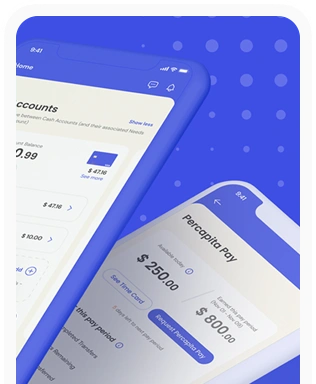
Percapita
We designed a full-fledged application for simplifying everyday finances.
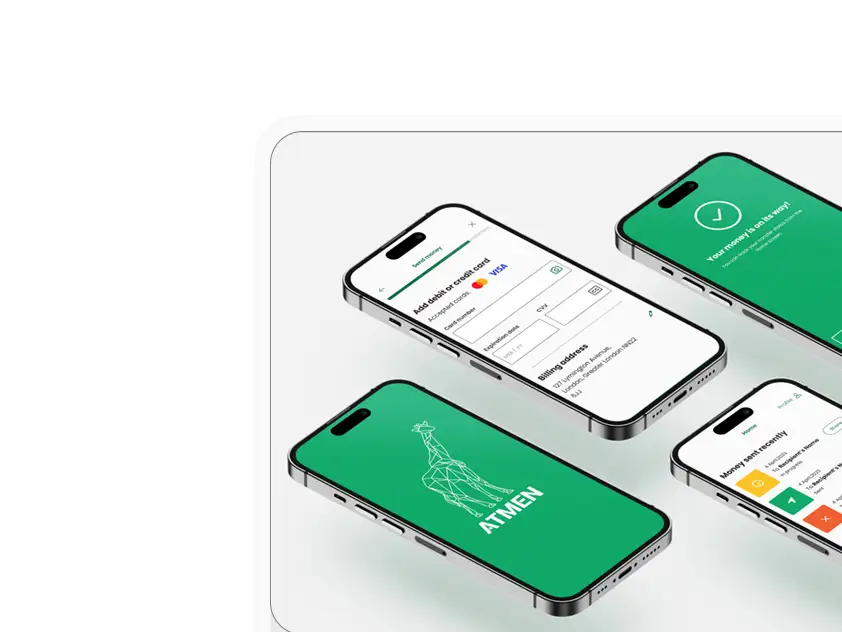
Atmen Fintech
Mobile App
Designing a Minimum Viable Product for a Diaspora Neobank Startup
Sterling Archer
By applying the DDD framework, we created multiple digital tools for a US based Data Company.

Ergomania and NGOs in the Netherlands
UX design for Fintechs, banks and financial startups is the everyday work of Digital Product Design company, Ergomania based out of Budapest, Hungary.

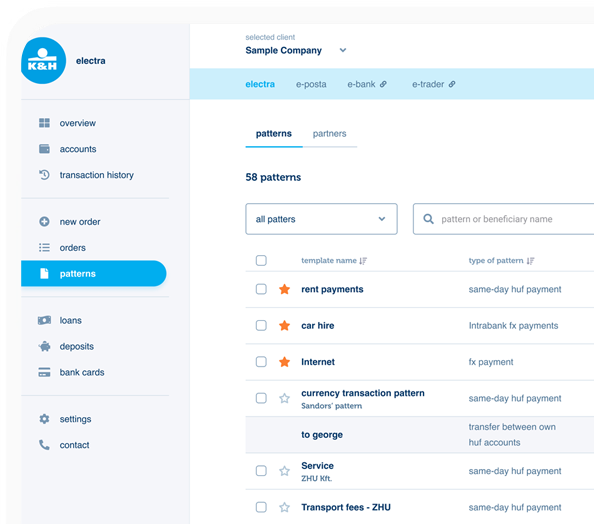
K&H Bank's Corporate Netbank
The K&H Electra Netbank App consolidates all financial needs into a single, user-friendly application. With its intuitive design, businesses can effortlessly manage their company's cash flow, transactions, and investments from one centralized hub.
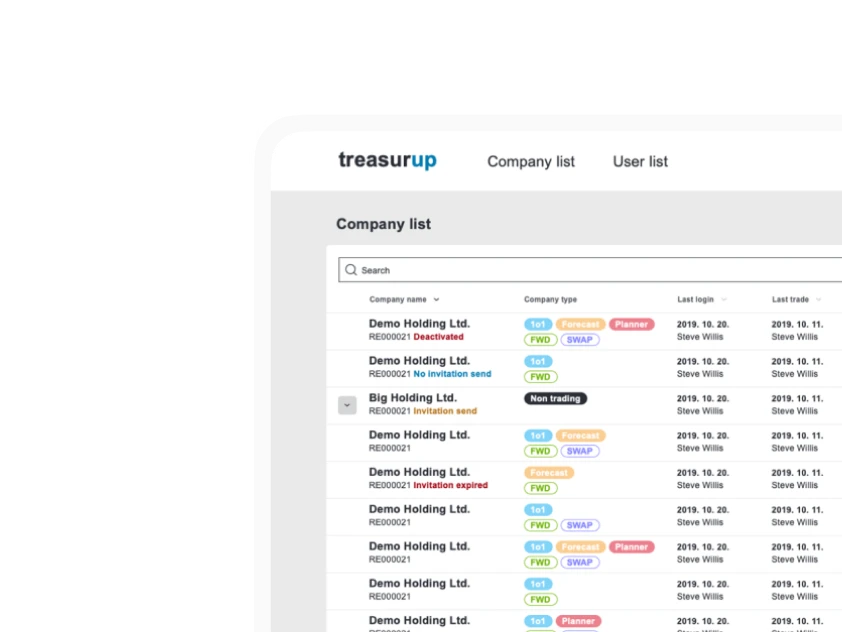
TreasurUp
We established written and visual consistencies and guidelines for TreasurUp’s financial platform.
Simple by OTP
Simple by OTP Bank is Hungary's No.1 mobile payment app for cashless payments with 1M+ downloads, and 1 million+ transactions.

White Label Banking App
We provide full-blown next-generation mobile banking solutions for sales-oriented banks.
Want to read more
about UX, fintech and banking?
Subscribe to our biweekly newsletter and get the latest of our news and thoughts!